
A lot of folks in Las Vegas think a water leak has to be a dramatic puddle spreading across the floor. The reality is, most leaks are sneaky. They start small, hiding behind walls, under your foundation, or in the ceiling, silently causing damage for weeks or even months before you notice. For Las Vegas homes, knowing how to detect water leaks early isn't just a good idea—it's essential for preventing catastrophic damage and sky-high water bills.
The good news? Your house usually gives you little hints that something’s wrong long before it becomes a disaster. You just have to know what to look—and listen—for. At MG Drain Services, we want to give you the same professional insights our experienced technicians use every day.
Your First Clues: Spotting the Early Warning Signs of a Water Leak
That nagging feeling that something is "off" with your plumbing? Trust it. Before a tiny drip turns into a flood, you’ll almost always get subtle clues. Especially here in Las Vegas, where slab foundations are the norm and every drop of water counts, catching these early signs can save you thousands. Ignoring them is a gamble you don't want to take with your property.
Pay Attention to Your Water Bill
One of the most reliable signs of a hidden leak is a sudden, unexplained jump in your water bill. If your habits haven't changed but your bill shoots up by 10%, 20%, or more, that's a huge red flag.
Don't just write it off as the Las Vegas heat. Pull out your last few bills and compare them to the same time last year. If you see a steady climb for no good reason, you've likely got a leak somewhere.
Pro Tip from the Field: We’ve seen Las Vegas homeowners' water bills literally double because of a single running toilet they didn't even notice. A small, silent toilet leak can waste over 6,000 gallons a month, which is why it's one of the first things our licensed & insured technicians check on a service call.
Look for Visual and Physical Signs
Next, it’s time to play detective. Do a slow walkthrough of your home, keeping a sharp eye out for anything that looks out of place, especially in kitchens, bathrooms, laundry rooms, and utility closets.
Here are the specific signs to look for:
- Discoloration and Stains: See any yellow or brownish stains spreading on your ceilings or walls? That’s a classic sign of a slow leak, maybe from an upstairs bathroom or a problem with the roof. When you're trying to figure out what's happening up there, these 8 Signs of Water Damage Ceiling can be a big help.
- Peeling or Bubbling Surfaces: If you notice paint or wallpaper blistering, bubbling, or peeling away from the wall—particularly near baseboards or under windows—it’s a dead giveaway that moisture is trapped behind it.
- Warped or Damaged Flooring: Got vinyl or laminate? Look for any warping, bubbling, or weirdly soft spots underfoot. If you have tile, check for loose tiles or grout that looks stained or dark. In many Las Vegas homes with concrete slabs, a mysterious warm spot on the floor is a tell-tale sign of a hot water line leaking under the foundation.
- Visible Mold or Mildew: Any sign of mold—often appearing as black or green specks—or even just a stubborn musty smell that won't go away points to a constant source of moisture. These little signs are often tied to bigger plumbing issues. You can learn more about what to look for in our guide on the signs of sewer line problems.
Listen for Unusual Sounds
Finally, trust your ears. The best time to do this is when the house is quiet, like late at night or first thing in the morning.
Turn everything off and just listen. Do you hear a faint hissing, dripping, or the sound of running water? These are sounds that shouldn’t be there. A hissing from a toilet is often a bad fill valve. A faint dripping inside a wall could be a leaky pipe fitting. Don't ignore these sounds—they're direct evidence of a hidden leak that needs to be found by local plumbing professionals.
Using Your Water Meter to Confirm a Hidden Leak
When your water bill starts creeping up for no reason, or you just get that nagging feeling something’s not right, your water meter is the ultimate truth-teller. This simple test is the single most effective way for any Las Vegas homeowner to confirm if there's a leak hiding somewhere, and it won't cost you a dime. It’s a professional-grade diagnostic you can do yourself, taking you from suspicion to certainty in just a couple of hours.
Honestly, learning how to detect water leaks with your meter is a skill every homeowner should have. The process is straightforward, but success is all in the details. It's a step people often skip, but it’s the quickest way to find out if you're throwing money and water down the drain.
Locating and Reading Your Water Meter
First things first, you've got to find your meter. In most Las Vegas neighborhoods, it’s tucked inside a concrete box near the curb, usually with a metal or composite lid. You might need a screwdriver to gently pry it open. Just be careful—spiders and other desert critters love to make a home in there!
Once the lid is off, you'll see the meter face. It looks a bit like a car's odometer, with a big sweep hand and a row of numbers. The part you really care about is the low-flow indicator. It's usually a small triangle or star-shaped dial, and it’s incredibly sensitive. It'll spin with even the smallest trickle of water.
This flowchart can help you visualize when it's time to head out to the curb and check that meter.
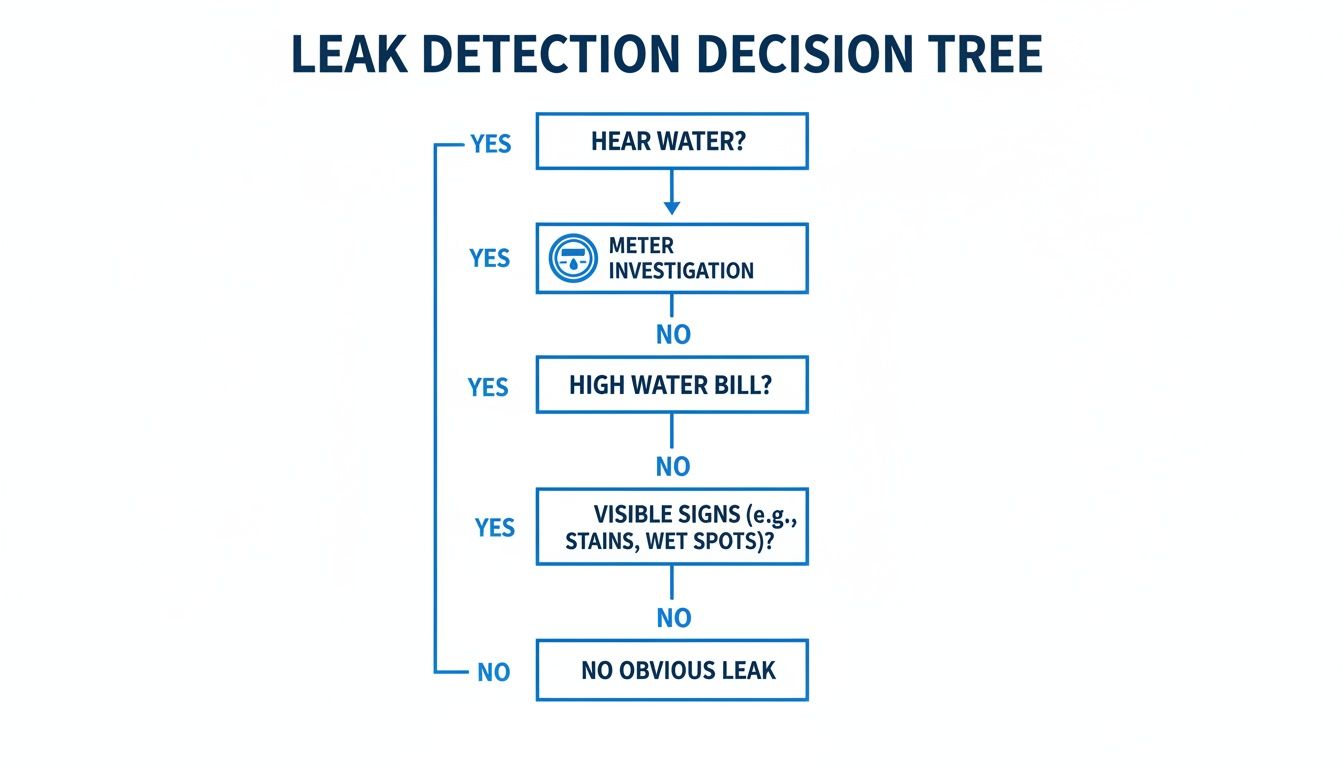
As you can see, whether you hear running water, get a surprise bill, or spot a damp patch, the meter test is your best next move.
Performing the Meter Test: A Step-by-Step Guide
Ready to play detective? For this to work, you have to follow these steps exactly.
- Turn Off Every Drop of Water. Go through your entire house and yard. That means every faucet is tightly off, the dishwasher and washing machine are finished, and your irrigation system is completely shut down. Don't forget the icemaker and any outdoor hose bibs.
- Get Your Starting Point. Head out to the meter. Snap a quick, clear photo with your phone or just jot down the numbers on the dial. Make a special note of where the sweep hand and low-flow indicator are positioned.
- Wait it Out. This is where patience pays off. You need to leave all the water off for at least one to two hours. The longer you wait, the more obvious even a pinhole leak will become. Absolutely no flushing toilets or grabbing a glass of water during this time!
- Check Your Results. Go back to the meter and compare what you see now to your initial photo or notes. If those numbers have ticked up or the sweep hand has moved at all, you've got a confirmed leak somewhere on your property.
Our Field Experience: We once helped a client in Henderson whose low-flow indicator was moving so slowly they could barely see it. It turned out to be a tiny pinhole leak in a pipe buried under their driveway, silently wasting hundreds of gallons a week. They never would have found it until the pavement started to crack if it wasn't for this meter test.
What Your Meter Is Telling You
So, you found movement. What now? The speed of the dial can give you a clue about the size of the problem you're dealing with.
A little bit of movement can still be a big deal. The table below breaks down what the meter's behavior might mean and what you should do next.
Interpreting Your Water Meter Test Results
| Meter Dial Movement | Potential Leak Size | Common Culprits in Las Vegas Homes | Recommended Next Step |
|---|---|---|---|
| Low-flow indicator is barely moving | Very Small (drips) | A worn-out toilet flapper, dripping faucet, leaky refrigerator icemaker line. | Start by checking all toilets and faucets. A simple dye test in the toilet tank can often find the problem. |
| Low-flow indicator is spinning steadily | Small to Medium | A constantly running toilet, a leaky irrigation valve, a failing water softener. | Isolate fixtures one by one. Shut off the angle stop to each toilet and appliance to see if the meter stops. |
| Main sweep hand is visibly turning | Medium to Large | A broken sprinkler pipe, a crack in an underground service line, a significant fixture leak. | Walk your property looking for wet spots. Isolate the house from the irrigation system at the main shut-off valve. |
| Main sweep hand is spinning quickly | Large (gushing) | A major pipe break, a serious slab leak under your foundation, a broken main water line. | Shut off your main water valve immediately to prevent property damage and call MG Drain Services at 702-480-8070 for an emergency response. |
As you can see, even a subtle change can point to a common, fixable issue. But you can't ignore it.
Understanding the scale of the problem is critical. The desert heat in Las Vegas can cause soil to expand by 10-15%, putting immense stress on buried pipes and leading to those dreaded slab leaks. As our local infrastructure ages, proactive detection becomes more important than ever. Worldwide, better leak detection could save an incredible 120 billion liters of water each year, and the market for these technologies is growing by nearly 7% annually in North America alone. You can discover more insights about the growing need for leak detection technology and its impact on water conservation.
A Room-by-Room Hunt to Find the Leak
Okay, so your water meter test confirmed it—you’ve got a leak somewhere. Now the real detective work begins. We need to move from knowing there’s a problem to actually finding its source. The best way I've found to do this is with a methodical, room-by-room sweep of the house. It's all about checking the usual suspects first, which often reveals a simple fix you can knock out yourself.
Let's start the hunt.
Start with Toilets: The Silent Water Wasters
Toilets are absolute masters of the silent, costly leak. A bad flapper or a faulty fill valve can waste thousands of gallons a month, and you’ll never hear a thing. The easiest way to bust this culprit is with the good old-fashioned "dye test."
It’s simple. Just put a few drops of dark food coloring into the toilet tank—not the bowl. Then, walk away for about 15-20 minutes. The key here is not to flush it. When you come back, look in the bowl. If any of that color has seeped in, you’ve found a leak from the tank, which almost always points to a worn-out flapper that needs replacing.
Expert Insight: In our experience as plumbers in Las Vegas, a running toilet is the reason for a high water bill at least 50% of the time. It’s a quiet, constant drain, which is why we always tell homeowners to check this first. It's a common issue we handle quickly and affordably.
Check Under Sinks and Behind Appliances
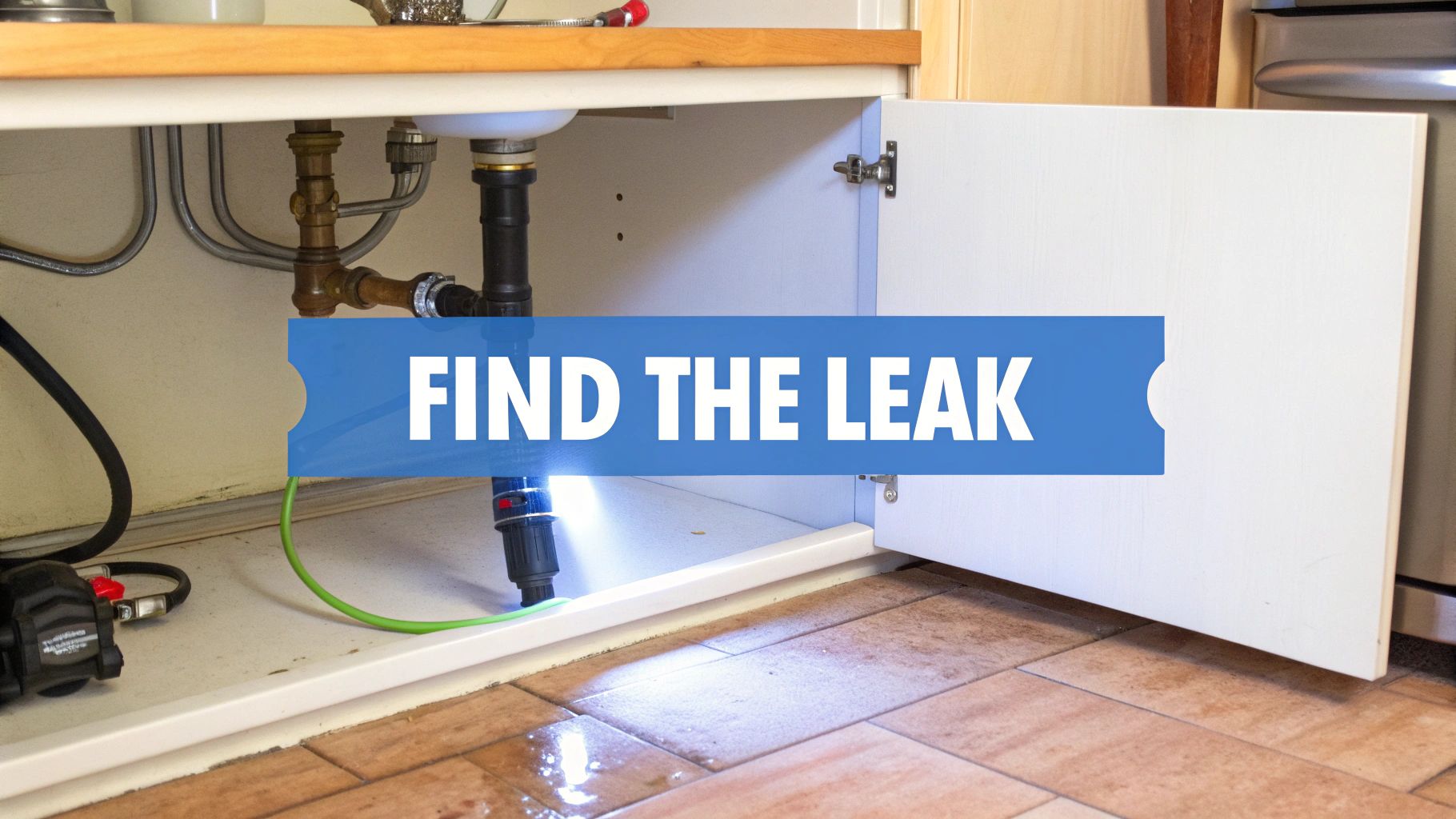
Next up, grab a flashlight and get ready to inspect all your supply lines. These are those flexible hoses connecting faucets and appliances to the shut-off valves, and they are notorious failure points as they get older.
Where to look:
- Kitchen & Bathroom Sinks: Get down and look under every single sink. You're searching for active drips, small puddles, or even the white and green crusty stuff—that’s mineral buildup from our hard Las Vegas water, a dead giveaway of a slow leak. Run your hand along the underside of the lines and valves; sometimes you can feel moisture before you see it.
- Washing Machine: You’ll need to pull the machine out from the wall a bit to inspect the hot and cold water hoses. Look for cracks, bulges, or any rust on the metal fittings. These hoses are always under pressure and really should be replaced every 3-5 years as a preventive measure.
- Refrigerator & Icemaker: That little plastic line feeding your icemaker is surprisingly delicate. Check behind the fridge for any puddles on the floor or obvious kinks in the line that could turn into a split.
Don't Forget Faucets, Showers, and Tubs
It’s easy to dismiss a tiny drip, but they add up fast. A faucet that drips just once per second wastes over 3,000 gallons a year. That’s a lot of water and money down the drain.
Go through your home and check every faucet and showerhead. Look for drips when they’re fully turned off and check for any moisture pooling around the base of the faucet. For showers, see if the head is still trickling long after you've shut it off. If your tub spout drips when the shower is running, that's usually a sign of a bad diverter valve.
Inspecting Your Outdoor Water Systems
For anyone living in Las Vegas, Henderson, or North Las Vegas, outdoor water use is a massive part of the monthly bill. A leak out there can be especially sneaky, often hidden by your normal watering schedule.
Key outdoor spots to check:
- Irrigation System: Walk the path of your entire sprinkler system. Look for soggy patches in the lawn, areas that are suspiciously green, or sprinkler heads that keep dripping long after the system has shut down. A single broken head can waste hundreds of gallons an hour.
- Hose Bibs (Spigots): Check every outdoor faucet. If it drips even when cranked off tight, the internal washer is probably shot and needs a quick replacement.
- Pool and Spa Equipment: Got a pool with an auto-fill device? Those things can get stuck in the "on" position, constantly pouring water into the pool and right out the overflow drain. Take a close look at the equipment pad for any drips or puddles.
If you’ve gone through this entire checklist and your meter is still showing water usage, then your leak is likely hidden—either inside a wall or under your home's foundation. At this point, it's time to call in the professionals.
When DIY Isn't Enough: Professional Leak Detection Tools
Sometimes, you can follow every DIY step, check every fixture, and still watch that water meter spin. This is where the real challenge begins, because the most destructive leaks are often the ones you can't see. They love to hide beneath the concrete slab your Las Vegas home is built on, behind pristine drywall, or deep underground in your main service line.
At this point, guesswork isn't just ineffective—it's risky.
This is the moment when knowing how to detect water leaks shifts from a homeowner's task to a job for skilled professionals armed with some seriously advanced technology. At MG Drain Services, our licensed and insured technicians don't guess. We use specialized equipment to pinpoint leaks with surgical precision, saving your property from unnecessary and destructive digging.
Seeing Through Walls with Thermal Imaging
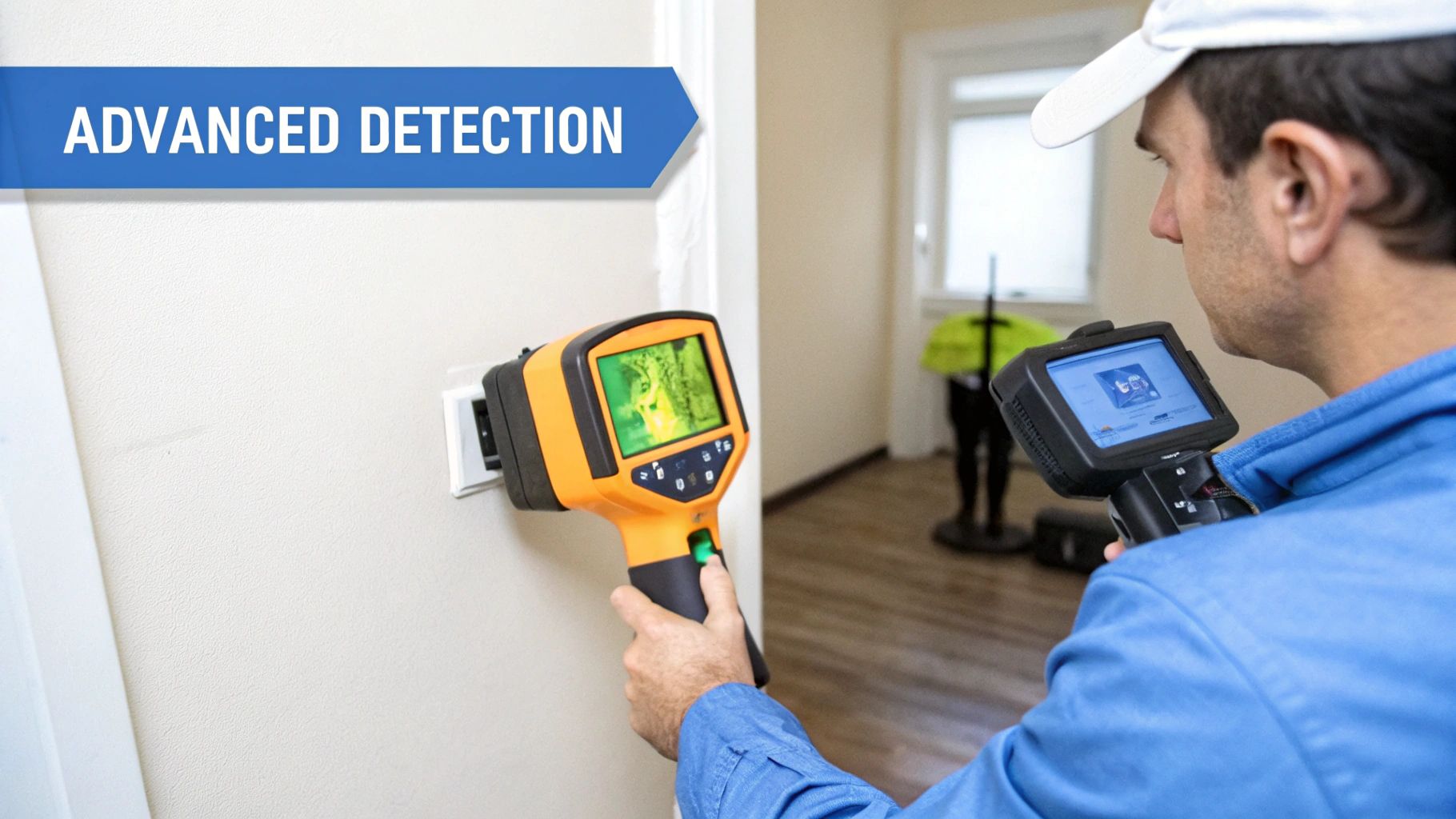
One of the most powerful tools in our arsenal is the thermal imaging camera. This device doesn’t see water itself; it sees temperature differences. When a hot water pipe is leaking under your floor or behind a wall, it creates a subtle warm signature that’s completely invisible to the naked eye.
Our technicians scan the floors and walls, and the camera displays these temperature variations as a color map. A tell-tale warm plume spreading out from a specific area allows us to trace the path of the leak without ever picking up a hammer. It's non-invasive, incredibly accurate, and often the key to finding those elusive slab leaks.
Hearing the Unhearable with Acoustic Listening Devices
For leaks in buried lines under your foundation or yard, sound is our best ally. Water escaping a pressurized pipe creates a distinct, often faint, sound. To find it, our technicians use acoustic listening devices—essentially highly sensitive electronic stethoscopes combined with ground microphones.
By listening at various points along the suspected pipe path, we can hear the hiss or rush of escaping water. The sound gets loudest directly above the break, allowing us to triangulate the exact location of the leak with remarkable accuracy. This technology turns a potentially massive excavation project into a targeted repair, saving both your landscaping and your wallet.
Professional Insight: Acoustic detection is a game-changer for underground leaks. We once located a main line break under a client's meticulously paved driveway in Henderson. Without this tool, the only option would have been to trench the entire driveway. Instead, we marked a small, precise spot for repair, saving them thousands in restoration costs.
Looking Inside Your Pipes with Video Camera Inspections
What about leaks related to your drain and sewer system? These often stem from root intrusion, cracks, or collapsed sections of pipe—problems you just can't see from the surface. For this, we rely on high-resolution sewer video cameras.
We feed a flexible fiber-optic cable into your sewer line, giving us a live video feed of the pipe's interior. This lets us see the exact cause and location of the problem, whether it's invasive roots from a mesquite tree or a cracked pipe causing wastewater to seep into the ground. It completely eliminates guesswork from drain cleaning in Las Vegas and sewer repairs.
For advanced leak detection in your home, especially when DIY methods prove insufficient, consider investing in reliable smart water leak detectors that can provide early warnings and minimize damage.
The U.S. market for water leakage detector systems was valued at $1.8 billion in 2022, a number driven by the need for technologies just like these. With undetected leaks wasting around 10,000 gallons per household annually, early professional detection isn't a luxury—it's a crucial investment.
The cost of hiring a professional is a key consideration, and you can learn more about the factors that influence the price on our detailed guide to underground water leak detection costs.
Proactive Maintenance to Prevent Future Water Leaks
Knowing how to find a water leak is a great skill, but preventing one from ever starting is the real win. It saves you a ton of stress, money, and protects your home from serious damage. Here in Las Vegas, the combination of our brutal summer heat and mineral-packed hard water puts a unique kind of strain on plumbing systems. The single best thing you can do for your property's health is to get ahead of these problems instead of just reacting to them.
Taking a few simple, preventative steps throughout the year can be the difference between a small adjustment and a full-blown emergency. It’s all about playing offense with your home maintenance, not defense.
Your Seasonal Las Vegas Plumbing Checklist
Living in the desert means our plumbing to-do list is a bit different from other parts of the country. We’ve put together a practical checklist based on the real issues we see every single day in homes across Henderson and North Las Vegas.
Twice a Year (Think Spring and Fall):
- Inspect All Appliance Hoses: Take a minute to pull out your washing machine and get a good look at the supply hoses. Are they bulging, cracked, or brittle? Check the lines to your dishwasher and refrigerator's icemaker, too. These rubber and plastic lines are under constant pressure and are one of the most common spots for a leak to start.
- Check and Flush Your Water Heater: Our local water is notoriously hard, which means sediment builds up fast inside your water heater tank. This gunk kills efficiency, cuts the unit's lifespan short, and can even cause the tank to fail completely. Flushing it once a year clears out those deposits and keeps it running the way it should.
- Test Your Shut-Off Valves: Go to every sink and toilet and gently turn the shut-off valve (also called an angle stop). They should move without a fight and completely stop the water. If a valve is seized up or starts dripping when you turn it, get it replaced now. You don't want to find out it's broken during an actual emergency.
Taming Las Vegas Hard Water and High Pressure
Two of the biggest enemies to your plumbing in Southern Nevada are hard water and high municipal water pressure. They both work silently, wearing down your pipes and fixtures from the inside out.
That chalky white residue you see on your faucets? That's calcium and magnesium. That same stuff, called scale, is building up inside your pipes, restricting water flow and corroding the fittings. It's especially tough on appliances like water heaters and dishwashers.
Our Recommendation for Las Vegas Homes: We can't stress this enough: install a whole-house water pressure regulator. In some parts of Clark County, the city water pressure can top 80 PSI, which is way too high for home plumbing systems built to handle 50-60 PSI. A regulator acts like a shield, protecting every single pipe, valve, and appliance from destructive pressure spikes.
Insulate Pipes for a Rare Desert Freeze
It doesn't happen often, but Las Vegas does get cold enough to freeze. Any exposed pipes, especially those on outside walls or in unheated garages, are at risk of freezing and bursting. A simple foam pipe insulation sleeve from any hardware store is cheap insurance against a horrible mess. It takes less than an hour on a fall afternoon to cover those lines—a tiny task that can prevent a massive disaster.
Preventative maintenance is more than just avoiding floods; it’s about being a smart homeowner. By taking these practical steps, you’ll extend the life of your plumbing and buy yourself some valuable peace of mind.
If you need a hand with a water heater flush or want to talk about getting a pressure regulator installed, the experienced technicians at MG Drain Services are here to help. Give us a call at 702-480-8070 to schedule a plumbing check-up.
FAQs: Your Water Leak Questions Answered
Even with a good game plan, you're bound to have questions when you suspect a water leak in your Las Vegas home. Our team hears the same concerns from homeowners all the time, so we've put together some straightforward answers to the most common ones we get.
How Much Does Professional Leak Detection Cost in Las Vegas?
Honestly, it varies. If we can spot the leak right away under a sink, the cost might just be part of a standard service call. But for something tricky like a hidden slab leak, the price goes up because we need to bring in specialized gear like acoustic sensors or thermal cameras to find it without tearing up your floor.
Think of it as an investment. Spending a bit more on precise detection can literally save you thousands in water damage and unnecessary demolition. At MG Drain Services, we are a local Las Vegas company that believes in honest pricing. We always give you an upfront quote so you know exactly what to expect before any work begins.
Can a Small Drip Really Cause That Much Damage?
Yes, absolutely. This is one of the biggest misconceptions out there. That tiny, annoying drip might seem harmless, but it can easily waste thousands of gallons of water over a year.
Worse than the water bill is the physical damage. Constant moisture is a welcome mat for mold, can cause wood structures to rot from the inside out, and might even compromise your home's foundation over time. Here in Las Vegas, every drop counts, and a small leak is a real threat to your property. Catching it early is everything.
Who Is Responsible for a Leak Outside My House?
This one causes a lot of confusion. For most homes in the Las Vegas area, the property owner is responsible for the entire water line from the city's water meter all the way to the house. The city's responsibility stops right at the meter.
So, if your water meter test shows a leak but all the fixtures inside your house are off, the culprit is almost certainly that main service line buried in your yard. Our experienced technicians have the right equipment to locate and fix these underground lines, usually with very little disruption to your landscaping.
I Found a Major Leak—What Should I Do Right Now?
If you walk into a room and find pooling water or see a big, discolored sag in the ceiling, the very first thing you need to do is shut off your home's main water supply. You can usually find this valve where the water line enters your house or inside the garage.
Once the water is off, your next call should be to a professional. The quicker you act, the less damage you'll have to clean up. For homeowners looking to understand how we pinpoint these hidden problems, our guide to sewer camera inspection prices offers some great insight into the technology involved.
When you're dealing with a water leak, you need a local company you can trust to show up fast and do the job right. MG Drain Services LLC provides expert leak detection and plumbing repairs for homeowners across Las Vegas, Henderson, and North Las Vegas. Don't let a small drip turn into a disaster—call our experienced, licensed, and insured team at 702-480-8070 or book your appointment online at https://mgdrainservices.com for a quick response and honest pricing.