A slow kitchen sink always seems to show up at the worst time. In Las Vegas, it might happen while you're cleaning up after dinner, getting kids ready for school, or trying to shower before work only to find water collecting around your feet. When that clog comes back again a week later, it's usually a sign that a real drain cleaning service is needed, not another quick store-bought fix.
That matters more than many may realize. Drain problems in Las Vegas homes often build slowly, especially where hard water leaves mineral scale inside pipes and recurring stoppages hide deeper sewer issues. Across the country, this isn't a niche problem. The septic, drain, and sewer cleaning services industry in the United States reached an estimated $7.8 billion in 2024 according to IBISWorld's U.S. market size data for septic, drain, and sewer cleaning services, which tells you drain cleaning is routine property maintenance, not just an occasional emergency.
Las Vegas homeowners already know the general rule with home systems. Ignore small maintenance issues and they turn into larger, more expensive ones. The same mindset shows up in exterior care too, which is why a practical resource like this gutter care guide for Long Island homes is useful even outside Nevada. Water has to move where it's supposed to move, whether it's on the roofline or inside a drain line.
If you're in Las Vegas, Henderson, or North Las Vegas, the goal isn't just to get water moving for today. It's to solve the actual cause so you don't keep paying for the same clog.
A Clogged Drain is More Than an Inconvenience
A clogged drain changes the rhythm of the whole house. One slow lavatory sink can seem minor until the shower starts draining slowly too. A kitchen line that gurgles may still empty, but it often leaves you with odors, standing water, and the nagging feeling that a backup is coming next.
In the field, the pattern is usually the same. A homeowner tries a plunger, then a bottle of chemical cleaner, then maybe a small hand snake. Sometimes that opens a narrow channel through the blockage and gives temporary relief. It doesn't remove the full buildup on the pipe wall, and it doesn't answer the more important question, which is why the drain clogged in the first place.
Why small drain problems turn expensive
The longer debris sits in a line, the more it catches. Grease grabs food particles. Hair traps soap residue. Scale from hard water gives waste something rough to stick to. Once that cycle starts, each partial clog makes the next one easier to form.
A drain issue also isn't always limited to the fixture where you notice it. The bathroom sink may be slow because of local buildup in the trap arm. Or it may be reacting to a larger restriction farther down the branch line or in the main sewer.
Practical rule: If a drain works for a few days after a DIY attempt and then slows right back down, the blockage usually wasn't fully removed.
Why Las Vegas homes need a closer look
Southern Nevada plumbing has some local realities. Hard water leaves mineral deposits that can narrow drain interiors over time. Some properties also deal with shifting ground or line offsets that don't announce themselves until recurring backups start showing up.
That is why a proper drain call should be treated like system service, not just emergency unclogging. Homeowners in Las Vegas, Henderson, and North Las Vegas usually save money by identifying the true problem once instead of paying repeatedly for temporary relief.
What a Professional Drain Cleaning Service Actually Is
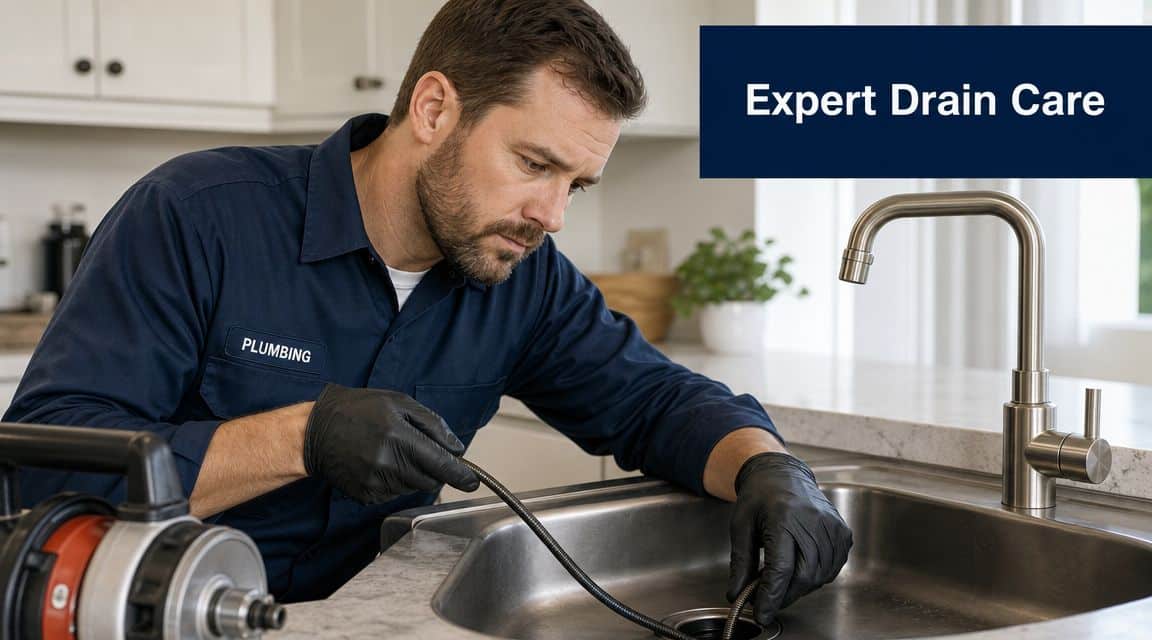
A professional drain cleaning service is not just sticking a cable into a pipe until water disappears. Its purpose is to restore flow, remove the material causing the restriction, and decide whether the line needs a deeper diagnostic step.
Think of a blocked drain like a narrowed artery. If you only poke a pinhole through the obstruction, water may move today, but the pipe still isn't carrying the way it should. Professional cleaning aims much closer to full performance. Industry specifications commonly call for sewer and drain cleaning to restore flow capacity to at least 95% of the original carrying capacity, as outlined in these sewer line cleaning specifications from BlueWorks.
What homeowners often mistake for drain cleaning
A bottle of chemical drain opener isn't professional cleaning. It's a chemical reaction inside a pipe you can't see. Sometimes it softens organic material. Sometimes it sits on top of standing water and does very little. It can also create a safety issue for the next person who opens the line.
Small handheld snakes have limits too. They're fine for a simple hair clog near the opening of a bathroom sink or tub. They don't tell you whether the line is coated with grease, narrowed by scale, or damaged farther down.
What the service should include
A proper call usually involves several parts working together:
- Assessment of the symptom so the plumber knows whether this looks like a fixture clog, branch line issue, or main sewer problem
- Selection of the right tool, such as a cable machine, jetting equipment, or a camera
- Verification after cleaning so the result isn't based on guesswork
- Advice on prevention based on what was found in the line
The goal isn't just to make the drain pass water. The goal is to leave the line in a condition where it won't trap the same debris again next week.
What works and what doesn't
What works is matching the method to the blockage. Hair, wipes, grease, scale, and root intrusion do not behave the same way. What doesn't work is assuming every slow drain needs the same treatment.
That's why experienced plumbers in Las Vegas don't treat every clog as a basic snaking job. The line condition matters just as much as the symptom.
Signs of Clogged Drains in Las Vegas Homes
In Las Vegas homes, clogged drains often begin without obvious signs. A little extra time for the sink to empty. A faint smell near the shower. A toilet that seems normal until someone runs the washing machine and then the bathroom starts making noise.
Those early signs matter because local conditions can make drain issues more stubborn. Hard water doesn't only affect supply lines and fixtures. It can also contribute to rough internal surfaces where soap residue and waste catch more easily. In some properties, ground movement or aging buried piping adds another layer to the problem.
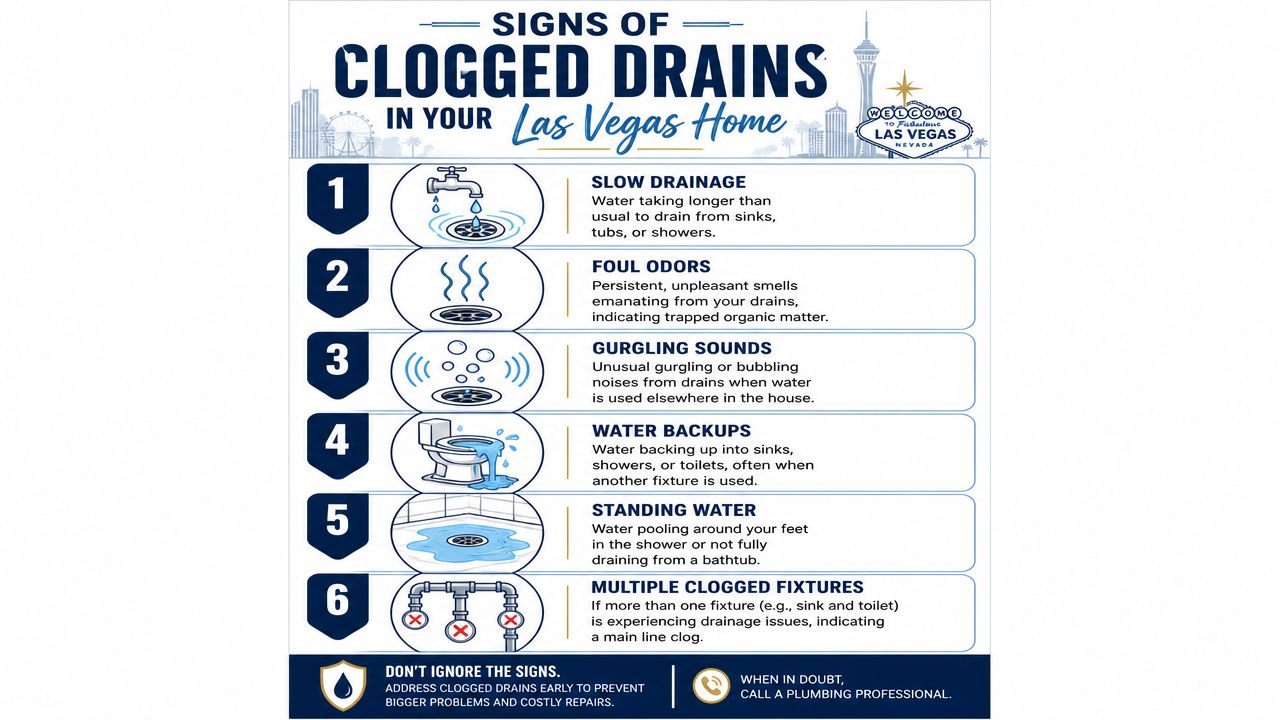
The warning signs to watch for
- Slow drainage in sinks, tubs, or showers that used to empty normally
- Gurgling sounds after flushing a toilet or running water somewhere else in the home
- Bad odors coming from a kitchen sink, shower drain, or floor drain
- Standing water in a tub or shower pan
- Recurring clogs in the same fixture after plunging or snaking
- Multiple affected fixtures at the same time, which can point to a larger line issue
When more than one fixture is acting up, the problem usually isn't just local to one drain opening. That's when a main line restriction moves higher on the list of likely causes.
Common Las Vegas clog causes
Kitchen lines usually fail from grease, food residue, and sludge buildup. Bathroom lines usually clog with hair, soap, and paper products. Floor drains and laundry lines can collect lint, sediment, and general debris.
Las Vegas adds two common complications. One is hard water scale, which gradually narrows the interior and gives debris a rough surface to cling to. The other is buried line trouble, where settling soil or pipe defects create spots that collect waste over and over.
If you're trying to stay ahead of home system problems in general, it also helps to read practical maintenance advice from local pros. MG Drain Services publishes useful guidance on its plumbers blog, where homeowners can learn what problems are worth watching before they turn urgent.
If you hear gurgling in one fixture when using another, don't treat it like a nuisance noise. That's often a drainage system warning.
Professional Drain Cleaning Techniques Explained
Not every clog needs the same tool. Consequently, many homeowners get trapped in the cycle of repeat service calls. The sink opens. A week later it slows again. Then someone runs another cable through it without checking why the blockage keeps returning.
The right question isn't "What clears drains?" It's "What clears this kind of blockage in this kind of pipe?"
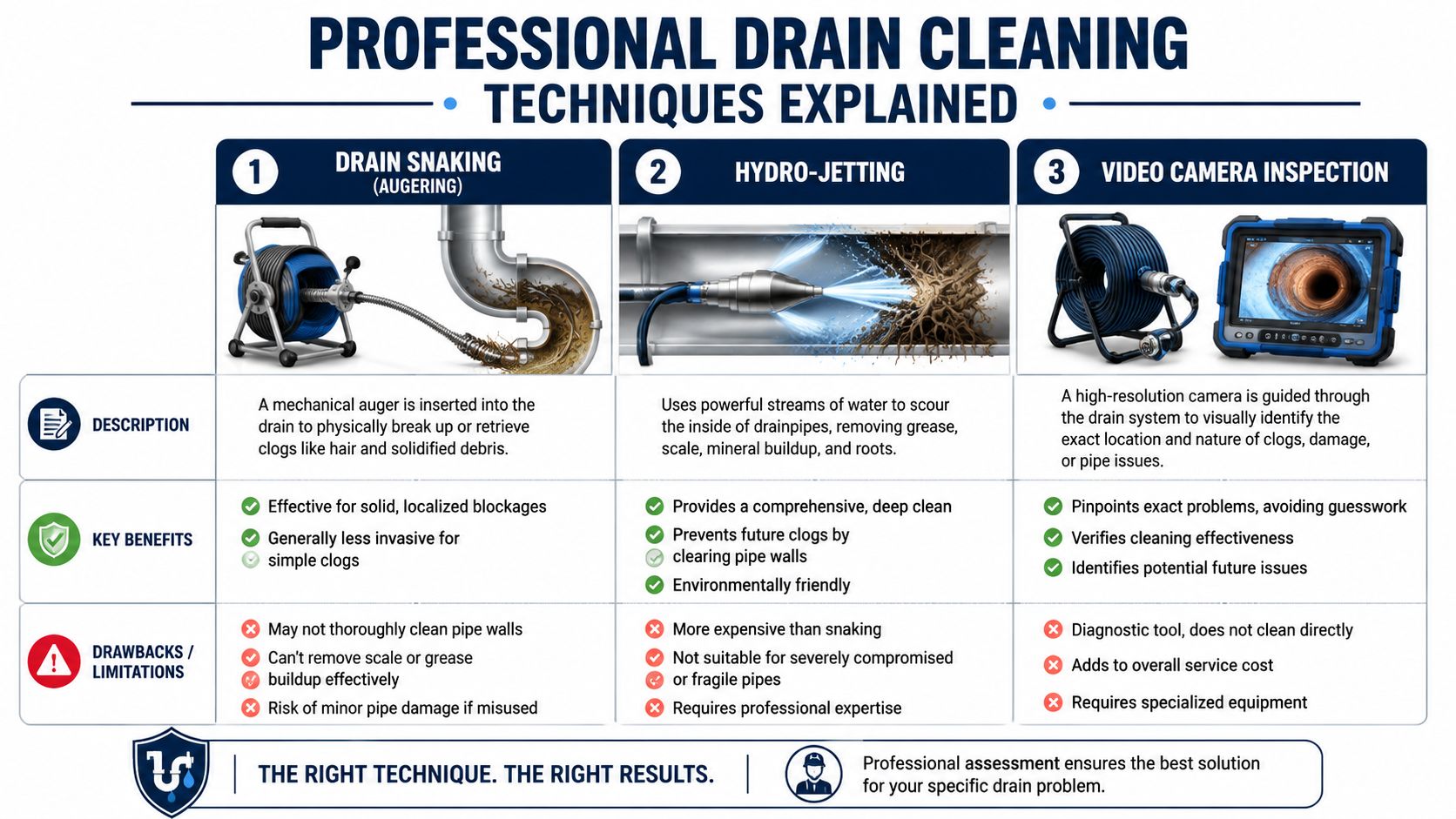
Snaking for localized stoppages
Drain snaking, also called augering, uses a cable machine to break through or retrieve a clog. This is often the right first move for a simple obstruction in a sink, tub, toilet, or branch line.
It works well when the blockage is compact and local. Hair mats, paper stoppages, and some soft debris respond well to a properly used cable. It is usually the fastest way to restore use when the issue is straightforward.
Its limitation is just as important. A snake may punch a path through grease or scale without fully cleaning the full pipe wall. In other words, it restores passage, not always full condition.
Hydro-jetting for grease and heavy buildup
Hydro-jetting uses high-pressure water to scour the inside of the pipe. This is often the better choice when a line has recurring grease, sludge, mineral accumulation, or widespread debris coating the walls.
For homeowners comparing options, the practical difference is this. Snaking often opens a line. Jetting washes it. If a kitchen line or main sewer keeps closing back up, hydro-jetting is often what breaks the cycle. MG Drain Services has a detailed local overview on how hydro-jetting works, including when it's a better fit than standard cabling.
A similar principle applies outside household drains. If you've ever dealt with residue buildup in spa plumbing, guides like this one on how to flush hot tub lines help illustrate why moving water through a system isn't the same thing as fully cleaning the inside surfaces.
Camera inspection for the root cause
A sewer camera inspection doesn't clear a line by itself. What it does is remove guesswork. The camera shows whether the clog came from grease, wipes, scale, roots, a belly in the line, a crack, or a bad connection between pipe sections.
This is the step that stops repeated "quick-fix" snaking when the underlying issue is buried deeper. In Las Vegas properties, camera work is especially useful when backups keep returning or when multiple fixtures are involved.
Here is the kind of process homeowners should expect to see demonstrated clearly:
A practical comparison
| Technique | Best for | Main strength | Main limitation |
|---|---|---|---|
| Drain snaking | Localized clogs | Fast relief for common stoppages | Doesn't always clean pipe walls |
| Hydro-jetting | Grease, scale, recurring buildup | Thorough wall-to-wall cleaning | Not right for every compromised pipe |
| Camera inspection | Recurring or unclear issues | Identifies exact cause and location | Diagnostic only, not cleaning |
Independent pricing guides make the same point in practical terms. A basic sink or toilet clog may take about 30 minutes and cost around $110 to $275, while a main-line clog can take 2 to 3 hours and cost roughly $100 to $800 depending on severity and access, according to Angi's drain cleaning pricing and service guide. The most effective money-saving move is choosing the right diagnostic step early so you don't pay repeatedly for temporary relief.
How to Choose a Trustworthy Las Vegas Plumber
A Las Vegas homeowner calls after the kitchen sink was snaked twice in six months. It drains for a few weeks, then slows down again. In my experience, that pattern usually points to a company treating the symptom instead of confirming the cause.
That is the standard to use when choosing a plumber. Hire based on method, not just speed or a low phone quote. Drain cleaning companies are easy to find, and analysts at Research and Markets coverage of the U.S. sewer and drain cleaning services market note that residential service makes up a large share of this market. More providers does not mean the work is equal.
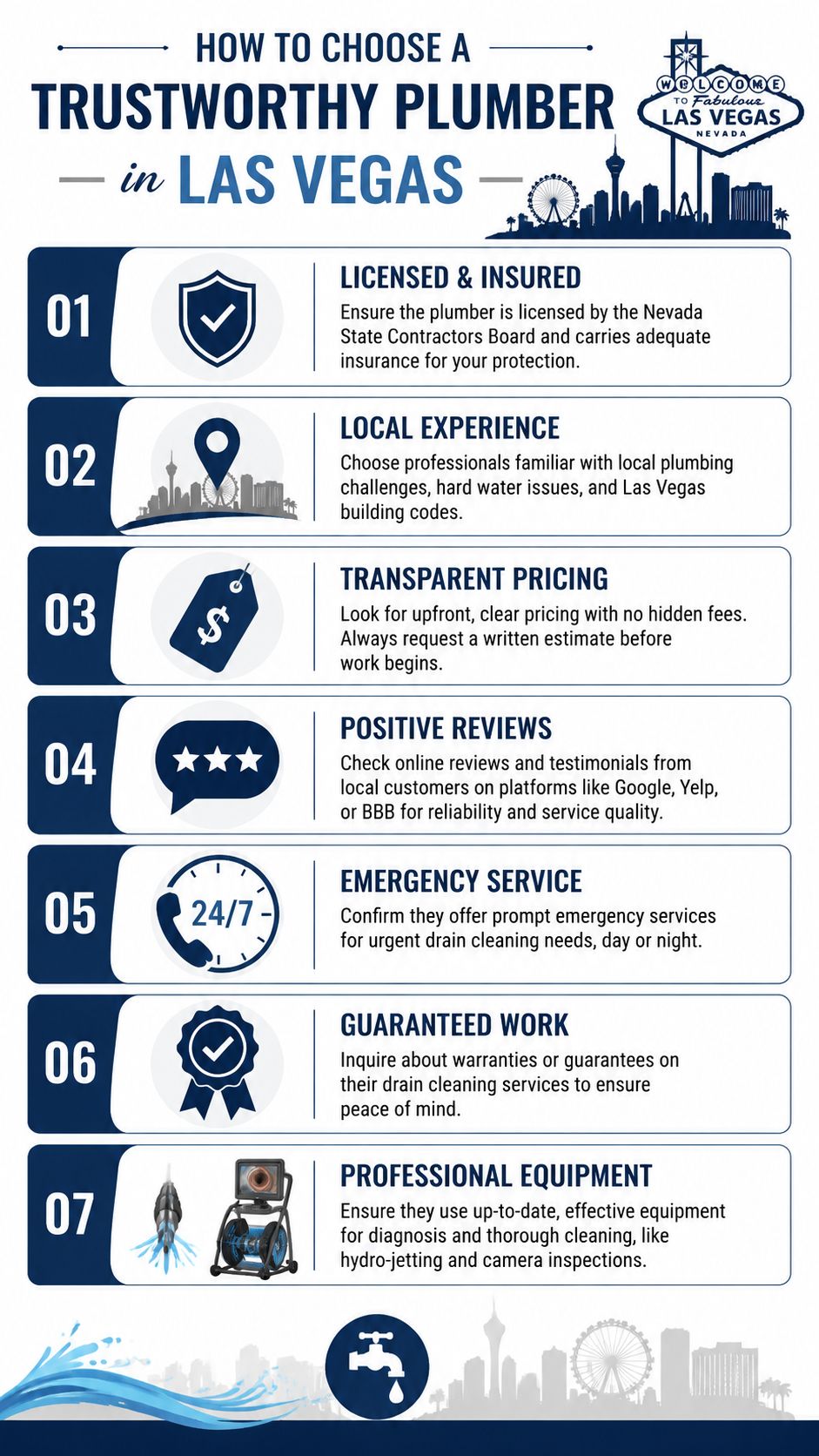
What separates a solid plumber from a guess-and-go one
- Licensed and insured. If a crew is working on a drain or sewer line, credentials and coverage should already be in place.
- Experience with Las Vegas plumbing conditions. Hard water scale is common here, and local soil movement can contribute to line shifts or recurring trouble underground.
- Clear pricing before work begins. You should know what the service call covers, what could change the price, and when approval is needed.
- Proper diagnostic tools. A plumber who can inspect the line with a camera can confirm whether the problem is grease, scale, roots, a belly, a break, or a partial collapse.
- A range of cleaning options. Some clogs respond to a cable machine. Others need a more complete cleaning method. The right company explains that trade-off instead of forcing one tool onto every job.
- Clear explanations in plain language. You should hear where the problem is, what caused it, and whether the line was fully cleaned or reopened.
- Respect for your home. Floor protection, careful setup, and cleanup still matter, even during messy drain work.
Questions worth asking before you book
Ask whether they recommend a camera inspection when backups keep returning. Ask how they handle heavy scale buildup, which is common in Las Vegas homes with hard water. Ask what they do if multiple fixtures are affected, because that often points to a branch line or main line issue rather than a single sink clog.
Also ask a simple question many homeowners skip. "How will you know the line is clean?" A trustworthy plumber should be able to answer that without dancing around it.
One more point matters. Be careful with companies that promise a flat fix before they have seen the pipe condition. Old cast iron, scaled kitchen lines, and underground piping affected by shifting soil do not all call for the same approach.
A trustworthy plumber identifies the affected line, confirms the cause, and chooses the cleaning method that fits the pipe's condition.
MG Drain Services LLC is one local provider homeowners may come across while comparing licensed drain cleaning companies, service details, and scheduling options.
What to Expect During Your Service Visit
Most homeowners feel better once they know what a real service call looks like. Good drain work shouldn't feel chaotic or mysterious.
The visit usually starts with questions that narrow the problem down. Which fixtures are affected. When did it start. Has it happened before. Did any DIY product or tool already get used. Those details help determine whether the plumber is likely dealing with a simple fixture clog or something deeper in the system.
The normal sequence on site
A professional technician will inspect the affected area, protect the workspace as needed, and test drainage behavior. If the symptoms suggest more than a basic local blockage, the next step may include a camera inspection or a recommendation for a heavier cleaning method.
Once the issue is identified, you should get a clear explanation of the problem and the available repair or cleaning options. That includes the trade-off between a basic opening and a more complete cleaning approach when appropriate.
What a finished job should include
After the cleaning, the line should be tested again. If a camera was used, many plumbers will show you what they found and what the pipe looks like after service. The work area should be cleaned up, and you should leave the appointment understanding what caused the problem and what habits or maintenance steps will help prevent it from returning.
That level of clarity matters. It turns a drain visit from "someone got it working" into "I know what happened and what to watch going forward."
Las Vegas Drain Cleaning FAQs
How often should a Las Vegas home get preventive drain cleaning
There isn't one schedule that fits every house. A newer home with careful use may go much longer between service visits than an older property with heavy kitchen use, recurring buildup, or past sewer issues. If you own rentals, manage a small commercial space, or have a history of repeat clogs, preventive service makes more sense than waiting for a full backup.
Is hydro-jetting safe for older pipes
Sometimes yes, sometimes no. It depends on the pipe material and condition. If a line is cracked, badly corroded, or structurally weak, jetting may not be the first step. That's why a visual inspection matters. The pipe has to be evaluated before high-pressure cleaning is chosen.
Are chemical drain cleaners ever a good idea
They're rarely the solution for recurring clogs. At best, they may soften part of an organic blockage. At worst, they sit in the pipe, create safety issues, and leave the underlying restriction behind. If a drain keeps clogging, the better move is diagnosis.
When is a clog likely to be in the main sewer line
When multiple fixtures are slow, when backups show up in the lowest drains, or when one fixture reacts while another is running, the main line becomes more likely. That's when a camera inspection is especially useful.
Should I call for one slow drain or wait
If it's a first-time minor slowdown, you may try basic safe steps like removing visible debris from the stopper area. If the slowdown persists, returns, or is joined by odor, gurgling, or another affected fixture, don't wait. Drain problems usually get cheaper to solve when they're found earlier.
If your sink, tub, shower, or sewer line keeps acting up, call MG Drain Services LLC at 702-480-8070 for fast, professional help in Las Vegas, Henderson, and North Las Vegas. Licensed and insured local plumbers, honest pricing, modern diagnostic tools, and experienced technicians make it easier to get the problem fixed right the first time. You can also book service online through the company website.