A drain usually doesn't fail all at once. It starts with a slow kitchen sink, a shower that holds water around your feet, or a toilet that sounds wrong after it flushes. In Las Vegas homes, those early signs matter because what looks like a simple clog can also point to buildup deeper in the line, a sewer issue, or a problem that keeps coming back for a reason.
If you're searching for Drain Cleaning Las Vegas services, you probably need more than a quick trick from a bottle or a plunger. You need to know what's causing the blockage, what will fix it, what it may cost, and when it's time to stop guessing and call a pro. Homeowners, landlords, and small property owners across Las Vegas, Henderson, and North Las Vegas deal with this every day.
Your Guide to Professional Drain Cleaning in Las Vegas
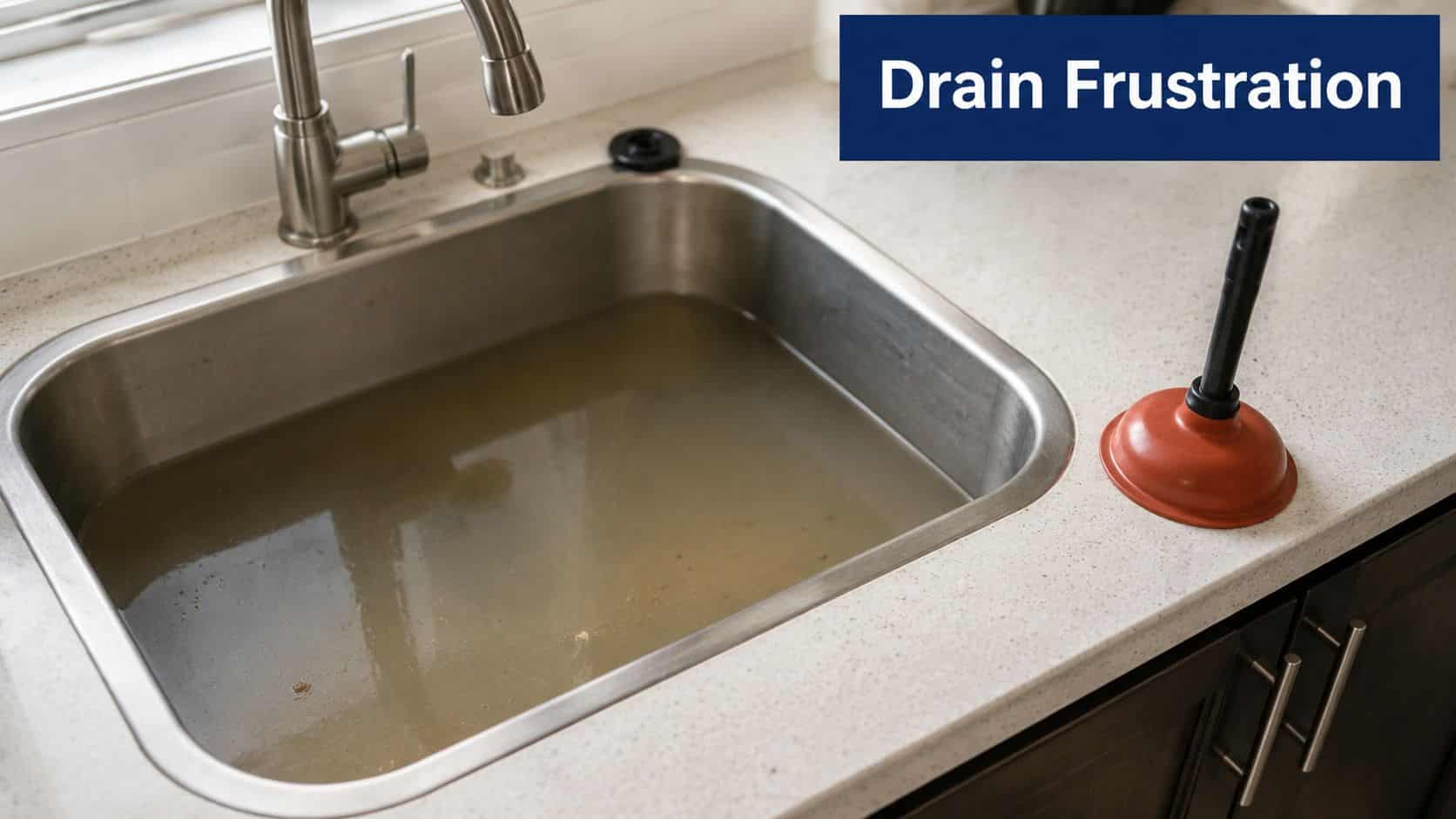
The call usually starts the same way. A homeowner says the kitchen sink has been slow for a week, then suddenly both bowls back up after dinner. Or the shower has needed a plunger twice this month and now the bathroom sink is gurgling too. That's the point where a basic clog stops feeling basic.
In the Las Vegas valley, drain problems often come with local conditions attached. Some jobs are simple fixture clogs. Others involve grease in kitchen lines, hair and soap scum in bathroom drains, or buildup farther down where repeated DIY clearing never reaches. That's why professional drain cleaning isn't just about punching a hole through a blockage. It's about finding out whether the problem is isolated or part of a larger pattern.
If you're trying to sort out who handles this kind of work locally, a directory of service professionals can help you compare providers serving Nevada properties and rental needs.
What homeowners usually want to know first
Four common questions are immediately asked:
- Is this an emergency: If water is backing up into tubs, sinks, or toilets, don't wait.
- Can this be fixed without tearing anything apart: Often yes, if the line is diagnosed correctly first.
- Is it a drain clog or a sewer-line issue: That depends on whether one fixture is affected or several.
- What will I end up paying: The method, access, and severity all matter.
A recurring clog is rarely just about bad luck. If the same drain keeps acting up, the real problem usually hasn't been removed.
What a good service visit should do
A solid drain service call should leave you with more than flowing water for one day. You should understand where the blockage was, what caused it, what method cleared it, and whether there are warning signs of a deeper sewer problem.
That's the difference between a temporary opening and a real fix. Las Vegas homeowners need both the cleaning and the diagnosis.
Why Do Drains Clog in Las Vegas Homes
Every clogged drain has a material cause. In kitchens, it's usually grease, food residue, and soap film. In bathrooms, it's hair, toothpaste, soap scum, and the small debris people don't think twice about washing down. In laundry areas, lint and detergent residue can create a sticky restriction over time.
Those are common anywhere. Las Vegas adds a local factor that changes the job.
Hard water changes the whole picture
One Las Vegas hydro-jetting source cites local water hardness at 291 ppm, which accelerates calcium and magnesium deposition on pipe walls. As scale narrows the pipe's interior, it catches debris more easily and can turn a small restriction into a recurring clog, according to this Las Vegas hydro-jetting explanation.
That detail matters in the field. A drain line with mineral scale inside doesn't behave like a clean pipe with one isolated blockage. Even after someone gets water moving again, the rough pipe wall keeps grabbing grease, soap, and waste. That's why some homes deal with the same sink or tub over and over.
The difference between a simple clog and a repeating one
A one-time blockage usually has a straightforward cause. A foreign object, a wad of hair, or a grease plug near the trap can often be cleared cleanly. A repeating blockage is different. It suggests the line itself is helping create the problem.
Watch for these patterns:
- Same fixture, same complaint: Water slows down, improves, then clogs again after a short stretch.
- More than one drain acting up: A bathroom sink and tub may point beyond a single trap arm.
- Gurgling sounds: Air movement can signal restriction farther down the system.
- Backups after routine use: Normal dishwashing or showering shouldn't overwhelm a healthy line.
For kitchen-specific odor and residue habits, this practical guide on maintaining fresh kitchen drains is useful for day-to-day prevention.
Field note: If a drain has been chemically treated several times and still clogs, stop adding chemicals. At that point, the line needs inspection, not another guess.
When the problem may be beyond the fixture
If one sink is slow, that often stays in the drain-cleaning category. If multiple fixtures are affected, or backups appear in the lowest drain in the home, the issue may involve the branch line or main sewer line instead. That's where homeowners waste money by treating symptoms one fixture at a time.
The right question isn't just how to clear the clog. It's why this drain keeps failing in the first place.
The Professional Process From Inspection to Solution
A professional drain call should follow a sequence. Not because it sounds polished, but because drain work goes wrong when people skip diagnosis and jump straight to equipment.
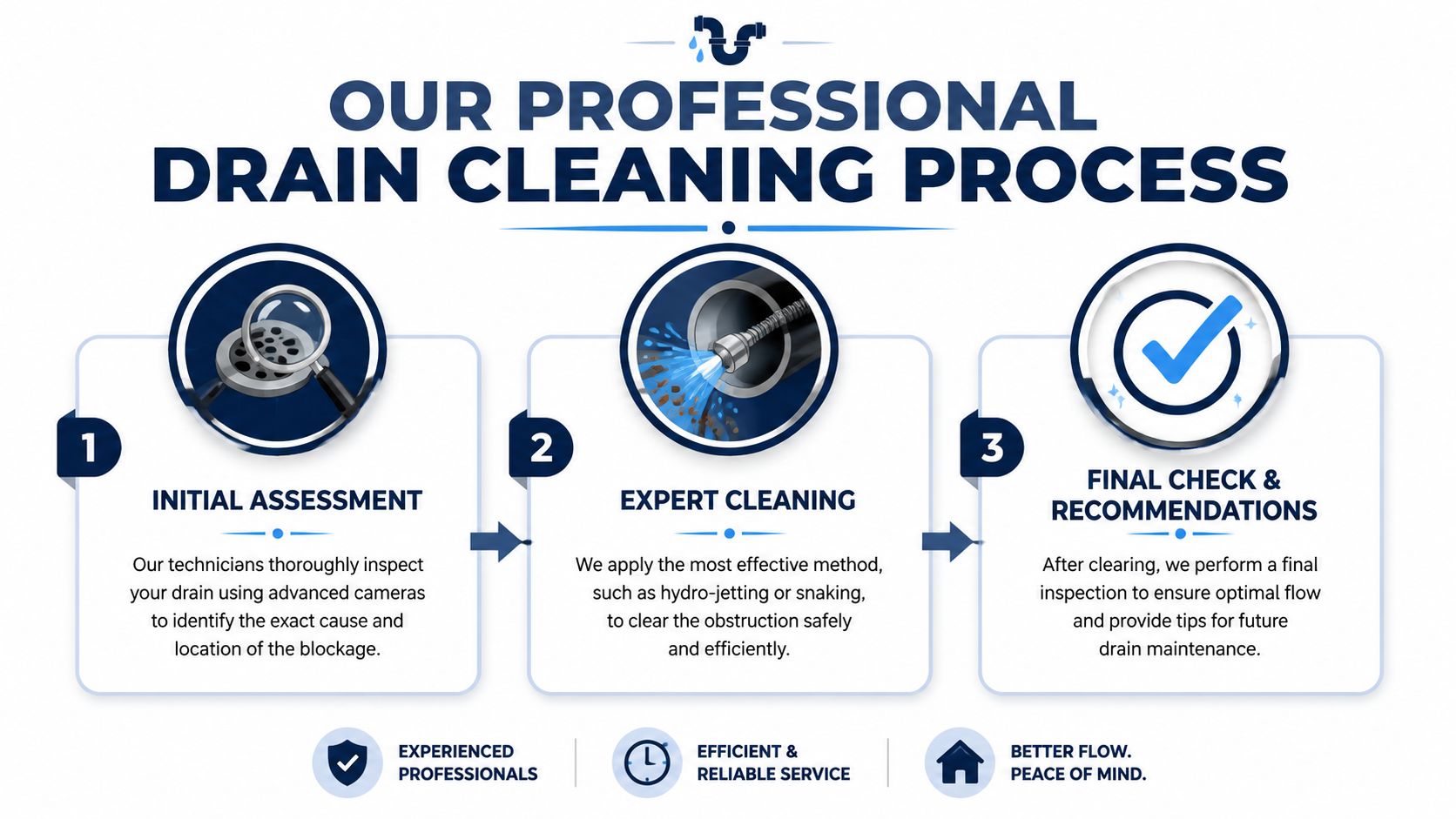
Step one starts with seeing the line
When the history suggests more than a simple stoppage, camera inspection matters. Las Vegas providers increasingly offer live color sewer camera inspections as part of modern drain diagnostics, and that shift reflects a wider move away from blind snaking toward targeted diagnosis in major metro service areas, as described in this Las Vegas drain service overview.
A camera changes the conversation. Instead of “something is clogged somewhere,” you can identify whether the line has grease, scale, standing water, root intrusion, or signs of damage. If you want a closer look at how that technology works in residential sewer work, this guide to a sewer inspection camera near me breaks down what homeowners should expect.
Step two is diagnosis, not just locating the clog
Once the line is visible, the decision becomes more precise. Is this a local fixture clog. A grease-coated kitchen line. A recurring restriction from scale. A main-line blockage. A root issue. A damaged section that won't stay open no matter how many times it's cleaned.
That distinction saves money. There's no point paying for a more aggressive cleaning method if the pipe is broken. There's also no point paying for repeated basic snaking if the buildup on the walls is what keeps causing the stoppage.
Step three matches the tool to the job
Professional sewer-cleaning specifications call for high-velocity jetting equipment with two or more nozzles capable of a scouring action at 15° to 45°, as outlined in these sewer line cleaning specifications. That nozzle behavior matters because narrower angles help propel the hose, while wider angles scrub pipe walls more aggressively.
Here's the practical version:
- Minor obstruction near the fixture: A cable machine or snake may be enough.
- Heavy wall buildup: A cleaning method that restores the pipe interior is often the better fit.
- Roots or severe fouling: The line needs more than a passage punched through the middle.
If the technician can't explain what's in the pipe and why they chose a specific method, you're being asked to buy a process instead of a solution.
MG Drain Services LLC handles drain cleaning, sewer camera inspections, rooter work, and hydro-jetting in the Las Vegas area, which is the kind of service mix homeowners often need when the problem turns out to be more than a simple clog.
Comparing Drain Snaking and Hydro Jetting Services
Homeowners often hear both terms and assume they do the same thing. They don't. Each method solves a different kind of problem, and choosing the wrong one is a big reason clogs return.
What snaking does well
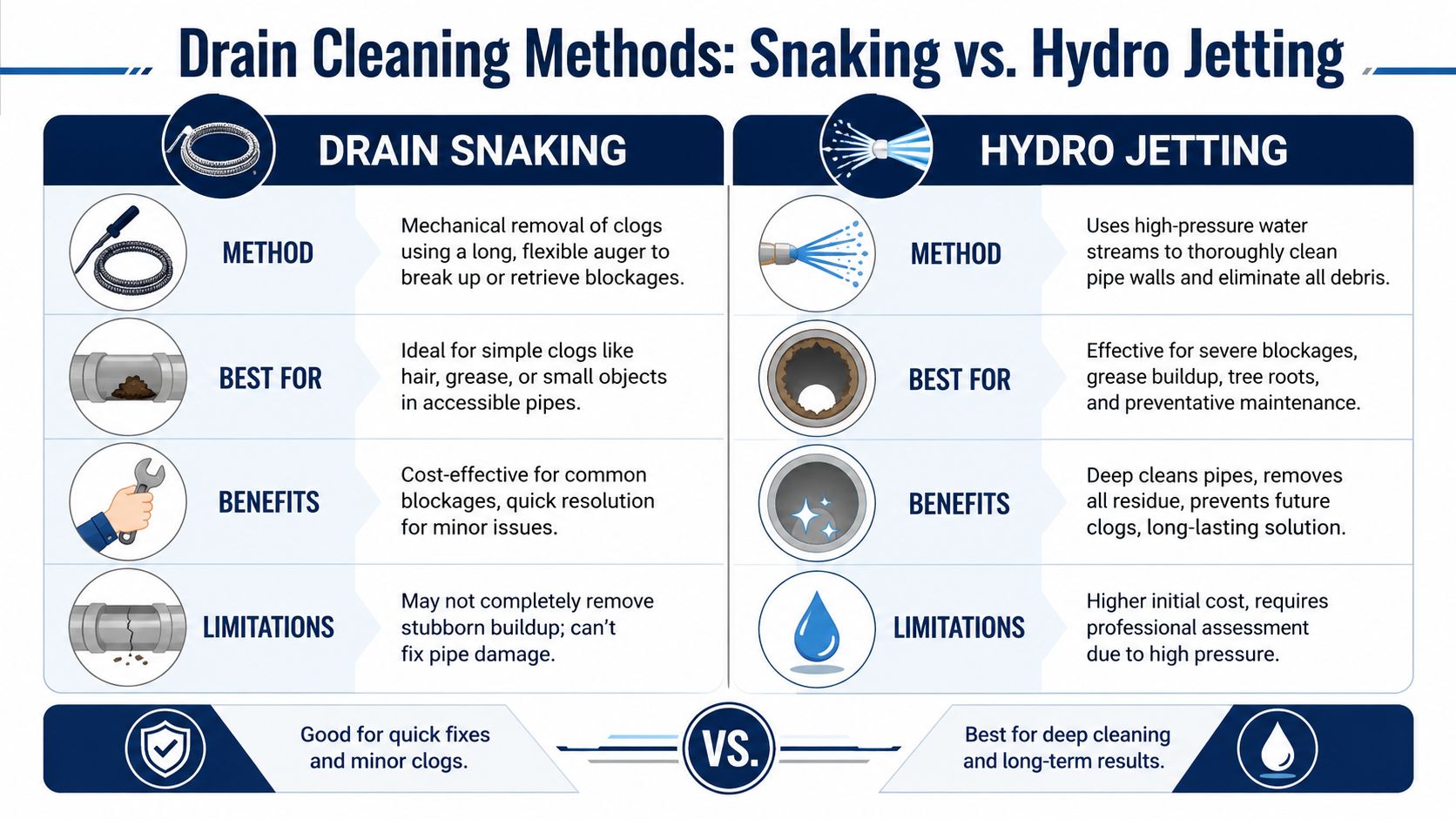
Drain snaking uses a cable or auger to break through, pull back, or bore through a blockage. It's often the right tool for a stoppage caused by hair, paper, soft buildup, or a localized obstruction in an accessible line.
Snaking makes sense when:
- One fixture is clogged: A sink, toilet, or tub with a straightforward stoppage.
- The line needs quick mechanical opening: Good for restoring immediate flow.
- You don't have evidence of wall buildup: The blockage is the issue, not the whole pipe surface.
The limitation is simple. Snaking opens a path. It doesn't necessarily clean the full inside diameter of the pipe.
Where hydro jetting becomes the better answer
In larger service areas like Las Vegas, drain work has shifted toward camera-based diagnosis and high-pressure cleaning because recurring backups and main-line issues are more common, as noted in this local drain cleaning discussion. That's why hydro jetting is often recommended when a line has grease coating, sludge, scale, or root-related fouling that keeps catching debris.
Hydro jetting is better suited when the goal is to remove material from the pipe wall, not just punch a hole through the center. That makes it a stronger option for recurring kitchen line blockages, buildup in longer runs, and lines where basic clearing keeps buying only short-term relief.
Side-by-side decision guide
| Problem type | Snaking | Hydro jetting |
|---|---|---|
| Single simple clog | Usually a good fit | Often unnecessary |
| Repeating slow drain | May help temporarily | Often more complete |
| Grease-coated kitchen line | Limited cleanup | Better wall cleaning |
| Root-heavy line | Can open a path | Better for deeper cleaning after diagnosis |
Choose the method based on what's inside the pipe, not on which machine sounds stronger.
How Much Does Drain Cleaning Cost in Las Vegas
Price matters, and honest drain companies should address it directly. The hard truth is that nobody can quote responsibly without knowing what's clogged, where it's clogged, and what method the job requires. A bathroom sink stoppage isn't priced the same as a main-line hydro-jetting job.
The broad Las Vegas market reflects that range.
Typical local pricing ranges
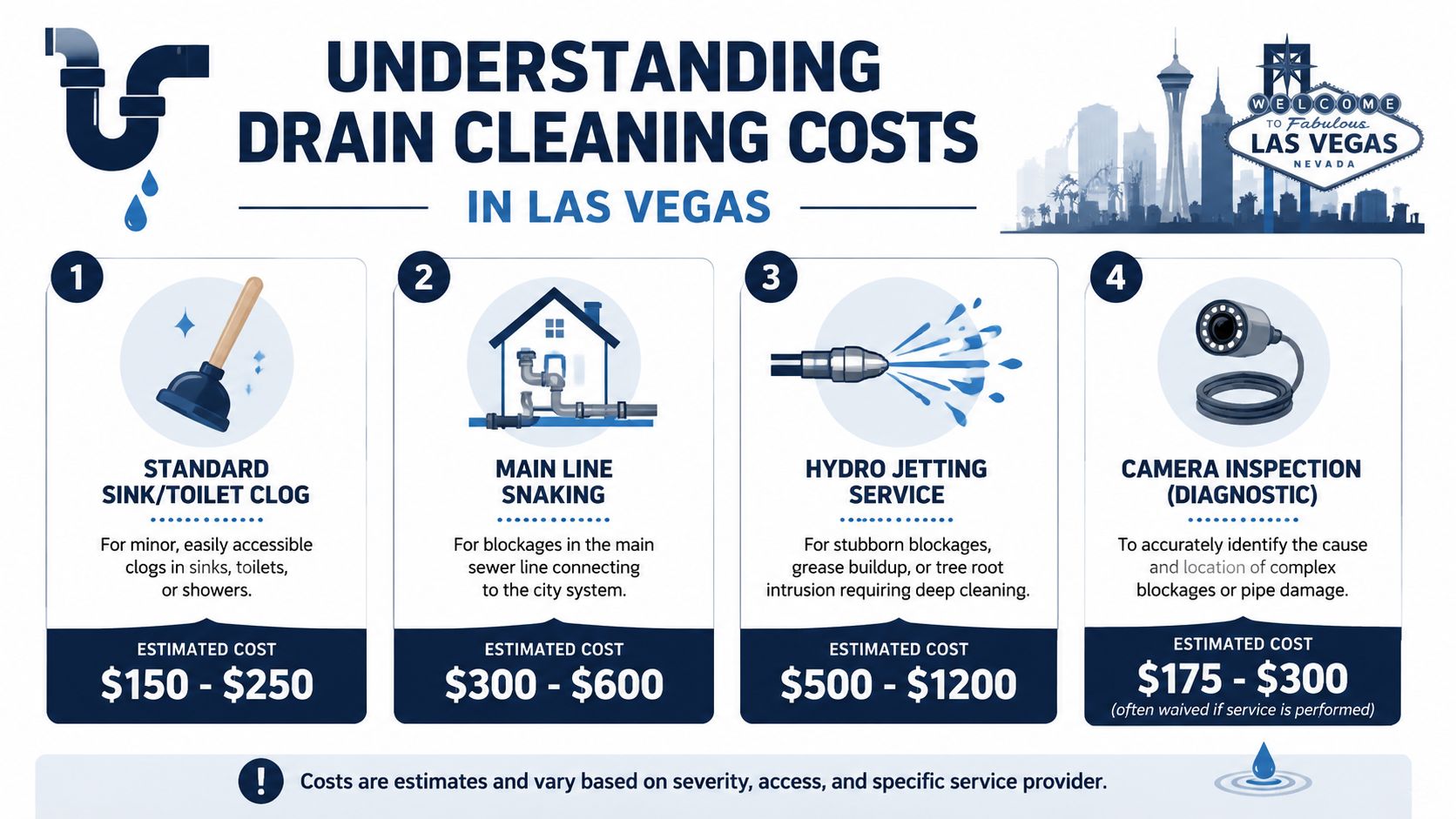
Professional drain and sewer cleaning in Las Vegas typically costs $207 to $600 per job, with a broader market range of $92 to $1,200 depending on severity, method, and provider, according to this Las Vegas drain cleaning cost guide.
That same local pricing data breaks out the work like this:
- Basic drain snaking: $92 to $276
- Mid-range cleaning: $300 to $600
- Premium hydro-jetting or severe main-line work: $600 to $1,200
North Las Vegas is shown at $207 to $276, while Henderson is described as similar to Las Vegas averages in that same guide, which suggests pricing stays fairly consistent across the valley unless the blockage is more complex.
What changes the final bill
Two jobs can sound similar on the phone and still price very differently on site. The major factors are:
- Location of the clog: A kitchen branch line is different from a main sewer line.
- Severity of blockage: Partial restriction costs less to address than a packed or recurring line.
- Access: A cleanout makes some jobs easier and faster than working through a fixture.
- Method used: Basic cable work costs less than advanced cleaning and diagnostics.
Another Las Vegas pricing page also places drain inspection at $100 to $350 and simple drain clearing at $90 to $350, reinforcing that diagnostics and intervention level affect the economics of the job, as described in the earlier local market source.
What homeowners should ask before approving work
A good quote should answer three questions clearly:
- What are you clearing
- How are you clearing it
- What makes this the right method
If those answers are vague, the price probably is too. Transparent pricing starts with a real diagnosis, not a guess over the phone.
Emergency Service and Preventing Future Clogs
It is 9 p.m., someone takes a shower, and dirty water rises in the hallway floor drain. That is not a wait-until-morning clog. In Las Vegas homes, that kind of backup usually points to a larger drainage problem, not a simple sink stoppage.
Emergency drain service is for situations where wastewater has nowhere to go or is coming back into the house. The common triggers are a blocked main line, a laundry or kitchen line that has shut down the room, or a recurring clog that keeps returning because the actual cause was never identified. Restoring flow matters right away. Finding out why it failed matters just as much, especially in older valley homes where hard water scale can narrow pipe walls over time, and in properties with outside line damage or root intrusion.
A quick opening with a cable can get water moving again. It does not always tell you whether the line is coated with buildup, cracked, bellied, or being invaded by roots. That is the trade-off homeowners need to understand. The emergency fix and the lasting fix are sometimes the same visit, and sometimes they are not.
Smart prevention is targeted, not automatic
Preventing future clogs starts with the pattern, not a generic schedule. As noted in this North Las Vegas drain cleaning guidance, some homes need more attention because of how they are used and what the pipes are dealing with.
The risk profile changes from house to house:
- Kitchen drains: Grease, starches, and food solids build up faster than many homeowners expect.
- Older homes: Repeat stoppages can signal worn pipe interiors, offsets, or a line that needs camera inspection.
- Rental properties: Wipes, paper towels, and overloaded disposals create repeat branch-line problems.
- Homes with prior sewer backups: These lines deserve closer monitoring because recurrence often means an unresolved cause.
What you can do at home
Good habits help, but they only work on preventable buildup.
- Use drain strainers: They stop hair, food scraps, and debris before they enter the line.
- Keep grease out of the sink: It cools, sticks to the pipe, and catches more debris downstream.
- Pay attention to repeat symptoms: One isolated clog is different from the same fixture slowing down every few weeks.
- Avoid routine chemical cleaners: They can damage some piping and still leave the underlying problem untouched.
Early action saves money.
When to stop troubleshooting
Homeowners should stop trying plungers and store products when the symptoms point beyond a single fixture. Call a plumber if several drains are slow at once, if the lowest drain in the house backs up first, or if a line was recently cleared and is already failing again. Those are signs that the issue may be deeper in the system.
Documentation also matters in real-world situations. If you are dealing with tenants, preparing a home for sale, or trying to confirm whether the problem is misuse or pipe condition, a licensed plumber can inspect the line and explain what is there.
For urgent service, homeowners can contact MG Drain Services LLC at 702-480-8070. The company serves Las Vegas, Henderson, and North Las Vegas with licensed and insured service, clear pricing, modern diagnostic equipment, experienced technicians, and bilingual support. Se habla español.