A hose bib leak usually starts the same way in Las Vegas. You turn off the outdoor faucet after rinsing a patio, watering plants, or washing down a driveway, and a drip keeps falling long after the handle is closed. In a dry climate, that constant leak is hard to ignore, and it's more than an annoyance when water is escaping right next to stucco, block, or siding.
Hose bib repair is often straightforward when the problem is inside the faucet. It gets more serious when the leak is at the wall or the pipe behind it. That's where homeowners in Las Vegas, Henderson, and North Las Vegas need clear guidance, not generic advice. This guide covers what usually fails, what you can safely fix yourself, what tends to go wrong in older local homes with hard water buildup, and when it's smarter to call plumbers in Las Vegas before a small outdoor faucet problem turns into hidden wall damage.
That Annoying Drip A Homeowners Guide to Hose Bib Repair
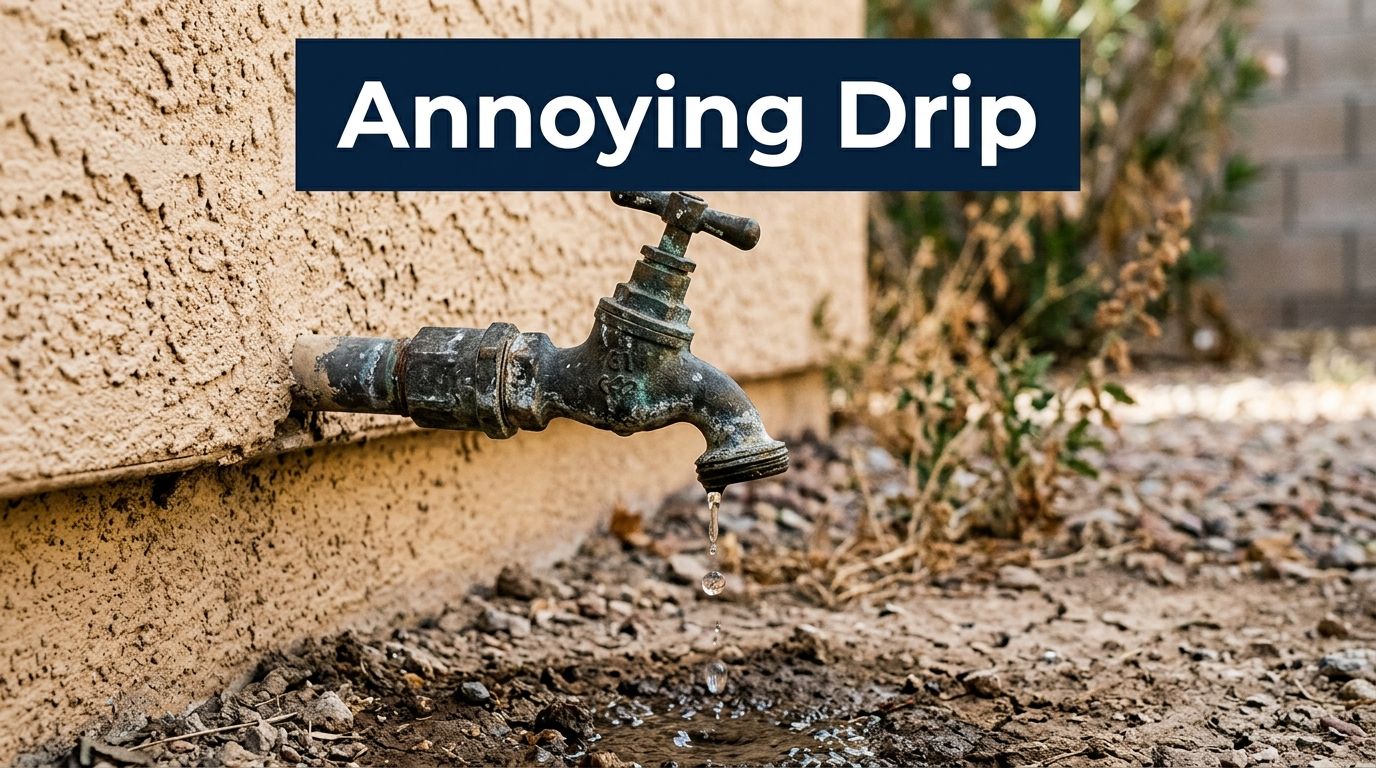
A lot of homeowners notice the problem at the worst time. The hose is off, the yard work is done, and the faucet still drips onto dry soil or concrete. In Las Vegas, that feels wasteful right away, but the bigger issue is what repeated leaking can do around the wall penetration and the pipe connection over time.
For many homes, the first fix is minor. The average cost to repair or replace a hose bib in the United States ranges between $200 and $600, with most homeowners spending about $300 for a standard outdoor faucet replacement, while minor repairs such as replacing an internal washer or tightening the packing nut usually fall between $10 and $60 in parts and labor according to HomeAdvisor's hose bib cost guide. That's exactly why this fixture deserves attention early. It's one of the cheaper plumbing repairs when you catch it before the leak spreads.
Why homeowners put this off
Outdoor faucets get ignored because they sit outside and still “mostly work.” The handle turns, the hose fills, and the leak seems small. That mindset causes trouble.
Practical rule: If an outdoor faucet leaks when it's off, or leaks around the handle when it's on, the repair is usually easier and cheaper now than after the fitting corrodes further.
What matters in Las Vegas
Las Vegas homes deal with intense sun, mineral-heavy water, and older exterior plumbing in many neighborhoods. Henderson and North Las Vegas properties often show the same pattern. Rubber parts dry out faster, threads seize up, and a basic repair can turn into a replacement if the bib has been leaking for too long.
The good news is that many hose bib problems follow a few predictable patterns.
Why Your Outdoor Faucet Is Leaking
The first thing to identify is where the water is showing up. A drip from the spout points to one failure. Water around the handle points to another. Those are different repairs.
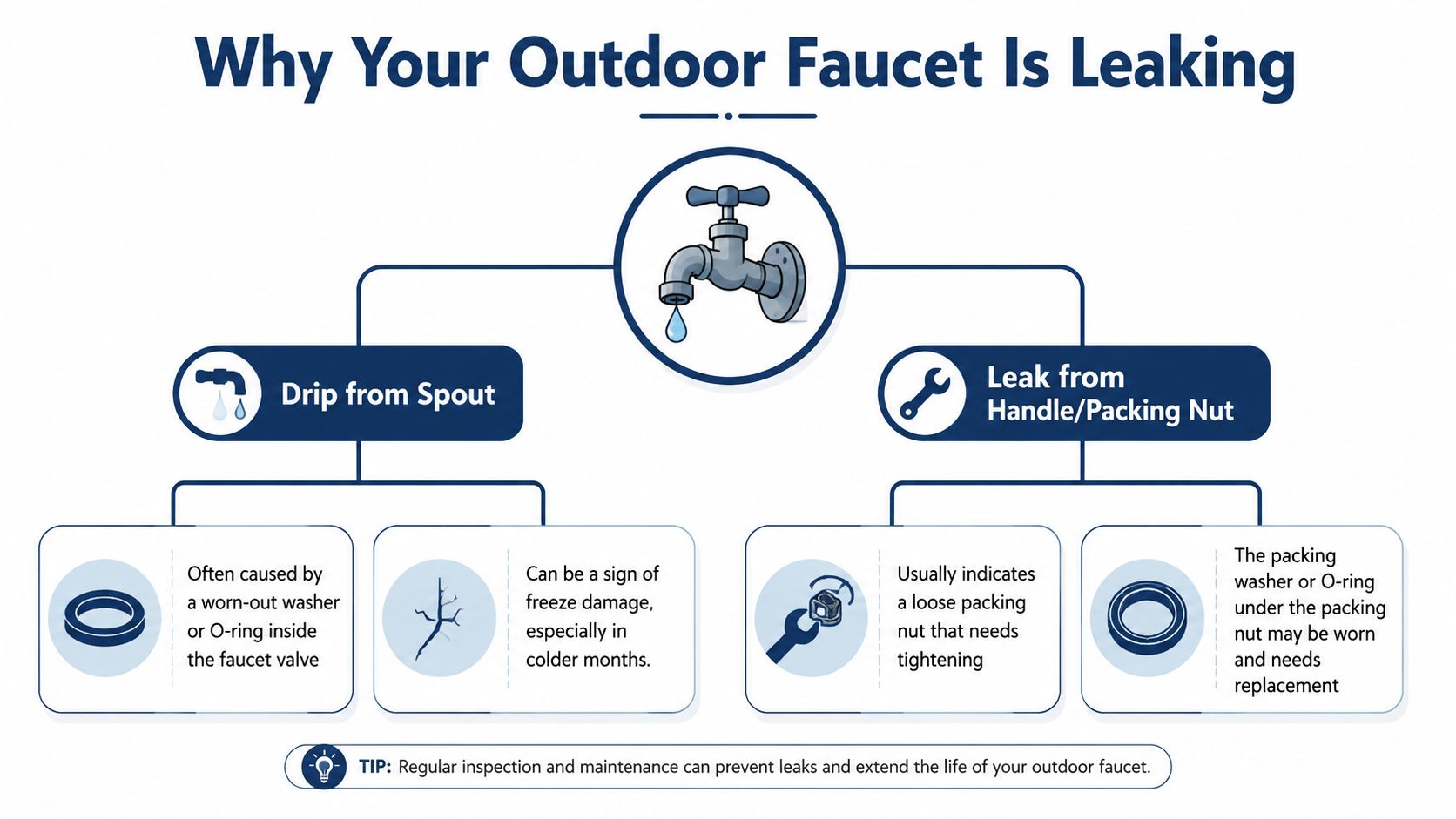
According to NFM Plumbing's hose bibb repair guide, hose bib leaks are primarily caused by two distinct failure mechanisms: a degraded stem washer causing spout dripping, or worn packing O-rings or packing string allowing water to seep around the handle under pressure. Diagnosing the specific source is critical for a successful repair.
Drip from the spout
Inside the faucet, the stem washer presses against the valve seat every time you shut the water off. Over time, that washer flattens, hardens, or cracks. Once it can't seal tightly, water keeps slipping past and dripping out the spout.
In Las Vegas, mineral deposits and heat make that wear show up sooner on neglected fixtures. Think of the washer like the sole of a work boot. Once it wears unevenly, it still looks usable, but it doesn't hold the line the way it should.
Leak from the handle area
A handle leak usually means the packing material around the stem isn't sealing anymore. Older bibs may use packing string. Newer ones may use an O-ring. Either way, when that seal degrades, water escapes around the stem when the faucet is under pressure.
Look for these clues:
- Spout dripping after shutoff: The stem washer is the likely suspect.
- Water around the handle while running: The packing nut, packing string, or bonnet O-ring is usually at fault.
- Moisture at the wall: That points away from a simple internal repair and toward a connection issue.
If the leak seems to be traveling into the wall or spreading across stucco, it's worth getting a closer diagnosis with water leak detection in Las Vegas before assuming it's just a bad washer.
In colder snaps, outdoor faucets can also fail from trapped water. If you want a plain-language prevention checklist, this guide on how to winterize your car, RV, and home is a useful reminder to disconnect hoses before freezing weather arrives.
DIY Hose Bib Repair Steps and Common Pitfalls
Some hose bib repairs are reasonable DIY jobs if the faucet is accessible, the body isn't badly corroded, and the leak is clearly coming from the spout or handle. If the faucet feels frozen in place, skip the experiment.
Safe repairs homeowners can try
Start by shutting off the water to that line if there's a local shutoff. If there isn't, use the main water supply. Then open the bib to relieve pressure before taking anything apart.
For a basic repair, gather:
- Adjustable wrench or channel-lock pliers
- Flathead screwdriver
- Replacement stem washer
- Packing string or the correct O-ring
- Teflon tape
- Pipe dope
The usual sequence is:
- Remove the handle screw and pull the handle off.
- Loosen the packing nut.
- Pull out the stem assembly.
- Inspect the washer at the end of the stem if the spout drips.
- Inspect the packing or O-ring if the handle leaks.
- Replace the failed part and reassemble carefully.
What works and what doesn't
Tightening the packing nut slightly can stop a minor handle seep. Cranking it down hard usually creates a stiff handle and can damage the seal. Replacing the washer often solves a steady drip, but only if the valve seat and threads are still in good shape.
For threaded replacement work, technique matters. This replacement demonstration shows a detail many rushed repairs miss: proper hose bib replacement requires 4 to 5 clockwise wraps of Teflon tape with the first thread left bare to avoid cross-threading. Applying pipe dope alongside the tape lubricates threads and creates a more secure seal against leaks seeping into the wall cavity.
Don't over-tighten a new bib. A secure fit is the goal. Forcing it farther can crack the female adapter or distort the brass body.
Common mistakes that create bigger problems
A lot of failed DIY repairs come from the same few errors:
- Using the wrong repair part: A washer that almost fits usually won't seal for long.
- Skipping thread prep: Dry threads and sloppy tape wrapping lead to wall-side leaks.
- Ignoring corrosion: If the stem, seat, or body is badly worn, new soft parts won't save it.
- Leaving the hose attached: Even frost-free models can crack when water stays trapped inside.
In Las Vegas, hard water buildup can lock old threads together. If the faucet won't back out cleanly, don't keep applying force just because an online tutorial made it look easy.
When a Simple Fix Is Not Enough
The leak that fools people most is the one at the wall. Homeowners often assume the faucet body is leaking internally, but the actual problem is where the bib threads into the pipe, where the sealant failed, or where the fitting behind the wall cracked.
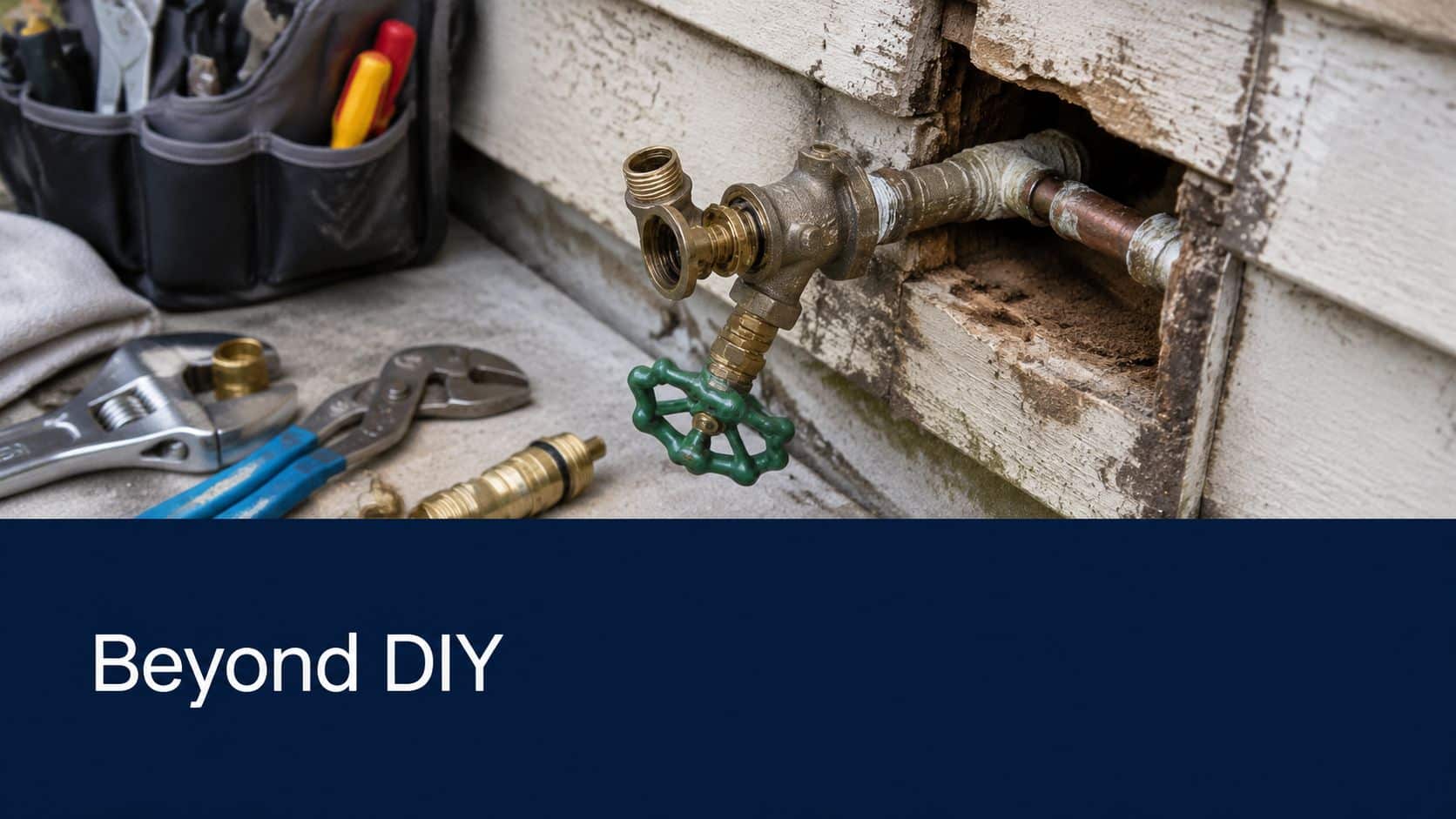
According to Lowe's coverage of hose bib leak diagnosis, over 35% of outdoor faucet leaks reported to plumbers in markets like Las Vegas stem from wall-seal failure or threaded fitting corrosion, not internal washer wear, yet less than 5% of top-ranking DIY articles provide dedicated steps on diagnosing this specific junction.
Signs the problem is behind the wall
If you see any of these, stop treating it like a simple faucet repair:
- Water appears where the bib meets the wall
- The stucco, brick, or siding stays damp
- The leak worsens only when the faucet is turned on
- The faucet feels loose at the wall
- You hear water movement inside after shutoff
Those symptoms can point to a cracked drop-ear fitting, failed threaded connection, or damaged exterior seal that lets water track back into the wall cavity.
Why this needs fast action
A wall-side leak can soak sheathing, framing, and insulation before you notice anything indoors. The faucet may still operate normally, which is why people delay the repair. If water is entering the wall, that delay is expensive.
When the leak is active, visible at the wall, or feeding into the structure, treat it like an urgent plumbing issue and get an emergency plumber in Las Vegas involved before the connection fails completely.
If the water is coming from the wall joint, changing washers won't fix the real problem.
Professional Repair vs DIY Cost and Risk in Las Vegas
A hose bib repair in Las Vegas is often cheap right up until the old faucet has to come out. That is where homeowners on older properties get into trouble. A simple drip can still be a washer. A sun-baked, mineral-locked bib on aging copper is a different job with a different risk level.
The local cost side
In the Las Vegas area, typical hose bib replacement ranges from $150 to $350, while replacing a general outdoor spigot can cost between $150 and $450 according to HomeGuide's Las Vegas plumber cost data. The same source notes that professional plumbers commonly charge $45 to $150 per hour with a minimum service fee of $50 to $200, so many straightforward hose bib jobs still fit into one visit.
Those numbers matter because DIY savings are usually small when the repair stops being internal. Once removal is involved, the cost question shifts from parts pricing to whether the pipe survives the work.
Why Las Vegas changes the risk
Las Vegas outdoor plumbing deals with two things generic DIY articles barely cover. Hard water leaves scale on threads and inside the valve body, and extreme summer heat dries and hardens rubber parts faster than milder climates do. On west- and south-facing walls, I regularly see seals, packing, and vacuum breaker parts age out sooner because they sit in direct sun for months.
Older homes add another layer. Many valley homes still have aging copper stub-outs or older threaded connections that do not like force. If the bib has been in place for years, mineral buildup can lock the threads together so tightly that turning the faucet body also stresses the pipe inside the wall. In some neighborhoods, shifting desert soils can add slight movement over time, which does not always break a line underground but can leave exterior connections less forgiving during removal.
That is why the risk assessment needs to be simple.
- Low DIY risk: minor spout drip, light handle seep, faucet body is solid, no moisture at the wall, parts come apart normally
- Moderate DIY risk: older bib, visible scale, stiff handle, worn packing nut, sun-damaged rubber parts
- High DIY risk: faucet is seized, loose at the wall, leaking at the siding or stucco line, connected to older copper, or shows corrosion around the threads
High-risk jobs are where a low-cost repair turns into wall repair, stucco repair, or a pipe replacement.
DIY vs Professional Hose Bib Repair in Las Vegas
| Factor | DIY Repair | Professional Repair (MG Drain Services) |
|---|---|---|
| Best fit | Minor spout drip or handle seep on an accessible bib | Corroded bibs, wall leaks, seized fittings, full replacement |
| Upfront cost | Lower if only soft parts are needed | Higher than parts-only DIY, but often handled in one visit |
| Risk on older Las Vegas homes | Rises fast with hard water scale, heat-damaged seals, and stuck threads | Lower because the connection, wall condition, and replacement method are checked first |
| Tools and materials | Homeowner must match washer, packing, tape, and sealant correctly | Proper tools, replacement parts, and sealing methods already on hand |
| Heat and sun exposure issues | Easy to miss brittle washers, cracked vacuum breakers, and degraded packing | More likely to catch UV and heat-related wear before the faucet is reassembled |
| Long-term result | Good for simple internal wear | Better when the faucet or connection needs replacement |
There is also a permit point worth keeping straight. In Clark County, minor leak repairs that don't involve replacing or rearranging components generally don't require a permit. For Las Vegas specifically, hose bib replacement is treated as a plumbing improvement that does not require a building permit.
If you want to compare likely service pricing before booking, review these Las Vegas plumbing cost estimates.
Your Trusted Plumber for Hose Bib Repair in Las Vegas
You turn off the hose after watering the yard, head back inside, and an hour later the faucet is still dripping. In Las Vegas, that small leak often points to more than a worn washer. Hard water leaves scale inside the stem and seat. Constant sun bakes rubber parts, and older hose bibs on long-owned homes can be brittle at the wall connection.
A careful repair solves many of these calls. The key is knowing when to stop before a simple faucet issue turns into a pipe repair inside stucco or block. If the hose bib is leaking from the handle, a rebuild may work. If water shows at the wall, the faucet body is cracked, or the connection will not loosen cleanly, replacement is usually the safer choice.
Older homes in Las Vegas, Henderson, and North Las Vegas need extra caution. Mineral buildup can lock threads in place so tightly that forcing removal twists copper or damages the fitting inside the wall. I see that risk most often on faucets that have been exposed to years of heat and little maintenance.
For homeowners, the practical decision is simple. Handle the easy fixes if the leak is clearly at the packing nut or washer and the faucet comes apart without a fight. Call a plumber if there is wall-side moisture, heavy corrosion, a loose faucet, or any sign the pipe behind it may move with the hose bib.
Fast repair keeps a nuisance from becoming wall damage. For service, call 702-480-8070. MG Drain Services LLC is a licensed and insured local Las Vegas company serving homeowners in Las Vegas, Henderson, and North Las Vegas with experienced technicians, honest pricing, bilingual support, and reliable response times. If your outdoor faucet is leaking, loose at the wall, or needs full replacement, they can also help with related plumbing repairs and local guidance through the MG Drain Services blog.