A shower that used to feel normal suddenly turns weak. The washing machine takes longer to fill, one faucet spits air, or pressure changes when another fixture opens. In Summerlin, those symptoms don't automatically mean the neighborhood has low water pressure. Your home may instead be receiving too much pressure, losing flow through a failing regulator, or dealing with mineral scaling inside the fixtures.
That distinction matters before you buy a booster pump, replace a faucet, or adjust a valve. The first useful question is simple: does your home sit below or above 80 psi under static conditions? The answer points toward a very different repair.
Why Summerlin Homes Have Pressure Problems in the First Place
A Summerlin homeowner can discover the issue during an ordinary morning shower. The flow weakens when a toilet refills or irrigation starts. In another house, pipes bang, the water-heater relief valve releases water, and fixture cartridges wear sooner than expected.
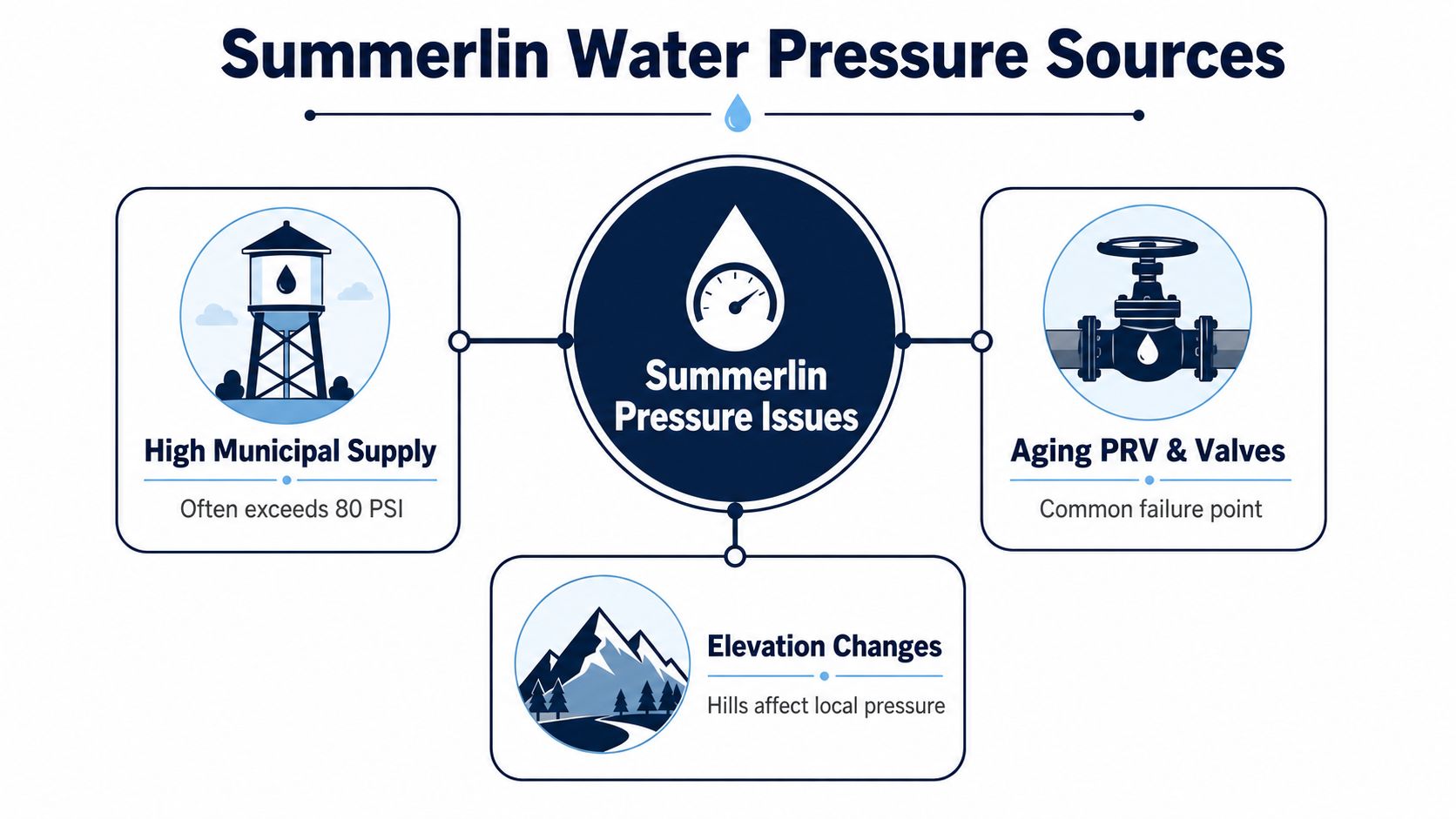
Both complaints begin with the same question: where does the home's static pressure sit relative to 80 psi? Summerlin's elevation and pressure zones can place nearby homes on different parts of the same supply system. That makes “low pressure” an incomplete diagnosis.
The Las Vegas Valley Water District system generally operates from about 30 psi to 100 psi, depending on elevation and pressure zone, as explained by the Las Vegas Valley Water District's water-pressure guidance. Summerlin's position along the western edge of the valley helps explain why readings can differ from lower neighborhoods.
A local Las Vegas plumbing reference reports that foothill neighborhoods such as Summerlin often measure 90 to 110 psi, with Summerlin and The Ridges commonly falling in the 85 to 110 psi range (local pressure and hard-water guidance). Another local plumbing source notes that some west-Summerlin homes can read above 95 psi (neighborhood pressure-zone information).
Pressure is a zone question
Residential plumbing is commonly designed to remain under 80 psi, and homes above that static pressure need pressure control under local service requirements. Sustained high pressure can wear fixtures, stress appliances, and make piping noisy.
Weak flow can come from a PRV that restricts water incorrectly, a partly closed shutoff valve, a leak, or mineral scale narrowing an aerator or pipe. Elevation does not identify the failed component. It explains why a citywide pressure assumption is a poor starting point.
If the buried service line is deteriorated or leaking, the repair may extend beyond the regulator. MG Drain Services handles main water line replacement in Las Vegas when testing points to the property's supply line rather than a fixture.
How to Test Your Water Pressure at Home
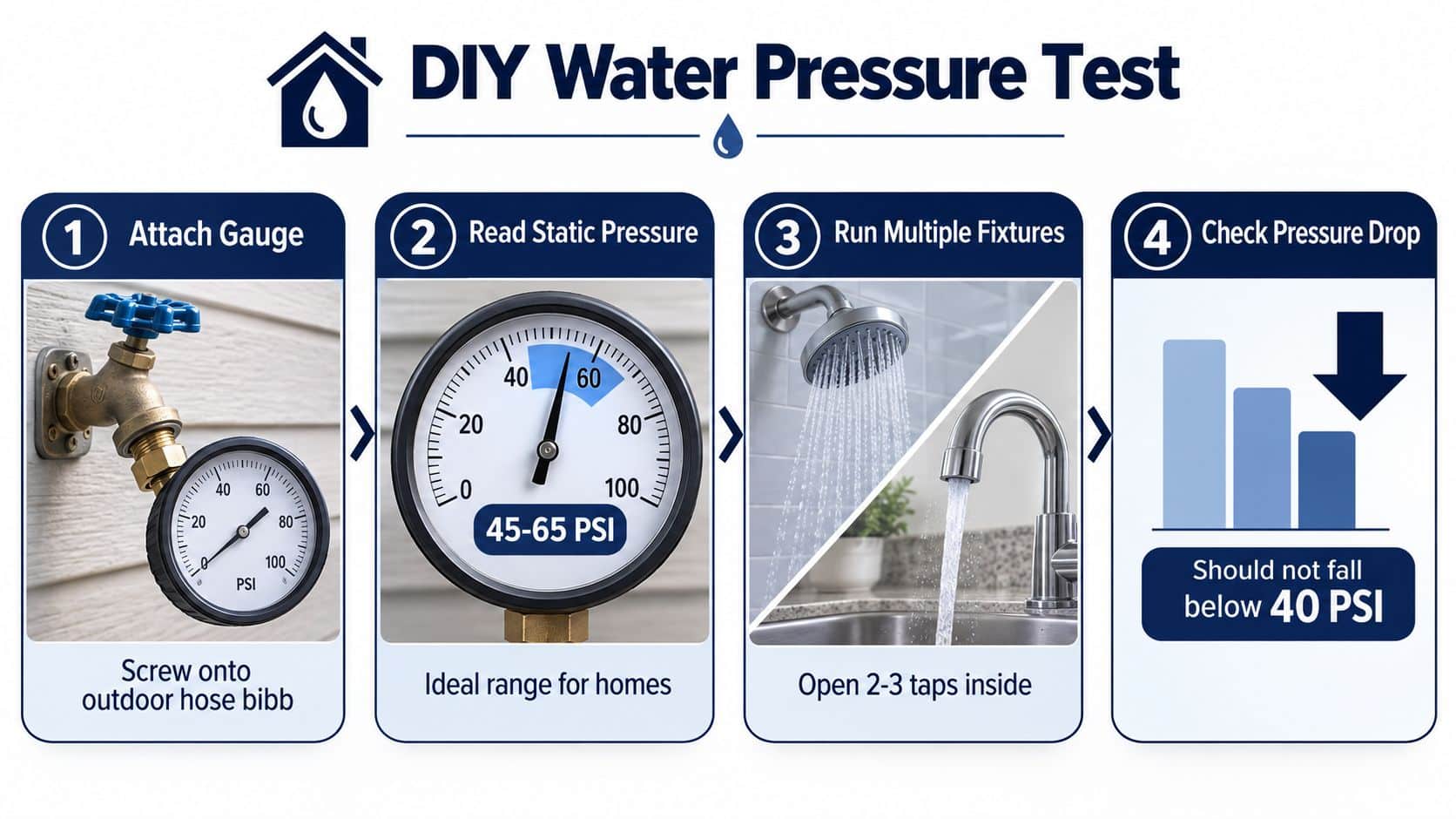
A shower that turns weak when the washing machine starts may point to the same elevation-driven system that produces excessive pressure elsewhere. A screw-on water-pressure gauge helps identify which side of 80 psi your home sits on before you adjust a valve or replace a fixture.
Start with a true static reading
- Stop all water use. Turn off faucets, showers, toilets, washing machines, irrigation, pool equipment, and water-using appliances. Nobody should open a fixture during the test.
- Attach the gauge. Screw it onto an outdoor hose bibb. Tighten it by hand, adding a hose washer if the connection drips.
- Read the dial. Keep water use off inside and record the static pressure.
- Compare the result. Residential systems are commonly evaluated in the 40 to 80 psi range, while 50 to 60 psi often provides comfortable operation (LVVWD pressure-testing guidance).
A static reading above 80 psi needs attention because residential plumbing requires pressure control at that level under local service requirements. Do not turn the PRV adjustment screw immediately. Confirm whether the pressure stays steady and whether the valve is regulating correctly.
Test pressure while the home is using water
Static pressure may look acceptable while flow remains poor. Open a shower or bathtub fixture and a nearby faucet, then watch the gauge. Add another fixture if the complaint appears during heavier household use.
A drop of roughly 10 to 15 psi under combined demand is often considered normal. A decline of 20 psi or more points toward a restriction or downstream problem (LVVWD pressure-testing guidance). The cause may be a clogged aerator, partly closed valve, failing PRV, scaled cartridge, or undersized branch line, and each responds differently under flow.
Practical rule: Static readings show supply capacity; readings taken under load show how the plumbing actually performs.
Compare the outdoor gauge with an indoor fixture when the hose bibb is accessible. Poor performance at one bathroom directs attention toward that fixture. Weak flow throughout the home calls for inspection of the main shutoff, PRV, leak indicators, and service line. For a suspected hidden leak, arrange a water leak detection service instead of repeatedly adjusting pressure.
The Pressure-Reducing Valve and Why It Matters in Summerlin
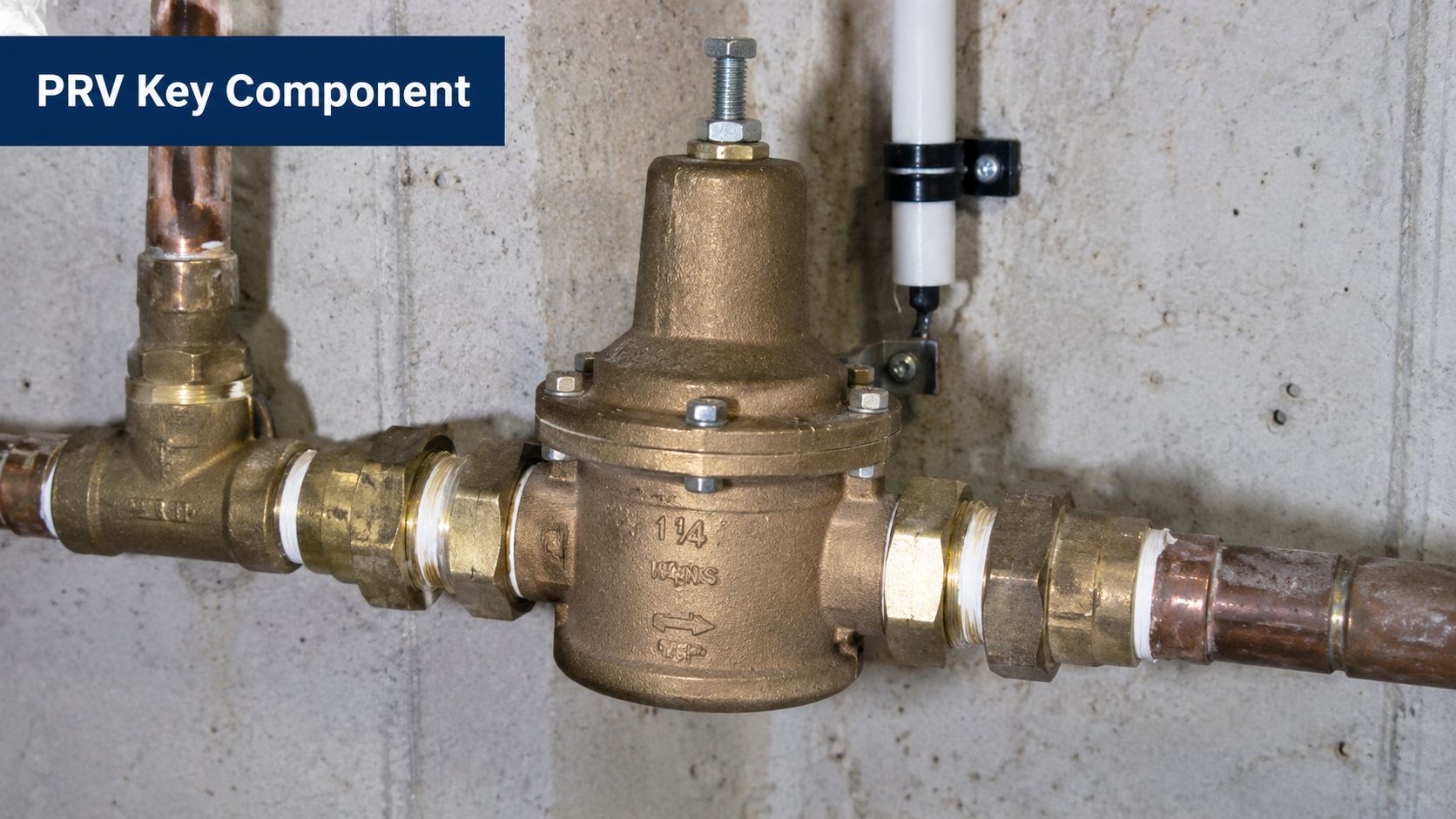
A plumber finds the pressure-reducing valve, or PRV, on the incoming water line near the meter or main shutoff. The exact location depends on the home's layout. This mechanical regulator separates the higher-pressure utility supply from the plumbing inside the house. Its diaphragm and spring respond to downstream pressure, restricting incoming flow to the selected setting.
Elevation makes that regulation especially important in parts of Summerlin. A PRV may work constantly to keep household pressure within a usable range. As the valve wears, it can produce either side of the same pressure problem: pressure may rise above a safe level, or the valve may restrict flow and leave the home feeling under-pressurized.
How a failing PRV behaves
A plumber checks the pressure pattern instead of relying on one symptom:
- Pressure climbs while fixtures remain closed. The downstream reading rises rather than holding steady.
- Pressure swings between fixtures. A shower feels acceptable, then changes sharply when another fixture opens.
- Pipes hammer or chatter. Unstable regulation and rapid valve movement can send noise through the piping.
- The water heater relief valve vents. Repeated discharge from the temperature and pressure relief outlet can indicate excessive pressure and needs prompt investigation.
- Flow weakens under demand. A worn internal part may pass water at rest but fail to maintain usable flow.
Nevada plumbing requirements allow normal working pressure as low as 40 psi and call for pressure control when static pressure can exceed 100 psi in a zone (Nevada residential water-supply code). The practical point is simple: a weak shower does not automatically mean the municipal supply needs boosting. The home may be on the restricted side of its pressure range, with the PRV, shutoff, fixture, or service line limiting flow.
What inspection should include
A proper PRV evaluation covers static and flowing pressure, pressure stability over time, valve condition, shutoff position, and the relationship between the main supply and downstream fixtures. The plumber may inspect unions, strainers, nearby fittings, and signs of leakage or corrosion.
Adjustment makes sense only when the valve responds predictably and its internal parts remain sound. If pressure continues drifting after adjustment, replacement is usually more practical than repeatedly turning the screw and hoping the symptom clears.
Hard Water Scaling and the Slow Pressure Problem
Some water pressure complaints develop so gradually that homeowners blame the fixture. A showerhead loses force over time, a faucet stream becomes narrow, and the washing machine seems slower. The supply pressure may be fine. Scale has reduced the opening through which water must pass.
LVVWD water in the Las Vegas Valley is classified as very hard, with hardness listed at 291 parts per million, or 17 grains per gallon. Calcium and magnesium are the minerals responsible for that hardness (Las Vegas hard-water information).
Start with the fixture, not the whole house
Remove the faucet aerator and inspect the screen for chalky deposits, grit, or discolored material. Soak removable parts in white vinegar, brush away loosened scale with an old toothbrush, rinse thoroughly, and reinstall the aerator. For a showerhead, remove it if practical and clean the spray outlets without damaging the finish or internal screen.
This is a reasonable homeowner task when the problem affects one fixture and there's no sign of a leak. Check the cartridge or flow restrictor only if you're comfortable shutting off the fixture supply and keeping track of the parts. A badly scaled, inexpensive aerator may be more practical to replace than to restore.
A clean showerhead won't correct a failed PRV, and a new PRV won't remove scale trapped inside a faucet cartridge.
If multiple fixtures on the same branch lose flow, the restriction may be inside a valve or supply line. At that point, surface cleaning won't solve the problem. A plumber may need to isolate hot and cold sides, test flow at accessible connections, inspect the water heater, and determine whether the piping can be cleaned or needs replacement. For hot-water complaints involving sediment or related equipment, water heater repair in Las Vegas can address the appliance side of the diagnosis.
PRV Adjustment, Replacement, and When Each One Makes Sense
Adjustment and replacement are both viable paths. The pressure test and the valve's behavior under load determine which repair makes sense. A worn PRV may improve briefly after adjustment, then return to unstable operation.
Compare the available repairs
| Option | Best When | Typical Lifespan | Notes |
|---|---|---|---|
| PRV adjustment | The valve is responsive, stable, and pressure has drifted from its setting | Not applicable | Corrects the setting but doesn't repair worn internal components |
| PRV replacement | The valve sticks, surges, leaks, or fails to hold a stable downstream reading | Not stated in the verified data | Restores regulation when adjustment no longer produces reliable control |
| Pressure tank or supplemental regulation | A plumber identifies pressure fluctuation that standard regulation doesn't resolve | Not stated in the verified data | Requires system-specific evaluation and available installation space |
A healthy PRV that has drifted may need careful adjustment, followed by another static and load test. The target is stable pressure that protects fixtures and still provides usable flow, rather than the highest possible shower pressure.
When replacement is the better decision
Replacement makes more sense when the gauge reading rises on its own, the valve responds inconsistently, or pressure drops sharply as several fixtures open. The plumber should also assess access, corrosion at the fittings, the incoming line, and any debris or hard-water deposits affecting the valve.
Summerlin's elevation differences make pressure regulation more demanding. Elevation alone, however, does not prove that the PRV has failed. A home can show high static pressure and weak flow at the same time when the regulator is damaged or a restriction exists downstream.
The 80 psi dividing line matters during diagnosis. Pressure above that level can put added strain on fixtures and piping, while a reading below it does not rule out a flow restriction. Test the home at rest and while fixtures run before choosing the repair.
A pressure tank or supplemental regulator is a system-specific solution. It belongs in the discussion only after testing identifies fluctuations that ordinary adjustment or replacement will not correct. Installing a booster pump before measuring incoming pressure can worsen an over-pressure condition, so diagnosis comes first.
Pressure Symptoms That Are Not a DIY Project
A pressure problem that affects several fixtures deserves more than a faucet-level fix. Homeowners can confirm a fully open shutoff valve, clean an aerator, and read pressure with a hose-bibb gauge. Work involving a PRV, regulator, or concealed supply line carries greater risk and can lead to a wrong diagnosis.
Call a licensed plumber if pressure changes sharply between fixtures, the water heater relief valve vents, or pipes bang repeatedly. Pressure that keeps climbing after an adjustment also needs attention. These signs may indicate unstable regulation or excessive pressure, rather than a weak showerhead.
The elevation-driven system can push a home toward either side of the 80 psi threshold. A house may have low flow from a restriction while static pressure remains high, so symptoms alone cannot identify the failed component. Test pressure at rest and during use before buying a booster, replacing fixtures, or altering the regulator.
Summerlin construction can hide the source. Slab construction may conceal a supply leak below finished floors. Mature landscaping, irrigation, aging valves, buried piping, and shared-lot irrigation crossover can also create pressure changes that cleaning a fixture will not resolve.
If pressure affects the whole house, changes without warning, or appears with water damage, stop guessing and isolate the water when safe.
A professional diagnosis compares the meter or hose-bibb reading with indoor flow, inspects the PRV and shutoffs, and checks for leak indicators. Active water loss or a serious pressure event may call for residential emergency plumbing service in Las Vegas.
Preventing the Next Pressure Problem
Pressure maintenance in Summerlin has two separate targets. The first is elevation-driven supply pressure, which calls for periodic measurement and a PRV that can regulate consistently. The second is very hard water, which calls for reducing mineral exposure and removing buildup before it narrows fixture openings.
A practical maintenance routine includes:
- Check static pressure periodically. Use the same hose bibb and record the reading with all water turned off, so changes are easier to recognize.
- Watch the PRV's behavior. A stable reading matters more than chasing a particular shower feel. Pressure that rises, surges, or drops sharply under ordinary use deserves inspection.
- Clean fixture screens. Aerators and showerheads reveal scale early. Cleaning them can restore flow when the restriction is local.
- Consider water treatment. A properly selected softener or scale-control device can help homeowners reduce mineral buildup in fixtures and piping, but it won't repair a closed valve, leak, or failed regulator.
- Pay attention to irrigation. Unexpected outdoor wet areas, valve noise, or pressure changes during scheduled watering can justify a supply-side leak check.
The most useful prevention step is knowing where your home sits before symptoms become disruptive. MG Drain Services LLC is a licensed, insured, local, family-owned, owner-operated residential plumbing company serving Las Vegas, Henderson, North Las Vegas, and Summerlin. Its pressure diagnosis can distinguish a PRV problem from a leak, fixture restriction, hard-water scaling, or a line issue before you spend money on the wrong repair.
MG Drain Services LLC can test residential water pressure, evaluate PRVs, investigate leaks, and recommend a repair suited to your Summerlin home rather than a generic booster fix. Call 702-480-8070 to schedule a diagnosis, or visit MG Drain Services LLC to request residential plumbing service.