
You turn on the shower and the spray feels weaker than it used to. The faucet aerator has a chalky white crust, the hot water takes longer to reach the upstairs bathroom, and small white particles occasionally appear after a fixture has been disturbed. In Las Vegas homes, those symptoms often point to hard-water buildup in pipes, but they can also resemble corrosion, sediment, or another plumbing failure.
Las Vegas water is consistently classified as very hard, commonly measuring about 16 to 18 grains per gallon, or roughly 275 to 304 parts per million of dissolved calcium and magnesium, according to local hard-water reporting for Las Vegas. The right response isn't automatically a water softener or a repipe. A plumber needs to identify what is restricting the system, where the problem is located, and whether the piping can be cleaned or has deteriorated beyond practical recovery.
Why Las Vegas Water Destroys Pipes Faster Than Most Cities
A homeowner may first notice scale at the end of the system, around a showerhead or faucet screen. The mineral deposits, however, can also be forming inside supply piping, water-heater connections, valves, and other low-flow areas that aren't visible during normal use.
The hardness comes from calcium and magnesium dissolved in the local water supply. Las Vegas homes commonly receive water in the very hard range, and recent reporting has placed average hardness around 304 ppm in 2024 and about 280 ppm in a district summary published in 2026, as documented by Las Vegas hardness reporting. Hardness above 180 ppm is widely treated as very hard, so Southern Nevada remains well beyond the level where scale becomes a routine plumbing concern.
Why heating speeds up the damage
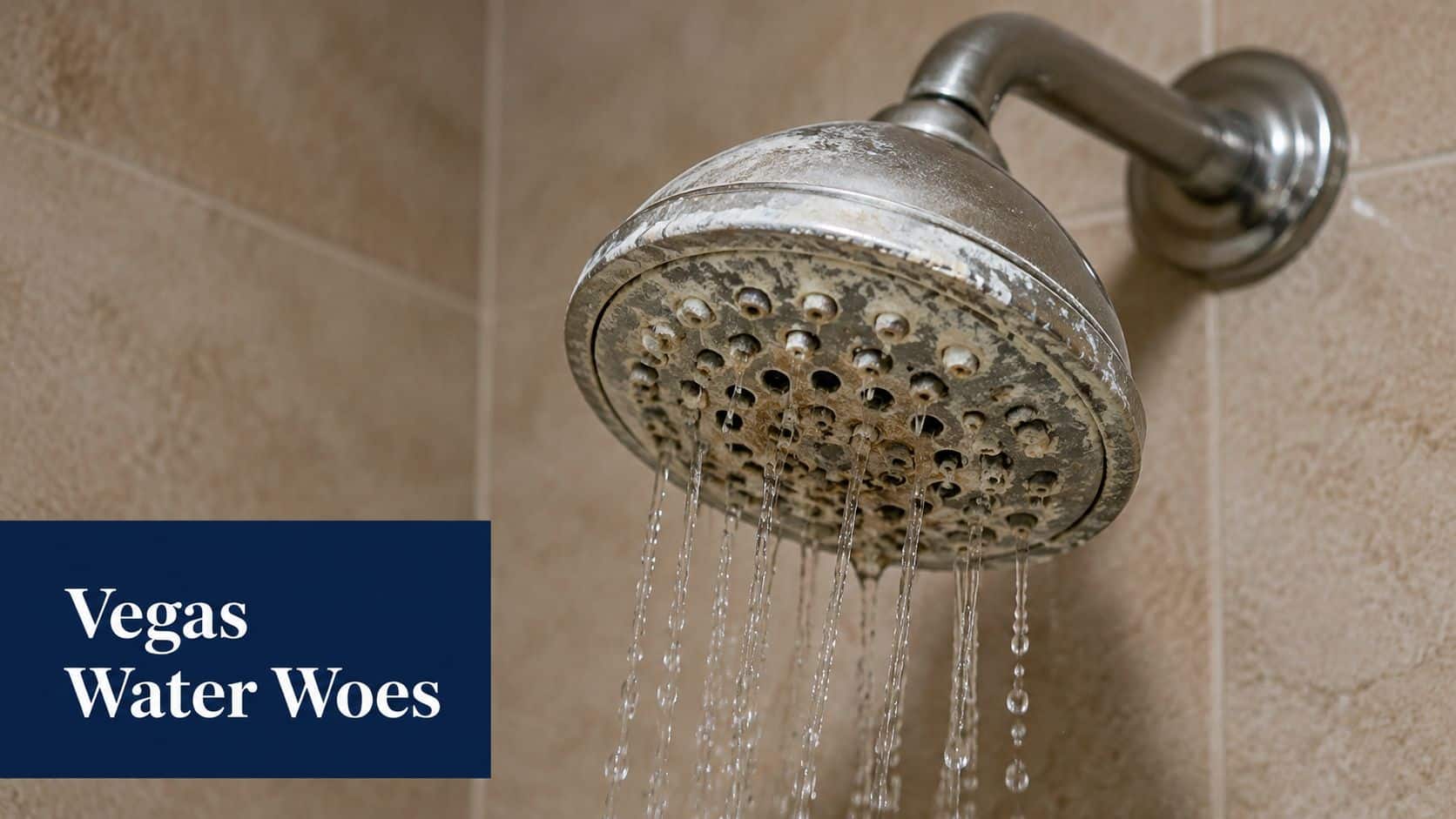
Scale forms when dissolved minerals leave the water and attach to plumbing surfaces. Heat makes that process more aggressive, which is why water heaters, hot-water outlets, and heated sections of piping often show heavier deposits. Hard-water scale guidance explains that warmed water holds less dissolved mineral content, allowing limescale to form more readily.
The desert environment adds practical stress. Las Vegas homes may have slab construction, aging galvanized or copper piping, frequent water-heater cycling, and long runs between the heater and fixtures. In older homes, scale can combine with corrosion and rough pipe interiors, giving mineral deposits more surfaces to cling to.
Field rule: White crust at a faucet is easy to clean. A restricted hot-water line or heavily scaled pipe is a different problem, and surface cleaning won't restore the inside of the system.
Scale is persistent because the incoming water keeps carrying the same mineral load. Homeowners can remove deposits from a fixture today and find them returning later if they haven't addressed the source. For broader background on recognizing hard-water effects in a household, Alderstone Water Company's hard water advice offers a useful explanation of the same basic mineral process, even though local hardness conditions vary by region.
A leak, damp wall, or unexplained moisture shouldn't be blamed on scale without testing. Mineral buildup can contribute to weakened components, but water leak detection in Las Vegas is the appropriate diagnostic path when the concern is hidden water loss rather than restricted flow.
Signs Your Pipes Are Suffering From Mineral Scale
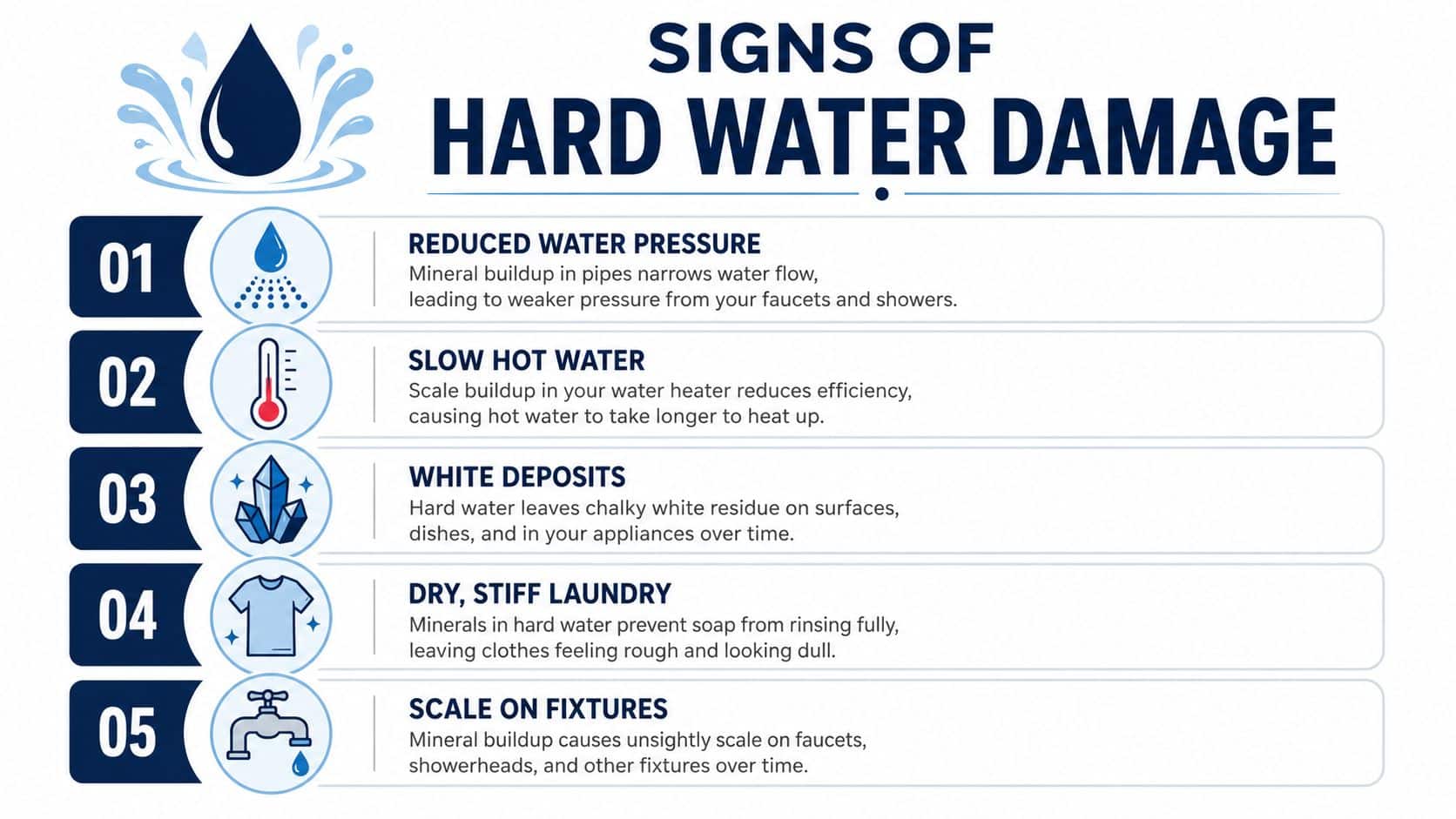
The most useful clues usually appear as a pattern rather than one isolated symptom. A crusty aerator by itself may only need cleaning. Weak pressure at several fixtures, slow hot-water delivery, and white particles after valve work suggest a system-level issue that deserves closer inspection.
What homeowners can check first
Reduced flow: Mineral deposits gradually narrow the opening inside a pipe. In older galvanized steel systems, one source reports that scale can reduce the inside diameter by 50 to 75 percent over 15 to 20 years, a condition that can produce weak showers and poor pressure at distant fixtures. See guidance on hard-water effects in older piping.
Slow hot water: If hot water reaches a fixture slowly while nearby cold-water flow remains acceptable, inspect the hot side separately. Heat encourages mineral precipitation, and water-heater outlets, hot-water recirculation paths, and narrow valves can become restricted.
White particles: The Las Vegas water district notes that white particles may be mineral deposits or scale dislodged from piping and fixtures. They aren't proof of a failed main line, but repeated particles after a valve opens, water heater service, or fixture replacement deserve attention.
Chalky fixture deposits: White rings around drains, crust on aerator screens, and deposits inside showerheads are visible evidence that minerals are leaving the water and attaching to surfaces. Cleaning the screen can restore that fixture temporarily, but it doesn't prove the supply piping is clear.
Water-heater changes: Scale on heat-transfer surfaces can reduce performance and contribute to recurring maintenance. Tankless heaters are particularly sensitive to restricted passages, while tank heaters can accumulate sediment and mineral material at the bottom.
Low-flow zones and heated surfaces are the usual trouble spots. A pipe can look acceptable at a high-flow fixture while a partly closed valve, elbow, branch line, or heater connection carries a much thicker deposit.
Laundry and glassware may also show hard-water effects, and exterior windows can develop mineral spotting. Homeowners looking for a household-care perspective can review this guide to professional window care for well water, but window cleaning won't address a plumbing restriction.
DIY cleaning is reasonable when one aerator or showerhead is affected. Remove the screen, rinse out loose material, and follow the fixture manufacturer's cleaning instructions. If several fixtures have weak flow, recurring particles, or slow hot water, drain cleaning in Las Vegas may be relevant for drainage symptoms, but a supply-side restriction requires a different diagnosis.
How a Plumber Diagnoses Scale Versus Corrosion or Sediment
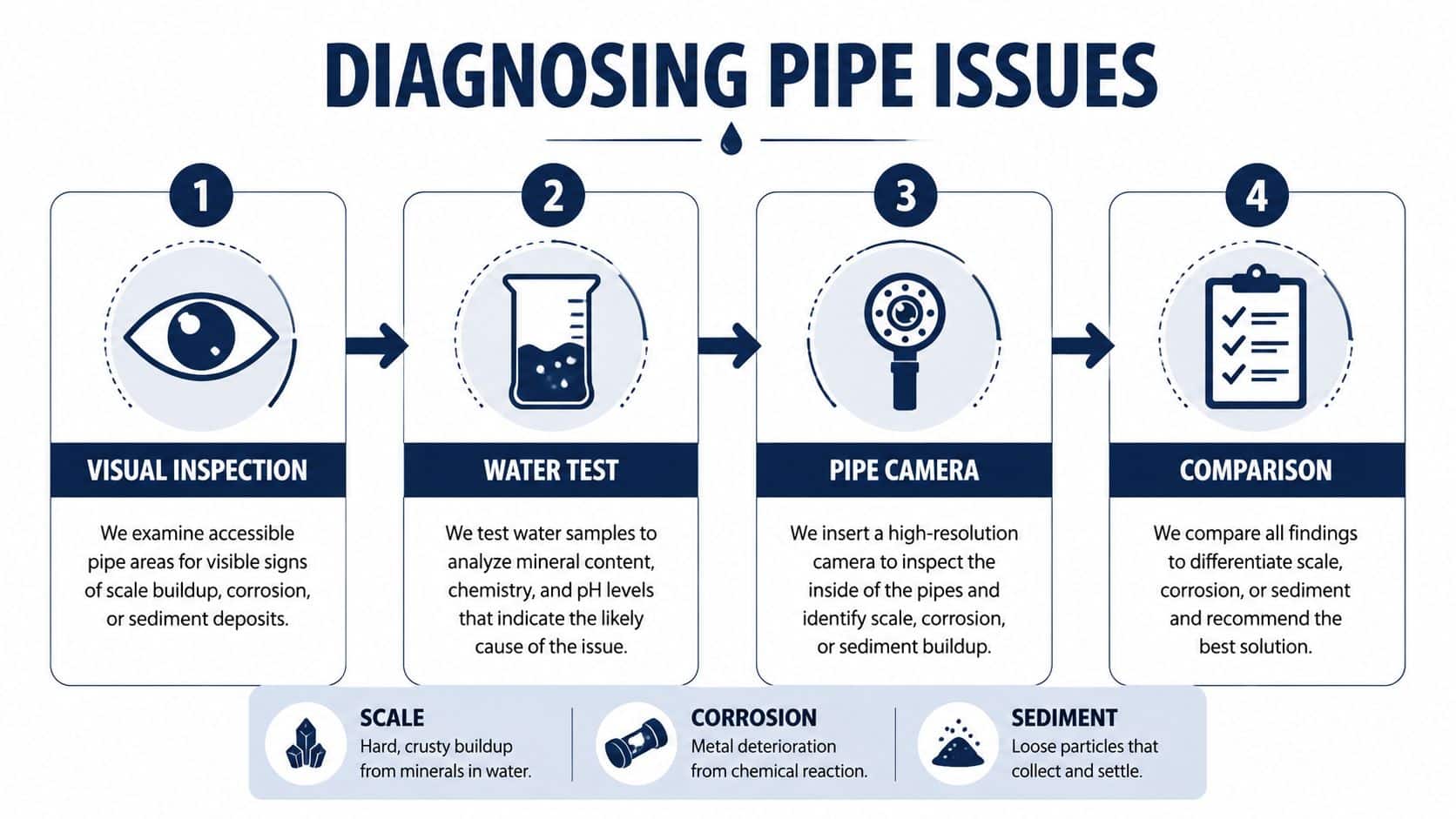
Reduced pressure doesn't identify the material causing the restriction. Mineral scale is usually hard and chalky, corrosion can create rust-colored water and irregular pipe deterioration, and sediment may collect in tanks, valves, or low points without adhering as firmly to the pipe wall.
A sound diagnosis starts by separating those possibilities instead of selling treatment first.
The diagnostic sequence
Map the symptoms. A plumber checks whether the pressure problem affects hot water, cold water, one fixture, one branch, or the entire home. White crust at aerators points toward hard water, while rust-colored water, leaks, or a metallic appearance may indicate corrosion or disturbed pipe material.
Verify the water. Hardness should be checked with a meter or laboratory test rather than assumed from a sales presentation. Local reporting places Las Vegas hardness around 291 ppm, or 17 grains per gallon, in one district summary, which supports a strong scaling risk but doesn't prove that scale is blocking a particular pipe. That distinction matters.
Inspect the accessible components. Removing an aerator, shower cartridge, angle stop, or valve can reveal whether the restriction is at the fixture or deeper in the branch line. A plumber also checks pressure before and after the suspected restriction and compares readings at multiple locations.
Use a camera when access allows. A sewer or pipe camera can show whether the interior is coated with mineral scale, rough from corrosion, obstructed by sediment, or affected by another condition. Camera work is especially useful before recommending replacement, because a softener won't repair corroded pipe and descaling won't solve a damaged line.
Practical rule: A water test tells you what the supply can cause. A camera and pressure comparison help show what the plumbing has actually developed.
The same reasoning applies to drain symptoms, although drain lines have different causes. For general reference on professional sewer and drain diagnosis, Piper Plumbing's drain and sewer resource discusses diagnostic service in another market. In Las Vegas homes, sewer camera inspection and locating can help distinguish scale, corrosion, roots, and other obstructions where the camera can reach the affected line.
A camera isn't a magic answer. Heavy deposits, inaccessible supply piping, and certain slab-routed lines can limit visibility. When a camera can't reach the area, pressure testing, fixture teardown, selective pipe exposure, and comparison between affected and unaffected branches can still narrow the cause.
Repair and Treatment Options Compared
Once scale is confirmed, the correct option depends on the condition of the pipe, not just the hardness number. Descaling can recover usable flow from a restricted line, a softener or scale-control system can reduce future deposition, and repiping may be necessary when corrosion and mineral damage have left the pipe unreliable.
The main mistake is expecting one treatment to perform all three jobs.
| Option | What It Fixes | What It Does Not Fix | Best For |
|---|---|---|---|
| Mechanical or hydraulic descaling | Removes or breaks up deposits that restrict flow | Doesn't stop new scale if the incoming water remains hard, and won't rebuild corroded pipe | Serviceable piping with confirmed mineral restriction |
| Whole-house water softening or conditioning | Reduces the mineral conditions that create future scale | Doesn't restore heavily narrowed, cracked, or corroded piping | Homes that need ongoing protection for fixtures, heaters, and supply lines |
| Partial or full repiping | Replaces piping that is severely deteriorated or no longer reliable | Doesn't change the hardness of replacement water | Old, damaged, repeatedly failing, or inaccessible systems where cleaning isn't a durable answer |
Mechanical cleaning may involve a descaling tool, chain knocker, or controlled hydraulic cleaning, depending on the pipe material and location. Hydro jetting is more commonly associated with drain and sewer lines, where high-pressure water can remove deposits and restore the passage. The technician must choose equipment carefully, since aggressive cleaning against fragile or heavily corroded piping can expose weaknesses that deposits were temporarily masking. Hydro jetting service information is useful when the buildup is in an accessible drain or sewer line rather than a small interior supply tube.
Research on crystallization inhibitors for copper pipe reported 82.8% to 95.0% reduction in calcium carbonate scale formation after 48 hours at 30°C, depending on calcium concentration, as documented in Water Research Commission material on scale control. That finding supports prevention at the water source, but it shouldn't be misread as proof that an installed treatment system will remove old deposits from every home.
What softening cannot do: It won't magically restore a pipe that has already lost usable diameter or suffered corrosion.
Descaling can improve performance without replacing the system, but recurrence remains likely if hardness continues entering untreated. Repiping offers a cleaner long-term starting point, yet it brings disruption, access issues, and decisions about how much of the home to replace. A professional should explain whether the recommendation targets an isolated branch, a heater connection, the main supply, or a broader aging-pipe problem.
Prevention Steps and When to Call a Professional
Prevention starts with routine observation. A homeowner doesn't need specialized equipment to notice a faucet screen that clogs repeatedly, a shower that weakens, or hot water that takes longer to arrive. Those changes are more useful when recorded by fixture and date, because the pattern helps a plumber determine whether the restriction is local or system-wide.
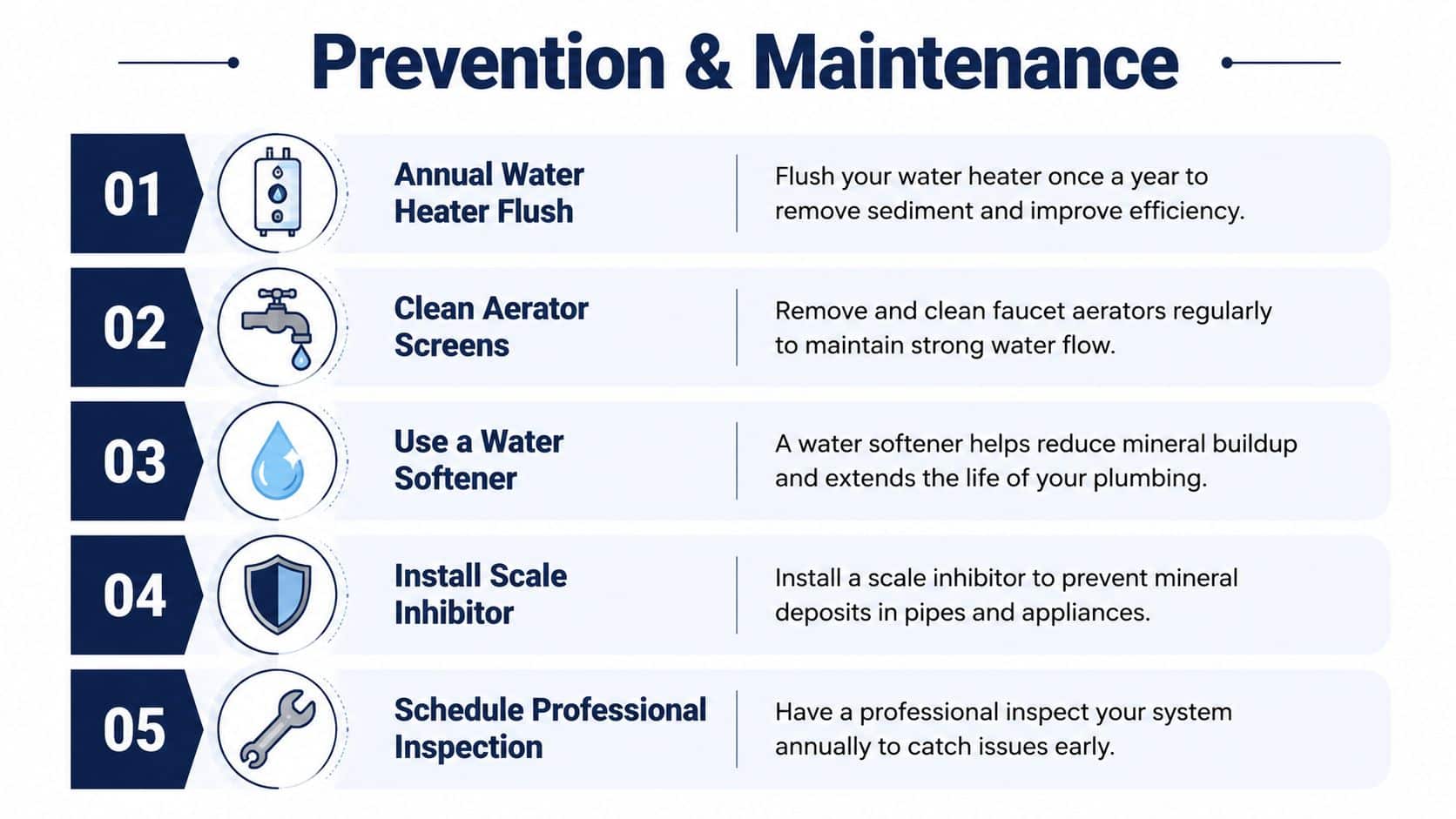
Maintenance that helps
Flush and service the water heater: Follow the heater manufacturer's maintenance guidance. Flushing can remove loose sediment, but it won't dissolve thick scale bonded to heat-transfer surfaces or repair a damaged tank.
Clean aerator screens: Unscrew faucet aerators, rinse loose particles, and inspect the screens. If the same fixture clogs again soon, look for an upstream restriction rather than repeatedly treating the symptom.
Evaluate whole-house treatment: A softener addresses hardness at the source. A scale inhibitor or conditioning system may target deposition differently, so the equipment should match the water chemistry and the home's plumbing needs.
Watch pressure changes: Compare an affected fixture with one that still performs normally. A broad decline suggests more than a dirty showerhead, especially when hot and cold sides behave differently.
Schedule targeted inspection: A camera, pressure test, or fixture teardown is more useful than guessing when several fixtures show reduced flow, white particles keep returning, or water changes color.
Homeowners can safely clean removable screens and document symptoms. They shouldn't open pressure-regulating equipment, alter a water heater's safety controls, or use harsh acids inside piping without understanding the material and discharge requirements. A chemical treatment that works on a removable fixture can damage finishes, seals, or older pipe components when used improperly.
Call a residential plumber when reduced flow affects more than one fixture, hot-water delivery changes across the home, a valve or heater releases recurring particles, or discolored water continues after flushing. Early diagnosis can preserve serviceable piping. Waiting until a line fails may turn a manageable restriction into a leak, water-heater problem, or disruptive replacement.
Get a Professional Diagnosis Before Scale Causes Major Damage
Hard-water buildup in Las Vegas pipes is common, but a hard-water reading alone doesn't tell you what repair your home needs. The same weak shower can come from a clogged cartridge, a scaled branch line, corroded galvanized piping, a failing pressure regulator, or a problem near the water heater.
That's why a camera inspection, pressure comparison, and fixture-level evaluation often provide more value than starting with a softener sales pitch. Softening can limit future mineral deposition, but it won't restore severely damaged pipe. Descaling may improve flow, but it won't stop recurrence or correct corrosion. Replacement makes sense when the pipe has become unreliable, not because the water is hard.
MG Drain Services LLC is a licensed and insured, family-owned, owner-operated residential plumbing company serving Las Vegas, Henderson, North Las Vegas, Summerlin, and nearby communities. Owner Miguel Garcia is a Nevada-licensed C-1d plumbing contractor and journeyman plumber with more than 25 years of plumbing experience, and the company uses professional camera, hydro-jetting, locating, and leak-detection equipment to identify the cause before recommending repair.
If your home has recurring white particles, declining pressure, slow hot water, or fixture restrictions that keep returning, call 702-480-8070 to arrange a focused evaluation.
MG Drain Services LLC can inspect hard-water-related restrictions, evaluate supply and drain piping, service water heaters, and discuss descaling, treatment, or replacement based on the actual condition of your plumbing. Visit MG Drain Services LLC to request residential plumbing service in the Las Vegas Valley, or call 702-480-8070 to schedule a professional diagnosis.