

A Summerlin homeowner notices a chalky white ring around the kitchen faucet, then finds the shower spray pattern getting weaker. The water heater still works, but it rumbles during recovery and the hot water doesn't last as long as it used to. Those symptoms often have the same local cause: hard water damage in the Las Vegas Valley.
Las Vegas Valley tap water is consistently classified as very hard. The Las Vegas Valley Water District lists hardness at 291 parts per million, or 17 grains per gallon, while another district FAQ lists 280 parts per million, or 16 grains per gallon. The utility's water-quality information explains that dissolved calcium and magnesium enter the supply through the Colorado River and Lake Mead. That water can be safe to drink while still creating a long-term plumbing and appliance problem.
What Hard Water Actually Does to a Las Vegas Home
Hard water doesn't damage a home because the water is dirty. It damages plumbing because dissolved minerals leave the water as conditions change. Heating, splashing, aeration, and evaporation encourage calcium and magnesium compounds to settle on surfaces, producing the white or tan scale homeowners see around faucets and inside equipment.
At roughly 17 grains per gallon, Las Vegas Valley water is well into the very-hard range, and the local utility advises homeowners to set a softener around that hardness level in its hard-water guidance. A 2024 report cited by a Nevada water-industry publication placed the Las Vegas Valley Water District's average hardness at 304 parts per million across its main treatment plants, reinforcing that this isn't an occasional neighborhood nuisance. It's the normal mineral load moving through many Southern Nevada homes.
The three consequences that matter
Scale creates problems in three connected ways:
- Restricted flow: Deposits reduce the usable opening in aerators, showerheads, valve seats, supply passages, and sections of pipe. A fixture may still have water pressure at the house, but the outlet can't pass the same volume.
- Reduced water-heater performance: Mineral deposits collect on heating surfaces and at the bottom of tanks. The layer acts as insulation, so the heater works harder to transfer heat into the water.
- Premature component wear: Mineral particles can interfere with cartridges, fill valves, angle stops, dishwasher parts, washing-machine screens, and appliance connections. Repeated movement can also loosen deposits, sending white particles downstream.
The damage usually accumulates gradually. A faucet may only need cleaning at first. Later, the homeowner may need a cartridge, shutoff valve, supply line, heater service, or treatment change because the source was never addressed.
Practical rule: A clean faucet aerator is a symptom fix. If it clogs again quickly, inspect the whole water system instead of repeating the same cleaning.
The useful question isn't “Is my water hard?” It is, “Where is scale forming, and what is it doing there?” The answer determines whether cleaning, a repair, heater descaling, softener adjustment, or a broader plumbing inspection makes sense.
Where Scale Shows Up First in Las Vegas Plumbing
Scale usually announces itself at the smallest openings first. A faucet aerator, showerhead nozzle, or appliance screen has a narrow passage, so even modest mineral accumulation changes the flow pattern. White chalk around a spout is easy to see, but it can also be the first visible clue that deposits are affecting less accessible components.
Read the symptom by location
At the sink, remove the aerator and look for a brittle white coating or loose grains. On a showerhead, uneven spray usually means individual nozzles are partially blocked. Those are surface deposits, but they tell a plumber whether the problem is isolated to one fixture or appearing throughout the house.
The next group of trouble spots includes dishwasher spray arms, washing-machine inlet screens, refrigerator water connections, and toilet fill valves. These components use small passages and moving seals. Restricted flow, slow filling, or a dishwasher that no longer sprays evenly can point to mineral fouling rather than a drain obstruction.
Hot-water equipment is where scale becomes more expensive. The bottom of a tank-style heater can collect sediment, while electric elements develop a hard coating that slows heat transfer. The first few feet of hot-water piping can also accumulate deposits, especially where water repeatedly heats and cools. Tankless heaters face a related problem inside the heat exchanger, where restricted passages and mineral coating can reduce heat transfer.
For larger equipment decisions, a homeowner may find it useful to compare 100-gallon gas models, but capacity alone doesn't solve mineral buildup. The correct repair still depends on the home's water chemistry, heater type, flow demand, and condition.
| Symptom | Likely Scale Location | Mechanism |
|---|---|---|
| White crust and uneven faucet flow | Aerator, spout screen, cartridge inlet | Deposits narrow small passages and disturb the stream |
| Weak or irregular shower spray | Showerhead nozzles and flow restrictor | Mineral coating blocks individual outlets |
| Slow dishwasher or washing-machine fill | Inlet screen, valve passage, or spray arm | Scale limits incoming or circulating water |
| Toilet that refills slowly | Fill-valve inlet and internal seal | Deposits restrict the valve's opening |
| Rumbling or popping from a tank heater | Tank bottom or heating element | Sediment and scale interfere with heat transfer |
| Weak hot-water flow at several fixtures | Hot-water pipe, heater outlet, or valve | Deposits reduce the available passage area |
If several hot fixtures show the same problem, the issue is less likely to be one dirty aerator. A plumber may need to inspect the heater, pressure conditions, shutoff valves, and interior piping. For a suspected heater problem, review the Las Vegas water heater repair service rather than treating repeated outlet cleaning as a permanent repair.
How a Plumber Diagnoses Hard Water Damage
A proper diagnosis separates hard-water scale from unrelated problems. Low flow can come from a clogged aerator, a failing pressure-reducing valve, a closed shutoff, a leaking pipe, municipal pressure changes, or interior deposits. A plumber shouldn't recommend a softener or pipe work until the pattern supports that conclusion.
The diagnostic sequence
Confirm the incoming hardness. A technician can use a test strip or titration kit, then compare the result with the local supply benchmark. Homeowners who want to collect an initial reading can review this practical guide to test water hardness at home. The important point is to test water entering the home, not only water after a treatment device.
Inspect aerators and showerheads. Removing these parts reveals whether the restriction is mineral scale, debris, damaged rubber, or a failing cartridge. A housewide pattern matters more than one dirty outlet.
Measure static and flowing pressure. A gauge at an outdoor hose bib can show pressure with no fixtures running and pressure while water is flowing. If pressure drops sharply, the plumber investigates the pressure-reducing valve, supply restriction, leak, or piping condition instead of blaming hardness automatically.
Isolate fixtures at the angle stops. Closing and reopening individual supplies helps identify whether one branch is restricted or the entire home has a flow problem. A crusted angle stop can fail internally even when its handle still turns.
Evaluate the water heater. The inspection may include the anode rod, a tank-drain sample, element resistance on an electric unit, or burner operation on a gas unit. Sediment, scale, corrosion, and heating-component failure produce different clues and require different repairs.
A camera inspection can help when symptoms suggest hidden piping damage, but a camera doesn't replace pressure testing or fixture isolation. If the concern involves concealed lines or a suspected obstruction, a plumber may also use sewer camera inspection equipment where the plumbing layout and access make that appropriate.
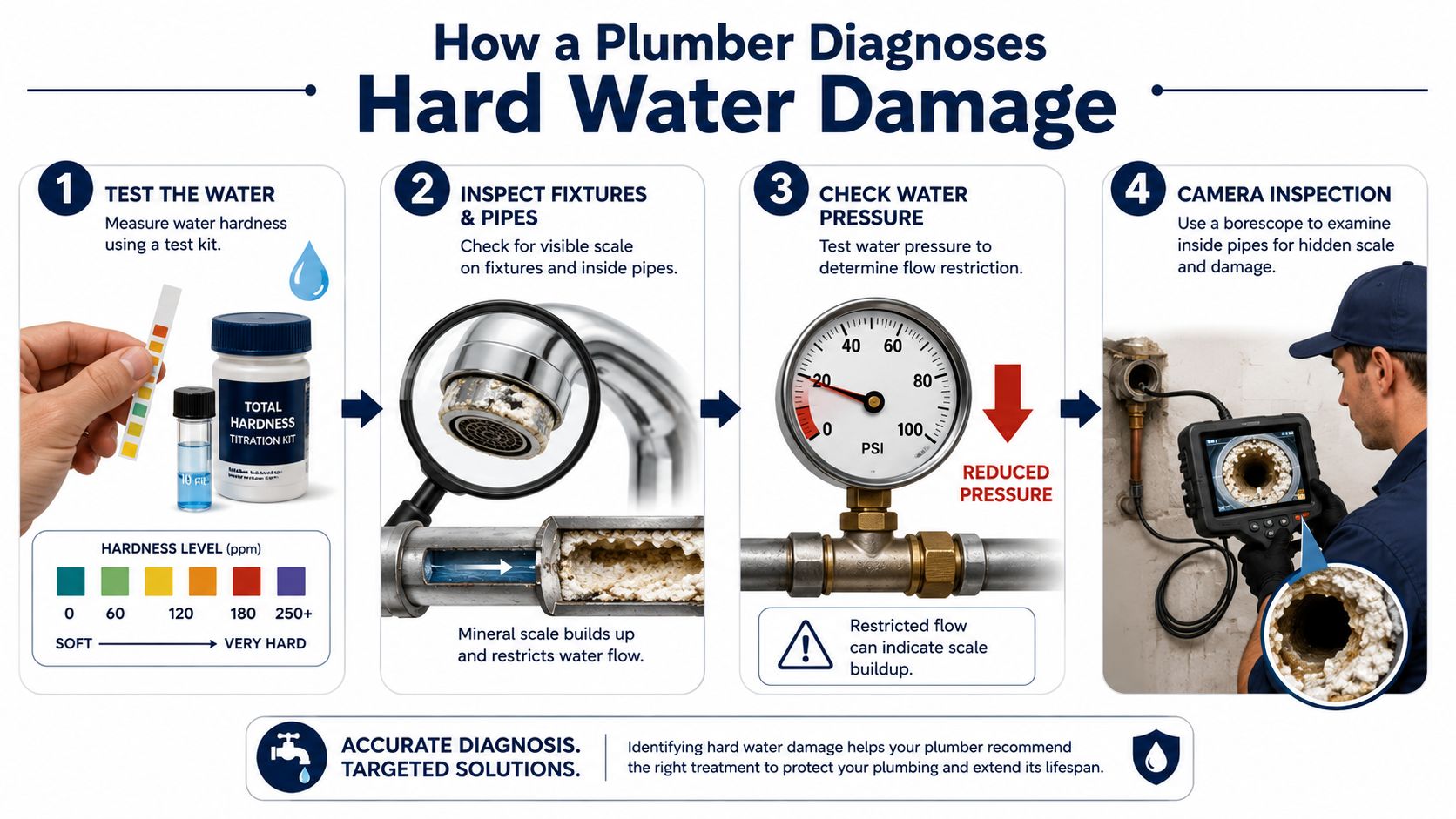
The goal is to match the repair to the mechanism. A clogged aerator needs cleaning or replacement. A pressure problem needs pressure diagnosis. A scaled heater needs service or replacement assessment. A softener needs calibration based on measured inlet hardness and household demand.
Safe DIY Steps for Las Vegas Homeowners
Visible scale is a reasonable DIY target if the fixture is accessible and no pressurized connection needs to be forced. Start by shutting off the fixture's local supply when possible. Unscrew the faucet aerator by hand or with a cloth-covered wrench, keeping track of the screen and rubber gasket.
Soak removable aerators and showerheads in white vinegar, then brush away softened deposits with an old toothbrush. A showerhead may also need its flow restrictor cleaned if the part is designed for removal, but don't drill it out or permanently alter the fixture. After rinsing, reinstall the parts and check for leaks.
A short surface-cleaning routine
- Faucet and fixture surfaces: Spray a 50/50 mixture of white vinegar and water onto early crust, let it work briefly, then wipe and rinse. Don't leave vinegar on delicate stone, unsealed grout, or finishes that the manufacturer says are acid-sensitive.
- Coffee equipment: Run the manufacturer's descaling process on a kettle-style coffee maker. Follow the appliance instructions, rinse thoroughly, and don't assume a coffee-machine cycle treats household plumbing.
- Softener settings: Check the salt level, look for a hard bridge in the brine tank, confirm the bypass valve is open, and verify the hardness setting on the digital metered valve.
- Water testing: Use a drop-test kit covering 0 to 25 grains per gallon if that's the kit available from a local hardware store. Compare the result before and after treatment, and follow the kit directions carefully.
A softener that has salt in the tank can still fail to soften if a bridge prevents brine from forming, the valve is in bypass, or the hardness setting is too low. The local utility's 17 gpg benchmark is a useful starting point, but actual inlet water should guide calibration.
Vinegar removes accessible surface calcium. It can't reach scale inside a water heater, a tankless heat exchanger, or a long run of half-inch supply line.
This routine generally takes about 45 to 90 minutes, depending on how many fixtures need attention. Gather vinegar, a bucket, an old toothbrush, a soft cloth, adjustable pliers, replacement aerator gaskets, and the hardness kit. Stop if a fitting starts twisting in the wall, a valve won't shut off, a heater drain leaks, or you find active water damage. For uncertain moisture around cabinets, walls, or slabs, use professional water leak detection rather than opening concealed connections.
Professional Repairs and Water Treatment Options
Once scale has moved beyond removable fixture parts, the repair needs to address the affected component and the source water. A licensed plumber may flush a tank-style heater, circulate food-grade citric acid through a tankless heat exchanger, rebuild a faucet, replace a restricted supply line, or assess whether older piping can be treated safely.
A tank-style heater flush removes loose sediment through the drain port. Full descaling may involve circulating 2 to 4 gallons of food-grade citric acid with a submersible pump, and the service can take about 90 minutes, depending on access and the heater's condition. Tankless service requires a dedicated isolation-valve loop so the descaling solution passes through the heat exchanger instead of entering the home's fixtures.
The anode rod deserves attention during heater service. In hard-water conditions, a magnesium rod may be exhausted in 4 to 6 years, compared with 8 years in soft-water regions, according to the supplied trade guidance. The rod's condition helps determine whether a heater is a candidate for continued maintenance or is already showing broader corrosion.
Repair choices depend on the failure
A faucet cartridge may need replacement when calcium has pitted internal ports or damaged seals. Moen and Delta cartridges are common examples, but the correct replacement depends on the faucet model. A supply line with significant internal restriction should be replaced rather than repeatedly cleaned, especially if the connector or shutoff also shows corrosion.
Treatment must be sized from hardness and demand, not home size alone. At 17 gpg, a household of 3 to 4 people may use roughly 6,800 to 8,500 grains per day, based on the supplied sizing guidance. An ion-exchange softener removes calcium and magnesium but uses salt and requires regeneration. Template-assisted crystallization may appeal to owners who reject salt, but it controls scale differently and doesn't create conventionally softened water.
Reverse osmosis is better suited to point-of-use drinking water than whole-house scale control. A softener also doesn't remove chlorine or repair a pressure problem. For broader background on treatment categories, this guide to hard water filtration can help homeowners compare approaches before discussing a system with a plumber.
| Option | Best For | Typical Cost (Las Vegas) | Service Life |
|---|---|---|---|
| Fixture cleaning or cartridge replacement | Isolated faucet or shower restriction | Varies by part and labor | Depends on water treatment and component condition |
| Tank water-heater flush or descale | Sediment, rumbling, or reduced heating performance | Varies by heater type and service scope | Maintenance service, not a permanent water-treatment solution |
| Tankless heat-exchanger descaling | Mineral restriction inside a serviceable tankless unit | Varies by access and equipment | Recurring maintenance need |
| Ion-exchange softener | Whole-home calcium and magnesium control | Varies by capacity and installation | Requires ongoing salt, testing, and service |
| Template-assisted crystallization | Scale reduction for owners avoiding salt | Varies by equipment and installation | Media and system life depend on product and water conditions |
| Reverse osmosis | Drinking and cooking water at one point of use | Varies by system and installation | Requires filter and membrane maintenance |
MG Drain Services LLC handles residential plumbing diagnosis, water-heater service, fixture repairs, and water-treatment recommendations in the Las Vegas Valley. Drain service, including Las Vegas drain cleaning, may be part of a broader plumbing evaluation when mineral debris and unrelated drainage symptoms occur together, but drain cleaning won't soften incoming water.
Preventing Hard Water Damage Year After Year
Hard-water prevention works best as a routine rather than a reaction to a failed heater or seized faucet. Keep a simple calendar for the home, record what you find, and connect each check to a symptom. That turns white crust, weak flow, and inconsistent hot water into early warnings instead of surprises.
Quarterly checks
- Inspect visible restrictions: Remove or examine faucet aerators, showerheads, and appliance screens for fresh white buildup. Rapid recurrence suggests the treatment system needs attention.
- Test the hot side: Run the kitchen hot-water faucet for two minutes and observe flow. A noticeable reduction compared with the cold side points toward a heater outlet, hot-water valve, or hot-side piping restriction.
- Check the brine tank: Keep salt above the water line, look for bridging, and confirm that the bypass valve hasn't been left closed after service.
- Look at shutoffs: White crust around angle stops or supply-line connections deserves attention before a valve refuses to operate or begins leaking.
Annual and longer-cycle work
Flush a tank water heater before the home's heavier hot-water season. The flush helps remove loose sediment, while a professional assessment determines whether deposits have bonded to the heating surface or whether the tank is already deteriorating.
Test the softener output annually with a drop test. The supplied maintenance plan uses an outlet target below 3 gpg, but the test must be performed according to the equipment and kit instructions. If the result remains high, check the hardness setting, regeneration programming, brine draw, and bypass position before replacing equipment.
Inspect the heater anode rod every five years, and consider servicing angle stops and faucet cartridges before mineral deposits seize them. A heater that trips its reset, a shower that develops a cold-water sandwich, or a faucet that begins to bind can each point to a different maintenance need.
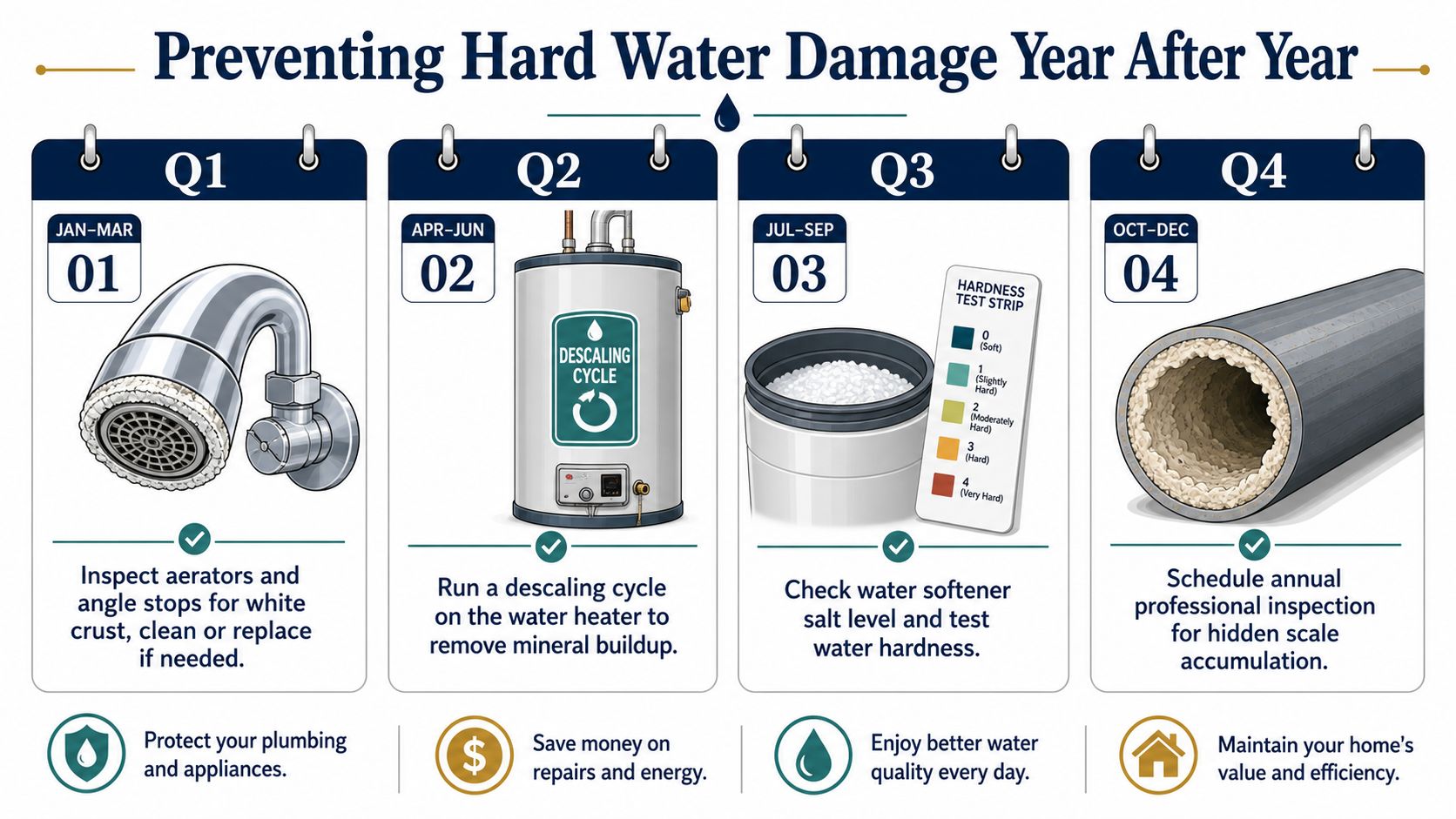
The simplest prevention is also the one homeowners skip most often. Keep the softener supplied and correctly programmed, then verify its output instead of assuming the display means the water is treated. An empty brine tank or an open bypass valve can leave the whole home exposed even when the equipment appears installed correctly.
When to Call MG Drain Services LLC
Call a residential plumber when the same symptom returns after reasonable cleaning. Repeatedly clogged aerators, heater popping that comes back after a flush, crusting around angle stops or supply lines, premature fixture failure, and unexplained pressure drops all suggest a condition beyond surface maintenance.
Don't force a stuck shutoff or remove a heater element from a full, energized tank. Water and electricity create a serious hazard, and a leaking connection can damage cabinets, walls, or slab areas before the source is obvious. Stop DIY work if the main shutoff doesn't close, a heater drain won't reseal, or moisture continues after a fixture is turned off.
Bring useful information to the appointment
Have the home's known hardness reading, softener age, salt-use pattern, water-heater age, and list of affected fixtures ready. Note whether the restriction affects hot water, cold water, or both. Photos of scale, the softener display, and the heater label can also help the technician prepare.
MG Drain Services LLC is a local, family-owned, owner-operated residential plumbing company serving Las Vegas, Henderson, North Las Vegas, Summerlin, and nearby Valley communities. The company is licensed and insured, provides bilingual service, and handles residential water-heater assessment, descaling, fixture rebuilds, leak detection, pressure concerns, and water-treatment sizing. Se habla español.
The right repair depends on what testing finds. A faucet may need a cartridge, a heater may need descaling or replacement assessment, and a softener may need calibration rather than replacement. A professional diagnosis keeps those decisions separate so you aren't paying for a treatment system to solve a pressure problem or cleaning a fixture while the whole-home source remains untreated.
If recurring scale is affecting your faucets, hot-water system, pressure, or softener, contact MG Drain Services LLC for a residential plumbing assessment in the Las Vegas Valley. Call 702-480-8070 to discuss the symptoms, or visit the website to request service and get a practical recommendation based on your home's actual plumbing condition.