
Most homeowners searching for plumbing in homes built by specific local builders start with the builder's name. That's understandable, but it's usually the wrong first question. A familiar builder name doesn't tell you whether the house has cast iron under the slab, copper supply lines, PEX with older fittings, or a partial repair hiding a failing section in the yard.
The useful questions are more specific: What year was the home built? Which pipe materials were standard at that time? Where are the buried transitions, cleanouts, and under-slab lines? In Las Vegas, hard water, slab construction, soil movement, mature landscaping, and years of piecemeal repairs can make two homes with the same floor plan fail in completely different ways.
Why the Builder Name Matters Less Than You Think
The builder's name on a Las Vegas tract home rarely explains why that house is calling a plumber. Homes built in different phases of one subdivision can contain different pipe materials, suppliers, inspection requirements, and repair histories. A later phase may follow a code or material change, while the first homes on the street still have older drain or supply systems.
Construction era gives a more useful starting point. A 2025 overview of historic residential plumbing materials describes early indoor systems that commonly used lead, cast iron, brass, and steel. Copper tubing was introduced around 1927 and eventually represented about 90% of indoor water piping, with more than 5.7 million miles installed in U.S. homes and commercial buildings. Those shifts affect what a plumber expects to find behind the walls, below the slab, and at buried connections.

Four conditions shape the risk
For a Las Vegas homeowner, plumbing performance usually comes from four overlapping conditions:
- Pipe era: The construction period narrows the likely material choices.
- Water chemistry: Mineral-heavy water can restrict valves, fixtures, water heaters, and piping.
- Slab construction: Buried drain and supply lines can fail without leaving visible evidence.
- Ground and landscaping conditions: Soil movement and tree roots can affect underground sewer sections.
Two identical floor plans can therefore fail in very different ways. Hard water may leave one home with restricted fixtures, while slab-buried piping or a damaged sewer section creates the main problem in the other. A remodel can add another layer by joining newer material to older pipe at concealed transition points.
A general inspection can document visible conditions, but it may not show the buried sewer line. A separate sewer scope can identify cast iron or clay deterioration, low spots, root intrusion, offsets, or partial collapses. For help connecting symptoms to the home's actual piping, contact a Las Vegas plumbing professional who can connect the home's symptoms to its actual piping, rather than relying on the builder name alone.
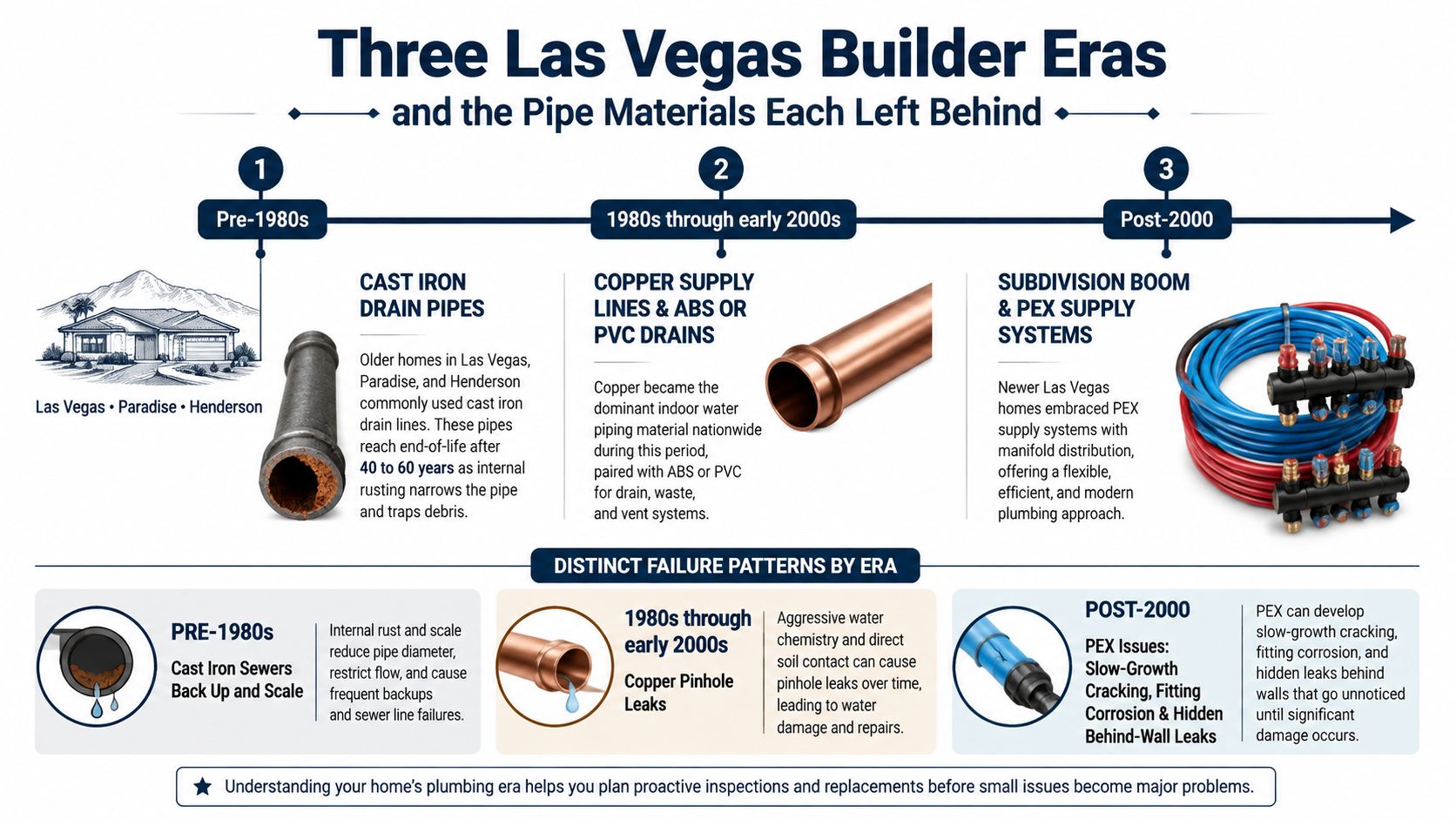
Three Builder Eras and the Pipe Materials Each One Left Behind
Las Vegas tract homes fall into three practical plumbing eras based on their construction period. The likely pipe material narrows the diagnostic path, although remodels and subdivision practices can alter the original installation.
Pre-1980s homes
Older homes in parts of Las Vegas, Paradise, and Henderson commonly still have cast iron drain lines under the slab. Local guidance on cast iron drain lines notes that these lines can reach end of life after roughly 40 to 60 years. Rust forms inside the pipe, narrowing the opening and giving paper or grease a rough surface to catch on. Typical symptoms include slow kitchen drains, repeated bathroom backups, gurgling, and a main line that needs cleaning repeatedly.
A camera inspection separates a localized blockage from corrosion, deformation, or a separated joint. That finding determines whether a spot repair is reasonable or replacement with ABS is the better fit.
1980s through early 2000s homes
Many homes from this period use copper for water distribution and ABS or PVC for drainage, though the exact installation depends on the subdivision and any later remodeling. Copper can provide long service, but leaks may develop at joints or concealed runs, especially where water and soil conditions affect the pipe. Mineral buildup can restrict valves and fixtures before the copper itself fails.
During a remodel, homeowners comparing which pipe is better for remodeling also need to evaluate access, material compatibility, water conditions, and local installation requirements. A practical choice is the one that can be installed, supported, and repaired without creating hidden transition problems.
Post-2000 subdivision construction
Later subdivision homes commonly shifted toward PEX supply systems, often arranged around a manifold. PEX reduced concealed connections in some layouts, but manifolds, fittings, and exposed transitions still require inspection. Residential PEX failures have been associated with slow-growth cracking, oxidative failure, creep rupture, and fitting corrosion, with leaks sometimes occurring inside walls and damaging drywall, flooring, or cabinetry, as documented in a federal court record discussing PEX failure allegations.
Start at exposed manifolds, under-sink runs, and water-heater connections. Check manufacturer markings, discolored fittings, corrosion, and recurring leak history. If the buried supply has failed, Las Vegas main water line replacement guidance may point to a different access and repair decision than an interior PEX fitting repair.
How Las Vegas Hard Water Shortens the Life of Builder-Grade Plumbing
The pipe material gets the attention, but Las Vegas water chemistry often determines which components fail first. The Las Vegas Valley Water District reports that local water measures 291 parts per million, or 17 grains per gallon, and is classified as very hard.
Minerals collect on toilet fill valves, flush valves, shower cartridges, water-heater components, supply stops, and pipe interiors. That creates recurring fixture problems even in newer homes with modern layouts and materials.
Where scale usually shows first
Look for these symptoms:
- Toilets: A fill valve that sticks, runs, or refills slowly may be restricted by mineral buildup.
- Showers: Reduced flow or temperature changes can point to a clogged cartridge or supply path.
- Water heaters: Sediment and scale can reduce heating performance and cause noisy operation.
- Faucets and stops: White deposits, stiff handles, and weak flow commonly indicate mineral accumulation.
- Drains: Scale and rough interiors give debris more places to catch, especially in older drain systems.
A single toilet valve usually calls for a replacement. Several unrelated fixture failures, a whole-house pressure drop, or repeated water-heater trouble deserves a system review. Check whether the home has had water treatment, then inspect accessible shutoff valves, water-heater connections, and exposed piping.
The outside hose bib provides a useful comparison. If indoor fixtures show white particles or scale, testing the hose bib helps determine whether the restriction is inside the home or already present in the incoming water.
Two identical homes in one subdivision can reach different failure points years apart. For example, a treated home may continue operating after routine valve replacements, while its neighboring home develops slow toilets, restricted shower flow, and a noisy water heater because deposits were left in place. Homeowners who treat hard water consistently tend to see fewer unrelated fixture failures over time.
How a Plumber Actually Diagnoses These Homes
A reliable diagnosis follows evidence. It doesn't start with excavation, a wall opening, or a promise that another drain-cleaning cycle will solve the problem.
For suspected sewer trouble
The first useful question is whether the blockage is local or part of the main line. A plumber may run a sewer camera from the nearest accessible cleanout, then look for:
- Corrosion and heavy internal scaling
- A separated or offset joint
- A low spot holding water
- Root intrusion
- A localized obstruction
- Deformation or partial collapse
The camera should be paired with locating equipment when the line's depth and position matter. That information helps determine whether a repair belongs in the yard, under the slab, or at a particular transition point. It also prevents unnecessary digging based on symptoms alone.
For this kind of evaluation, sewer camera inspection in Las Vegas provides the right diagnostic category, especially when a drain has already been cleaned and the backup returns.
For suspected slab supply leaks
Turn off every fixture and appliance that may use water. Then watch the water meter.
Practical rule: If the meter continues moving after all water is off, the home likely has a leak in the plumbing system rather than a fixture that was left running.
That test doesn't identify the leak location, and it doesn't replace pressure testing. It does tell the plumber whether there's a reason to pursue leak location before opening a wall or slab. A professional may then isolate hot and cold lines, test pressure, use acoustic or electronic detection equipment, and identify the likely path of the concealed pipe.
For pressure and hot-water complaints
Pressure problems require isolation. The plumber checks accessible valves, the pressure-reducing valve, water-heater connections, fixture cartridges, and restrictions in the distribution system. A water heater complaint may also require checking the unit's condition and anode, rather than replacing a faucet that only appears to be affected.
A real diagnostic gives you a cause, a location when possible, and repair choices. “It's old” may be part of the explanation, but it isn't enough to choose between cleaning, spot repair, repiping, or replacement.
Two Real Scenarios From Las Vegas Tract Homes
A 1978 single-story home in Spring Valley can develop a buried-drain failure that looks like an ordinary clog. The homeowner may report repeated kitchen and bathroom backups while the fixtures appear normal. Camera footage can reveal heavy cast iron scaling and a separated joint beneath or near the slab, turning a vague drainage complaint into a material-specific repair decision.
Another cable cleaning may restore flow for a short time, but it does not remove the damaged section. If the surrounding pipe is sound, a plumber can expose the joint through a targeted slab opening, protect the concrete edges, and repair only that section. If corrosion extends through several runs, replacing the affected cast iron with ABS may reduce repeat work. The access method, including concrete removal and restoration, often determines the disruption.
A clean fixture and a cleanout that accepts a cable don't prove the buried sewer is healthy.
A late-1990s two-story home in Summerlin presents a different failure pattern. Builder-installed PEX may run from a manifold behind the laundry wall, while intermittent ceiling stains point to a concealed hot-side leak. The stain does not identify whether the problem is a fitting, a branch run, or another fixture above.
After the water-meter check and pressure testing narrow the affected circuit, the plumber should trace the PEX branch and identify the fitting type before cutting into the wall. Crimp rings, clamp rings, and expansion fittings require different repair parts and tools. A fitting repair may suit one accessible failure. Repeated failures on the same run or inaccessible transitions can justify partial repiping, with access planned around the manifold and finished surfaces.
Both scenarios share one outcome: the repair decision depends on camera findings, pressure results, and the confirmed failure location, not the builder name.
Repair Options and What Each One Actually Costs You
Plumbing repairs have two costs. One is the invoice for the work. The other is disruption, access, restoration, and the possibility of paying again if the underlying failure remains.
| Builder Era | Typical Pipe Material | Most Common Failure | Realistic Repair Options |
|---|---|---|---|
| Pre-1980s | Cast iron drains, with older supply materials possible | Internal rusting, scaling, backups, separated joints | Spot repair, targeted under-slab access, or cast iron replacement with ABS |
| 1980s through early 2000s | Copper supply, ABS or PVC drains | Pinholes, joint leaks, restrictions, aging buried drains | Single-run repair, partial repipe, drain repair, or broader replacement |
| Post-2000 | PEX supply, manifold distribution, plastic drains | Fitting corrosion, concealed leaks, material-specific cracking | Fitting or branch repair, partial repipe, manifold work, or broader replacement |
Sewer repair choices
A spot repair makes sense when the camera finds one clearly localized defect and the surrounding pipe remains serviceable. It usually limits access and restoration, but it leaves other aging sections in place.
A broader ABS replacement addresses more of the failing system, but it can require yard excavation or slab access. The right choice depends on the camera findings, pipe condition, access, and the homeowner's tolerance for future repairs. A quote should identify the observed defect and explain why the proposed repair matches it.
Supply-line choices
A single copper or PEX run may be repaired when the failure is isolated and accessible. A partial repipe becomes more attractive when multiple leaks affect the same branch or when old fittings are difficult to access. Mixing materials can work, but the connection needs compatible fittings and proper installation. Don't accept a material change without asking how the transition will be made and where it will remain accessible.
For a clearer way to organize the scope, access, and allowances in a residential plumbing quote, review plumbing cost estimates. The important comparison isn't only the initial amount. Ask what portion of the system is being corrected and what remains at risk.
Hard-water repairs
Replacing a failed toilet fill valve solves that valve. It doesn't address mineral buildup affecting the rest of the house. If scale is widespread, evaluate water treatment alongside fixture repairs so the same failure pattern doesn't continue downstream.
What Homeowners Can Do Before Calling a Plumber
Homeowners can gather useful information safely without opening a slab or wall. Start with the main shutoff, water meter, exposed piping, and cleanouts. These observations help a plumber connect symptoms to the home's pipe material, access limits, and likely failure point.

Safe checks
- Find the main shutoff: Confirm that it turns and that everyone knows its location. Exercise it carefully once a year, but never force a seized valve.
- Watch the meter: Turn off fixtures and appliances, then check for movement. Note whether the movement stops when individual branches or the water heater are isolated.
- Keep cleanouts accessible: Do not bury or permanently cover them. A plumber needs clear access to inspect and service the sewer line.
- Inspect visible materials: Photograph exposed pipe, manifold labels, fittings, water-heater connections, and previous repairs. Manufacturer markings can help identify PEX or other materials.
- Look for scale: White deposits on aerators, showerheads, stops, and toilet components indicate mineral buildup. A homeowner evaluating treatment options should review how to protect your home from hard water.
Where DIY stops being sensible
Do not cut into a slab based only on a warm floor, ceiling stain, or high water bill. Confirm meter movement and have the leak located first. Avoid chemical drain treatments in homes with aging cast iron, especially when repeated backups suggest corrosion or structural damage.
A plunger or hand auger is reasonable for a simple fixture clog. One failed valve needs replacement. Multiple fixtures failing together warrant a system-level review. Repeated main-line symptoms, suspected under-slab leaks, visible water damage, and repairs involving buried sewer piping require professional diagnosis.
Save photos, record when symptoms occur, and note whether the problem affects one fixture or the whole home. This information gives the plumber a useful starting point before testing begins.
When to Call a Las Vegas Plumber You Can Trust
The builder's name is a starting point, not a diagnosis. Homes from before the 1980s with repeated drain symptoms need a sewer camera inspection, so cleaning is not repeated without finding the cause. In PEX-era homes, unexplained moisture or meter movement calls for leak location and pressure testing before opening a wall or slab.
Recurring scale, pressure loss, or water-heater trouble point to a connected-system issue rather than an isolated fixture failure. Hard water, pipe material, and slab construction can turn similar floor plans into very different repair jobs. For remodels where plumbing access affects finish restoration, this guide to Jennifer Gilmer Kitchen & Bath luxury design offers useful planning context.
MG Drain Services LLC is a licensed and insured, family-owned, owner-operated residential plumbing company serving Las Vegas, Henderson, North Las Vegas, Summerlin, and nearby communities. Owner Miguel Garcia is a Nevada-licensed C-1d plumbing contractor and journeyman plumber with more than 25 years of hands-on trade experience diagnosing sewer, leak, water-heater, and hard-water problems in Southern Nevada homes.
For recurring backups, concealed leaks, meter movement, or hard-water damage, MG Drain Services LLC can inspect, locate, and define the repair before work begins. Call 702-480-8070 or visit MG Drain Services LLC to request a residential diagnosis.