If you're in Las Vegas and your faucets hit hard, pipes bang when fixtures shut off, or your water heater seems to age too fast, high incoming pressure may be the problem. PRV installation is how plumbers in Las Vegas bring that pressure under control before it keeps stressing pipes, valves, fixtures, and appliances.
A properly installed pressure reducing valve protects the whole house, not just one noisy faucet. It also changes how the rest of the plumbing system behaves, especially the water heater. That's the part many homeowners never get told. In Las Vegas, Henderson, and North Las Vegas, that missing piece matters.
Is High Water Pressure Damaging Your Las Vegas Home
A lot of Las Vegas homeowners live with the same symptoms for months before they connect them. The shower feels aggressive. A faucet drips even after a repair. The washing machine hoses look fine until one day they don't. Then a toilet fill valve starts acting up, or a pipe knocks inside the wall when water shuts off.
Those aren't random annoyances. They often point to pressure that's too high on the home's incoming line.
In the field, this is one of the more common whole-house plumbing issues because it doesn't stay in one place. High pressure stresses seals, faucet cartridges, appliance valves, supply lines, angle stops, and the water heater. It can also make a small weakness fail sooner than it would have otherwise.
Common signs homeowners notice first
- Banging or hammering sounds when a faucet, dishwasher, or washing machine shuts off
- Dripping faucets that keep returning after repair
- Running toilets with fill valves that wear out too soon
- Shorter appliance life from constant pressure strain
- Leaks that seem to come back even after parts are replaced
Why it gets worse over time
Pressure problems usually don't fix themselves. The plumbing keeps taking the same stress cycle every day. In older homes across Las Vegas, Henderson, and North Las Vegas, that repeated stress can show up faster because parts are already worn, scaled, or stiff from normal age and hard water conditions.
Practical rule: If several fixtures act up at the same time, stop thinking fixture by fixture. Start thinking system wide.
A pressure reducing valve, or PRV, is the standard way to control that problem at the main supply. If the issue goes beyond pressure and the incoming line itself is damaged, that becomes a different repair path. In that case, a main water line replacement in Las Vegas may be part of the discussion.
What Is a PRV and Why You Need One in Las Vegas
You turn on a shower and the water hits hard enough to feel wrong. Then a toilet fill valve starts acting up, a faucet repair does not last, or a small leak shows up where you did not expect it. In a lot of Las Vegas homes, that points back to one control point at the main line.
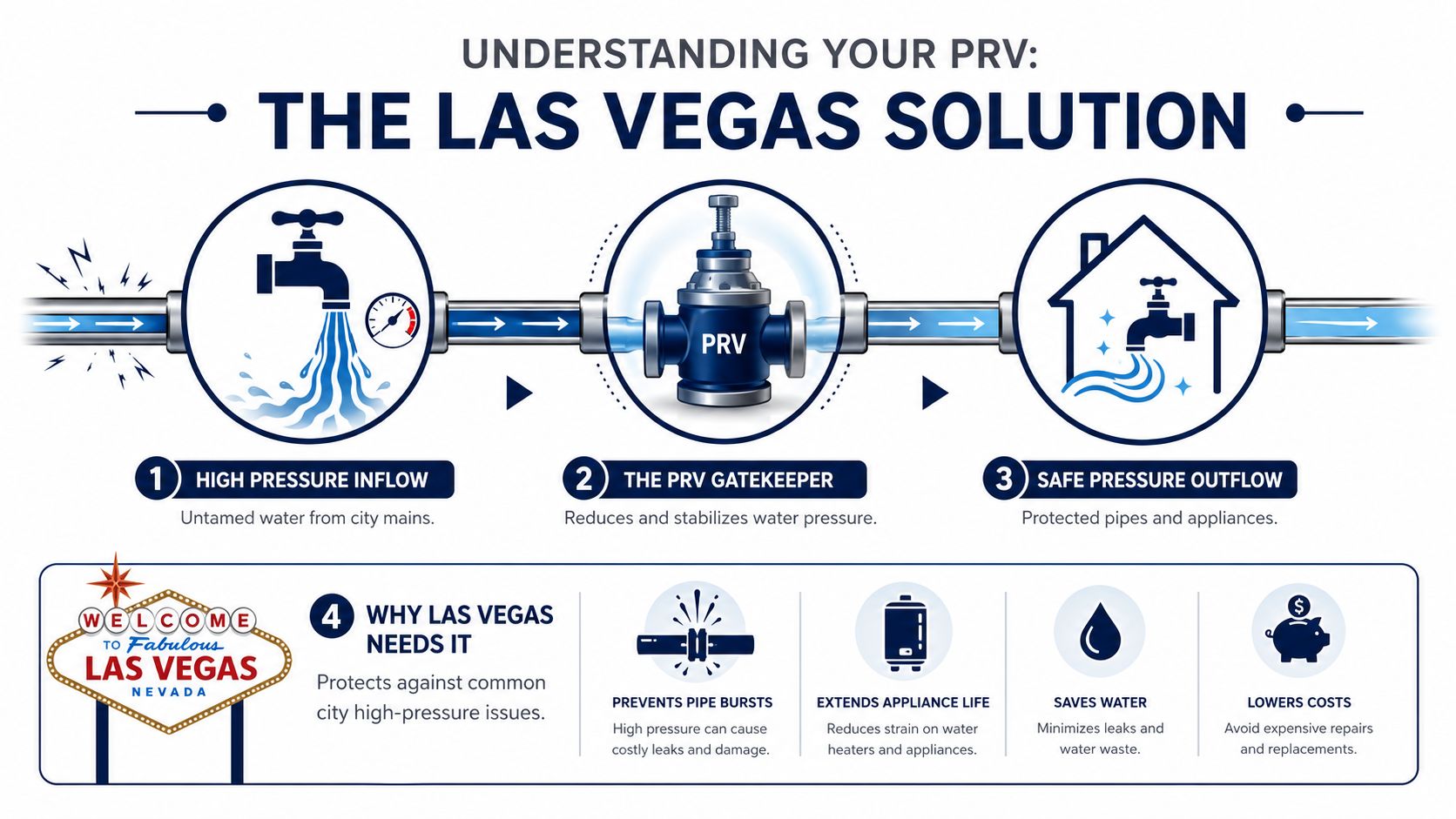
A pressure reducing valve, or PRV, is installed where the water service enters the house. Its job is to bring incoming city pressure down to a level your plumbing system can handle day after day. In practical terms, it protects the house side of the system from pressure that is too high for normal residential fixtures and appliances.
In Las Vegas, that matters because street pressure can come in high, and local hard water makes the system less forgiving. Mineral scale stiffens valves, cartridges, and appliance components. Add excess pressure on top of that, and parts wear faster, seal poorly, or fail before they should.
What the valve is actually doing
A PRV regulates pressure across the whole house. It is not just there to make one fixture feel better.
Once that valve is in place and adjusted correctly, everything downstream benefits. That includes faucet cartridges, toilet fill valves, appliance hoses, icemaker lines, angle stops, and the water heater. If a home already has mystery drips or hidden moisture, professional water leak detection can help confirm whether pressure has already pushed a weak point into a real leak.
Why a PRV matters more than many homeowners realize
A PRV changes how the whole plumbing system behaves. It lowers the constant strain on every connection in the house, but it also creates a closed system. That is the part many homeowners are never told. Once water cannot push backward toward the street the way it used to, heated water in the tank has nowhere to expand unless the system is built to handle it.
That is why PRV installation is not just about the valve itself. In many Las Vegas homes, the job also needs the right expansion control at the water heater so pressure does not spike when the burner or elements heat the tank. If that part gets skipped, the house can still see pressure problems even after a new PRV is installed.
A properly installed PRV protects the whole house, but it has to be matched to the rest of the system, especially the water heater side.
Signs Your Home Has Dangerously High Water Pressure
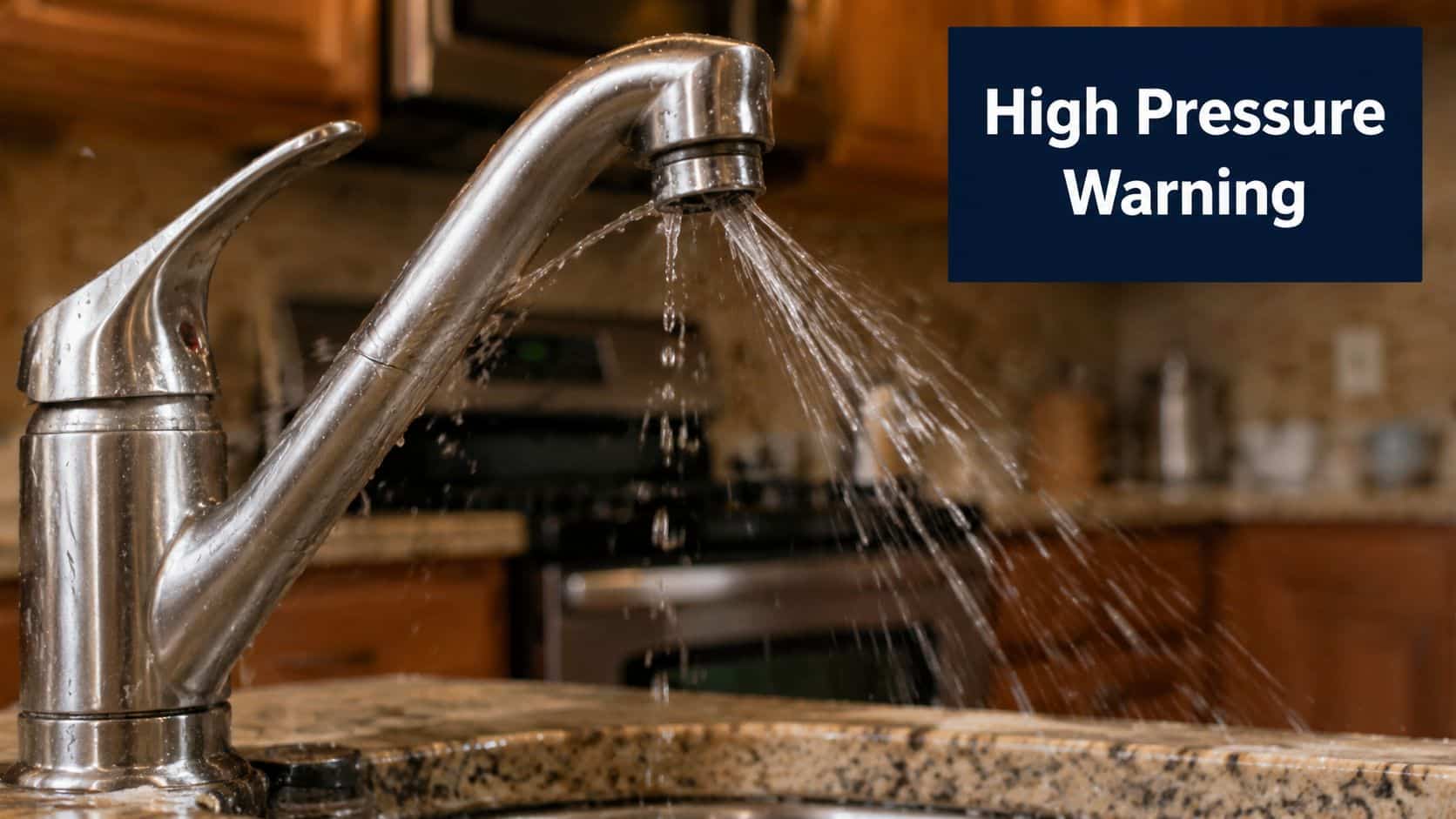
Homeowners usually don't call and say, “I think my pressure reducing valve is failing.” They call because something in the house feels off. The pressure symptom shows up as wear, noise, leaks, or repeat repairs.
High Water Pressure Symptom Checklist
| Symptom | What It Means for Your Plumbing |
|---|---|
| Pipes bang when water shuts off | The system may be dealing with water hammer and excess force at shutdown |
| Faucets drip again after repair | Seals and cartridges may be getting overworked by pressure |
| Toilets keep running or need frequent fill valve repairs | Internal toilet parts may be wearing faster than normal |
| Appliance hoses or valves fail early | Washing machines, dishwashers, and icemakers don't like chronic high pressure |
| Water heater starts leaking sooner than expected | Pressure stress can add to heat and expansion stress inside the system |
| Strong flow at every fixture feels harsh, not normal | The incoming pressure may be too high across the whole house |
The symptoms that matter most
If one faucet drips, that can be a fixture problem. If several plumbing parts start failing within the same stretch of time, it points toward a pressure issue affecting the entire home. That's where homeowners in Las Vegas can waste money by repairing the symptom but never fixing the source.
A loud system is another warning. Hammering pipes aren't just annoying. That repeated shock loads hangers, joints, stops, appliance valves, and faucet internals. Over time, the weakest point starts leaking.
What homeowners can check safely
You can pay attention to patterns without taking anything apart:
- Notice timing if noise happens when the dishwasher, washing machine, or a quick-closing faucet shuts off
- Look for repeat failures in toilet parts, faucet cartridges, and supply hoses
- Check around the water heater for early signs of leakage or pressure stress
- Watch your fixtures for flow that feels too aggressive throughout the house
If you already have an active leak, pressure may be making it worse. In that situation, leak location comes first. A water leak detection service in Las Vegas can help identify where the failure is happening before repairs are made.
When multiple small plumbing problems show up together, pressure is often the hidden cause tying them together.
The Professional PRV Installation Process
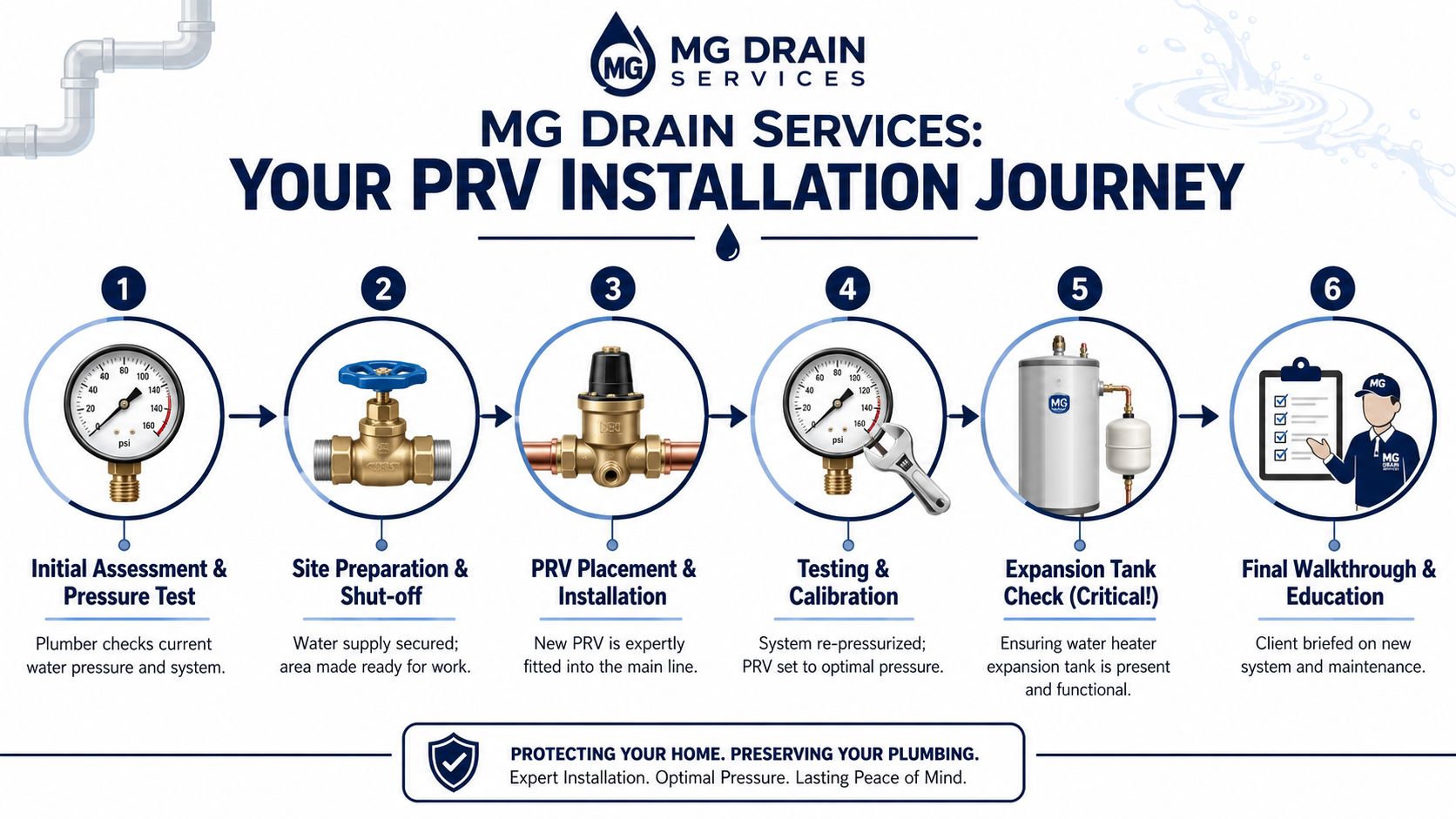
A real PRV job isn't just cutting in a valve and leaving. Good PRV installation is about placement, serviceability, protection of the valve, and final pressure control.
What happens during the service call
The first step is system assessment. A plumber checks the existing setup, confirms the symptom pattern, identifies where the main line enters the home, and evaluates whether the current piping layout will allow a clean, serviceable install.
Then the water is shut down and the work area is prepared. On a proper install, the valve isn't buried in a mess of tight fittings with no future access. The goal is a layout that can be serviced later without turning the next repair into a demolition project.
What a correct installation includes
For domestic water PRVs, the valve must be installed with the flow arrow on the body pointing in the direction of flow, isolation valves should be fitted on both sides, and a line strainer should be installed upstream where particulate is present to protect the valve's internal components, as described in Watts installation guidance for domestic PRVs.
That matters in practice because debris and service access are what make a valve either dependable or troublesome later.
Key parts of the job
Pressure verification
The plumber confirms the incoming condition and checks how the house is behaving before any cuts are made.Valve selection
The right valve type and size are chosen for the home's plumbing demand and existing piping layout.Line modification
The main line is cut cleanly, then the valve and supporting components are fitted in the proper direction.Protection details
Isolation valves and, where needed, an upstream strainer are included so the valve can be maintained and protected.Calibration and testing
Water is turned back on carefully. The downstream pressure is adjusted and the system is checked under operation.
What doesn't work
What fails in the field is usually predictable. A backwards valve won't regulate correctly. A valve with no service isolation turns future maintenance into a larger shutdown. A cramped install with no thought to access creates problems the next time the system needs attention.
For homeowners who want a local service option, MG Drain Services provides plumbing repairs and related main-line work in Las Vegas, Henderson, and North Las Vegas.
The Critical Part Most Plumbers Miss Expansion Tanks
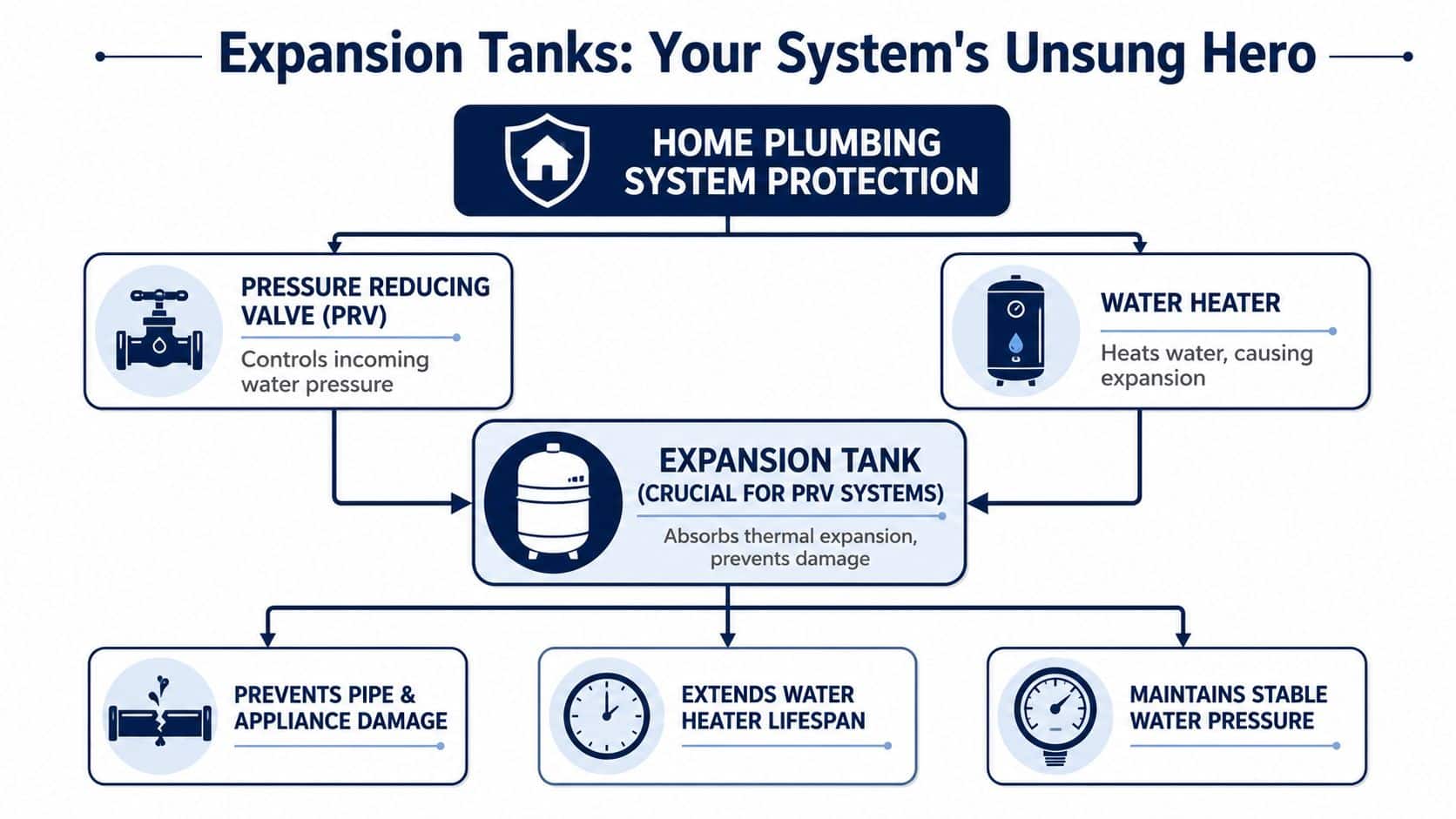
This is the part that gets skipped too often. A PRV solves one problem, but it also changes the behavior of the plumbing system. Once the valve is installed, the house side becomes a closed system. Water can come in under controlled pressure, but pressure created inside the home no longer has an easy path back out.
That matters the moment the water heater starts heating.
Why the water heater changes everything
When water heats up, it expands. In an open system, pressure behavior is different. In a closed system created by a PRV, that expansion has to go somewhere. If there's no proper expansion control, pressure spikes inside the house side of the plumbing.
That extra pressure doesn't announce itself politely. It shows up as seepage at the water heater, stress on supply lines, dripping relief components, and wear on fixture internals.
Install a PRV without handling thermal expansion, and you may trade one pressure problem for another.
Why an expansion tank is not optional
When a PRV is installed, it creates a closed system where thermal expansion will spike pressure unless explicit expansion control is provided via an expansion tank precharged to the home's static pressure. This is a code-compliant requirement in many jurisdictions and a leading cause of water heater leaks in homes with newly installed PRVs, according to residential PRV guidance discussing thermal expansion and tank precharge.
In practice, this is one of the clearest differences between a basic valve install and a complete system correction. Homeowners often assume the PRV alone is the whole job. It isn't.
What a proper plumber checks
A complete evaluation should include these questions:
- Is there already an expansion tank installed and is it still in usable condition
- Is the tank charged correctly for the home's static pressure
- Is the water heater already showing stress from previous pressure spikes
- Has anyone added a PRV in the past without addressing thermal expansion
If the water heater has already started leaking or showing signs of pressure damage, that has to be addressed directly. A water heater repair service in Las Vegas may be part of the fix along with the PRV and expansion setup.
Why PRV Installation Is Not a DIY Job in Las Vegas
A homeowner can notice the symptoms. That part is useful. The actual repair is different.
PRV installation means working on the main water supply, cutting into the service line, selecting a valve that fits the system, orienting it correctly, and making sure the rest of the plumbing still behaves safely afterward. In Las Vegas homes, the job also needs to account for hard water conditions, aging shutoffs, access limitations, and water heater expansion issues.
The trade-offs DIY videos don't show
Online videos make these jobs look tidy because they skip the hard parts. They don't show the seized shutoff, the piping that has no room for clean service valves, or the water heater that starts dripping after the new PRV traps thermal expansion. They also don't show what happens when a homeowner installs the valve but can't properly diagnose whether the system pressure issue is incoming pressure, a failing valve, debris in the line, or a separate plumbing defect.
For contractors who want to better understand the business side of service operations, staffing, and systems, this guide for plumbing contractors gives useful context on what goes into running a professional plumbing company. For homeowners, the takeaway is simpler. Good plumbing work is process driven for a reason.
Why professional work matters
The global PRV market was valued at US$3.9 billion in 2024 and is projected to reach US$4.9 billion by 2030 at a CAGR of 3.8%, according to global strategic reporting on pressure reducing valves. That kind of market size reflects how important pressure control is across modern water systems. It's not a casual add-on part.
Licensed and insured plumbers in Las Vegas bring the right tools, the right fittings, pressure testing know-how, and the judgment to catch the part that gets missed most often. That saves time, prevents repeat repairs, and lowers the chance that a pressure fix causes a second problem elsewhere in the house.
Frequently Asked Questions About PRV Installation
A typical call goes like this. The shower pressure feels great until supply lines start failing, a toilet fill valve gets noisy, or the water heater relief valve begins to drip. In Las Vegas homes, PRV questions usually are not about one part. They are about how the whole plumbing system handles pressure.
| Question | Answer |
|---|---|
| What does a PRV do for my house? | It lowers incoming water pressure at the main line so your plumbing system runs at a safer, controlled pressure. That reduces wear on faucets, angle stops, appliance hoses, ice maker lines, and other parts that fail early under constant stress. |
| Where is a PRV usually installed? | It is usually installed on the main water line after water enters the home, where it can be tested, serviced, and replaced without tearing into walls or hardscape. The right location depends on the layout of the house and access to the shutoff. |
| Can high water pressure cause leaks even if my pipes look fine? | Yes. High pressure often shows up first at weak points like supply lines, fixture cartridges, washing machine hoses, shutoff valves, and water heater connections. A house can look fine at a glance and still have pressure damage building up. |
| If I install a PRV, do I also need to think about the water heater? | Yes. Once a PRV closes the system, heated water has nowhere to expand unless the system has proper expansion control. That is why the expansion tank matters so much. If it is missing, failed, or undersized, pressure can spike when the water heater runs even if the PRV itself is set correctly. |
| Is PRV installation common or is it a special add-on? | It is a standard plumbing repair and upgrade in homes with excessive incoming pressure or failing pressure control. In Las Vegas, it comes up often because pressure problems tend to affect more than one fixture or appliance at the same time. |
| Can I just adjust pressure myself and skip replacement? | Sometimes a PRV can be tested and adjusted, but adjustment is not a cure for every problem. If the valve is worn out, clogged with debris, installed in the wrong orientation, or paired with no working expansion tank, turning the screw will not fix the real issue. |
| When should I call a plumber right away? | Call when you have banging pipes, repeated fixture leaks, hose failures, pressure that feels aggressive throughout the home, or any sign the water heater is dripping or relieving pressure. Those are warning signs that the problem is affecting the system, not just one fixture. |
One good rule is simple. If parts keep failing in different places, stop replacing parts one by one and have the house pressure tested.
If your home in Las Vegas is dealing with banging pipes, repeat leaks, harsh fixture pressure, or a water heater that may be under stress, call MG Drain Services LLC for professional plumbing in Las Vegas. They're a local, licensed and insured company serving Las Vegas, Henderson, and North Las Vegas with experienced technicians, honest pricing, and fast response times. Call 702-480-8070 or visit MG Drain Services LLC to book service.