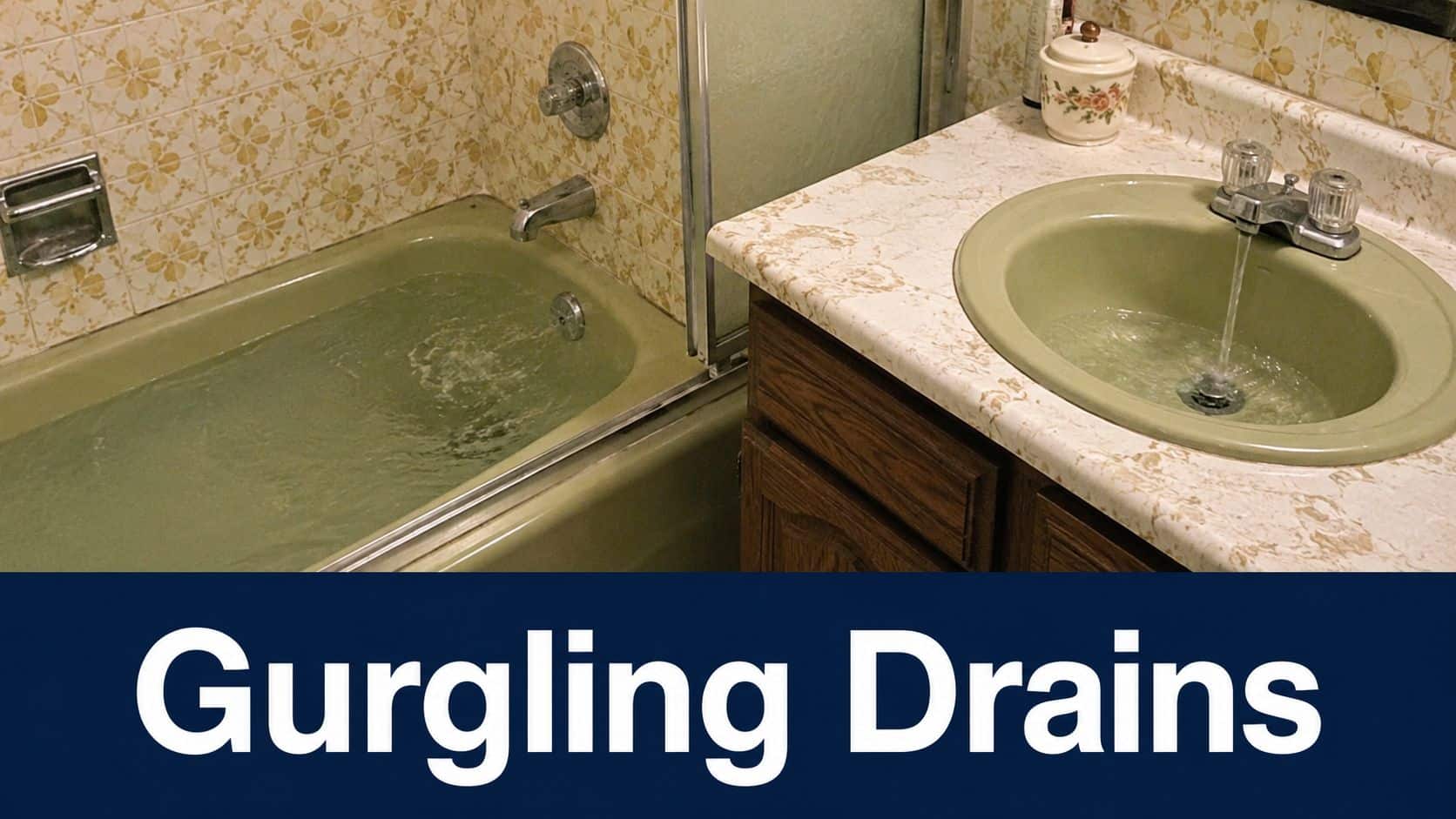
You flush the toilet, hear the bathtub gurgle, and watch the water drain slowly. A few months later, the same bathroom backs up again. In a 1970s Las Vegas home, that pattern may be more than a stubborn clog. It can indicate that the original sewer lateral is losing its structural integrity.
The useful question isn't only how to clear the blockage. It's whether the buried line is still structurally passable or has moved into repair-or-replace territory. The difference determines whether a cable cleaning buys you time or merely postpones a larger failure.
Why Sewer Repairs in 1970s Las Vegas Homes Are a Different Problem
A tub gurgles when the washing machine drains. The toilet works after a clearing, then backs up again months later. A floor drain smells foul after the children bathe. One fixture can have a local clog, but several fixtures reacting together usually place the restriction farther downstream.
That pattern changes the service decision. A cable may restore flow if the original line is still structurally passable. It will not repair a corroded pipe, a separated clay joint, or a collapsed section. The first question is whether cleaning is reasonable or whether the sewer has passed its dependable service window.
Homes built in the 1970s deserve closer inspection because many still contain original cast iron drain piping and vitrified clay sewer components. Older Las Vegas housing coverage notes that neighborhoods developed during the 1970s and 1980s often retain original cast iron drain lines and early sewer laterals. A camera inspection is the dependable way to identify the buried pipe's material and condition (Active Plumbing's Las Vegas cast iron and clay lateral overview).
Why the construction era matters
Las Vegas sewer infrastructure was expanding and being reorganized while these homes were built. The Las Vegas Lateral was constructed in 1970 and 1971 as part of the Southern Nevada Water Project. Wastewater flows in the Las Vegas Wash had reached about 25 million gallons per day by 1970, and the Clark County Sanitation District opened its East Plant in 1973 (Las Vegas Wash historical infrastructure documentation).
That history does not make every 1970s home defective. It does explain why buried laterals and neighborhood connections from the period may reflect older engineering practices, materials, and joining methods. The valley's sewage treatment plant had operated since 1958, with a capacity of about 12 million gallons per day, while sewer service continued developing as construction expanded (older Las Vegas sewer component discussion).
Practical rule: A repeat clog in a newer pipe may be maintenance. A repeat clog in an original 1970s lateral calls for a structural diagnosis.
Cast iron can corrode and scale internally, narrowing the passage. Clay can crack, separate at joints, or admit roots. If the pipe wall or joint system has failed, snaking can reopen a route without correcting the defect. For sewer repairs in 1970s Las Vegas homes, the line's condition should guide the decision, not the assumption that every backup is an isolated clog.
What's Actually Under a 1970s Las Vegas Home
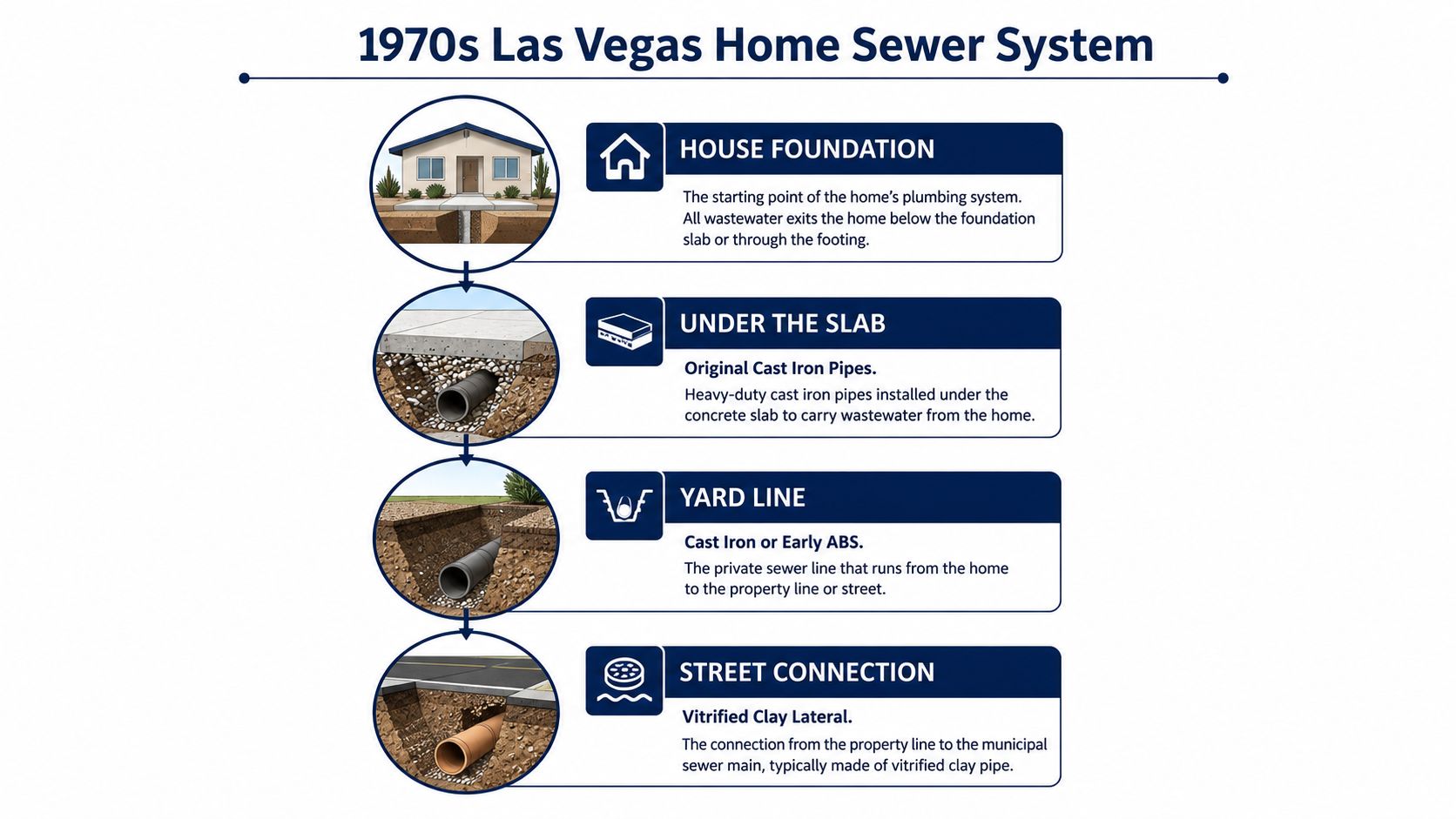
Start with a simple mental map. Wastewater leaves fixtures through branch drains, enters a larger building drain, passes beneath or near the foundation, continues through the private sewer lateral, and eventually reaches the municipal connection. A plumber may call the pipe under the home the building sewer, the run across the property the yard line, and the pipe heading toward the street the lateral.
In many 1970s Las Vegas houses, the original under-slab sections are cast iron. Cast iron is rigid and heavy, but decades of corrosion can roughen the interior and reduce the effective opening. Industry plumbing references commonly place cast iron drain-pipe life at roughly 50 to 60 years, which puts many 1970s systems in a high-risk age band today (cast iron service-life reference).
The materials a plumber may find
A typical inspection may reveal a combination rather than one uniform material.
- Under the slab: Original cast iron is common in older residential layouts. Access may require a cleanout, toilet removal, or carefully planned slab work.
- Across the yard: The line may remain cast iron, or an early ABS section may connect to older piping.
- Toward the street: Vitrified clay laterals were used in many older Las Vegas-area neighborhoods. Their joints are vulnerable to root intrusion and offsets as surrounding soil shifts.
- Remodeled areas: A previous repair may have inserted ABS or another newer section between original materials.
Cast iron was commonly used for residential sewer lines through the mid to late 1970s, so a house from that era may still have original main and branch drains unless a remodel or earlier repair replaced them (cast iron sewer material history).
Why slab construction changes the repair
Las Vegas homes are often built on concrete slabs rather than crawlspaces. That keeps the home compact, but it places drain piping beneath finished flooring and structural concrete. If the defect sits under a bathroom, kitchen, or hallway, open replacement can involve concrete cutting, excavation, pipe installation, backfill, and surface restoration.
A newer pipe with sound joints can sometimes be rehabilitated without opening the entire route. An aging line with a collapsed section, severe offset, or missing pipe may not provide the continuous host needed for lining. Homeowners comparing repair scopes may also find it useful to understand how residential concrete foundations differ in design and construction, as explained in this comparison of residential concrete foundations.
The key distinction is material condition, not just pipe age. A camera shows whether the old line still has enough shape, continuity, and grade for a less disruptive repair.
Warning Signs That Point to Sewer Trouble in Older Las Vegas Homes
A bathroom toilet gurgles when the washing machine drains, then the tub begins holding water. That pattern points beyond a single fixture. One slow sink usually belongs to its branch, while several fixtures reacting together implicate the shared drain or main sewer line. If cleaning restores flow only briefly, the pipe may be passing water through a narrowed or damaged section rather than functioning normally.
Symptoms that lean toward a blockage
A localized clog is more likely when one fixture drains slowly, nearby fixtures work normally, and a straightforward mechanical cleaning clears the problem completely. Hair, soap residue, grease, or debris can obstruct a branch without proving that the buried sewer has failed.
A plunger or small hand auger is reasonable for one fixture when there is no sewage overflow and the tool enters the drain without unusual resistance. Stop if the tool catches, the blockage returns quickly, or another fixture starts reacting. Those changes raise the possibility that the line is structurally compromised or that the blockage sits farther downstream.
Symptoms that raise the structural concern
- Multiple slow fixtures: A tub, toilet, and floor drain responding together suggests restriction in a shared downstream line.
- Recurring backups: Repeated failure at the same location can indicate corrosion scaling, root intrusion, an offset, a belly, or a collapsed section.
- Gurgling: Trapped air around a narrowing or obstruction can make tubs and toilets gurgle as water moves through the system.
- Sewage odors: Odors indoors or near the yard can accompany separated joints, cracks, or leaking wastewater.
- Wet or unusually green ground: A saturated or greener strip along the lateral route can indicate leakage in an otherwise dry desert setting.
- Roots on the cable: Roots commonly enter through vulnerable clay joints. Cutting them may reopen the passage, but it does not close the entry point or restore the joint.
Las Vegas and nearby Paradise and Winchester include older homes where vitrified clay pipe may be beyond its commonly cited 50 to 60 year service life. A line that still has shape and continuous joints may need cleaning and monitoring. Collapsed clay or fully corroded cast iron requires repair or replacement, not another cleaning cycle, as outlined in this Las Vegas clay pipe and root intrusion guidance.
Sewage on the floor requires containment and sanitation, not repeated drain chemicals. For cleanup and immediate response considerations, review this practical guide to sewage backup restoration advice.
A plumber separates these conditions by testing the affected fixtures, checking available cleanouts, and viewing the pipe with a camera. The symptoms identify the area to investigate. The inspection shows whether the original line remains structurally passable or has moved past its service window.
How a Plumber Diagnoses the Sewer Line in a 1970s Home
A 1970s sewer diagnosis starts with access and symptom isolation. The plumber may use the main cleanout, if available, or remove a toilet to enter the building drain. The camera then travels through the line while the monitor shows the pipe wall, joints, water level, and obstruction.
The inspection must distinguish a blockage from structural failure. In an older Las Vegas line, the camera can reveal interior corrosion, hard-water scale, root balls, cracked clay, separated joints, offsets, standing water caused by a belly, or a section collapsed inward. A cable can clear some of these conditions temporarily, but it cannot restore a failed joint or missing pipe wall.
What locating adds
A camera shows the defect from inside the pipe. A locator shows where that defect sits beneath the property. The technician follows the camera head from the surface and marks the approximate route, position, and depth. Those measurements help determine whether a spot repair can reach the failure, whether a lining installation has suitable access, and whether excavation would affect a slab, driveway, irrigation, or mature landscaping.
The camera can also show the transition between private piping and the city tap near the property line. That boundary matters because responsibility and repair access may change at the public connection.
Why cleaning must follow diagnosis
Cable cleaning and camera inspection serve different purposes. A cable may restore flow without showing the pipe wall. Hydro-jetting can remove scale and buildup, but aggressive cleaning before checking wall loss may expose perforations in thin cast iron instead of correcting the failure.
For a 1970s home, the practical sequence is inspection, locating, then cleaning or repair based on the findings. Las Vegas hard water can leave mineral buildup that narrows the opening and reduces flow, as described in this Las Vegas hard-water buildup information. If the original cast iron or clay remains continuous and structurally passable, cleaning may be reasonable. If the camera shows collapse, major corrosion, repeated offsets, or separated joints, another cleaning cycle only postpones the repair decision.
Homeowners can review MG Drain Services' sewer camera inspection service in Las Vegas to understand the equipment, process, and service scope.
A useful inspection should answer four questions:
- Is the pipe continuous from the house toward the street?
- Is the opening restricted by scale, roots, debris, or deformation?
- Is the pipe wall or joint system structurally compromised?
- Can the line support lining, or does it require excavation or replacement?
Repair Options for Aging Sewer Lines in Las Vegas
The right repair depends on what remains underground. A clean camera image through a narrowed line doesn't automatically justify replacement. A pipe that has lost continuity, grade, or wall strength doesn't become reliable merely because a cable opens it.
Spot repair
A targeted repair fits a localized defect, such as one separated joint or one damaged section with sound pipe on both sides. The crew exposes that area, replaces the failed segment, reconnects compatible piping, and tests the line.
The advantage is limited excavation. The trade-off is that the rest of the original line remains. Spot repair makes the most sense when the camera and locating results show an isolated failure rather than widespread corrosion, multiple offsets, or repeated root entry.
Cured-in-place pipe lining
CIPP lining places a resin-saturated liner inside the existing host pipe and cures it into a new pipe within the old route. Properly designed and installed liners commonly remain in service well beyond 20 years, and technical reviews report low structural failure rates with only a small percentage requiring major rework over 10 to 20 years (technical review of CIPP performance and quality control).
Lining requires more than a clear path. The host pipe needs enough continuity and shape to hold the liner. Accurate defect mapping, correct sizing, surface preparation, resin curing, and post-installation inspection all affect the result. A sagging, severely deformed, collapsed, or missing section can prevent proper installation.
Full replacement or bursting
Excavation is the dependable endpoint when the pipe is collapsed, severely offset, missing sections, or too deteriorated to serve as a host. Depending on access and surrounding conditions, replacement may involve open excavation or pipe bursting. The work can disturb a yard, irrigation, driveway, or slab, but it creates a new line rather than preserving a failed one.
Hydro-jetting can be useful for removing mineral scale, grease, and roots when the pipe remains suitable for cleaning. It isn't a structural repair. Details about that service are available through residential hydro-jetting in Las Vegas.
| Option | Best When | Main Trade-Off |
|---|---|---|
| Spot repair | One localized defect with sound pipe around it | Other original sections remain |
| Pipe lining | The host pipe is continuous, shaped, and structurally passable | It requires accurate preparation, sizing, curing, and inspection |
| Full replacement or bursting | The line is collapsed, severely offset, or missing sections | More access work and possible slab or landscape disruption |
The working decision rule is straightforward. Lining is favored when the host pipe remains continuous enough to hold a liner. Replacement is favored when the line has lost that continuity. A contractor should be able to show the defect on camera and explain why the proposed method fits the actual pipe condition.
Practical Prevention for Las Vegas Sewer Lines
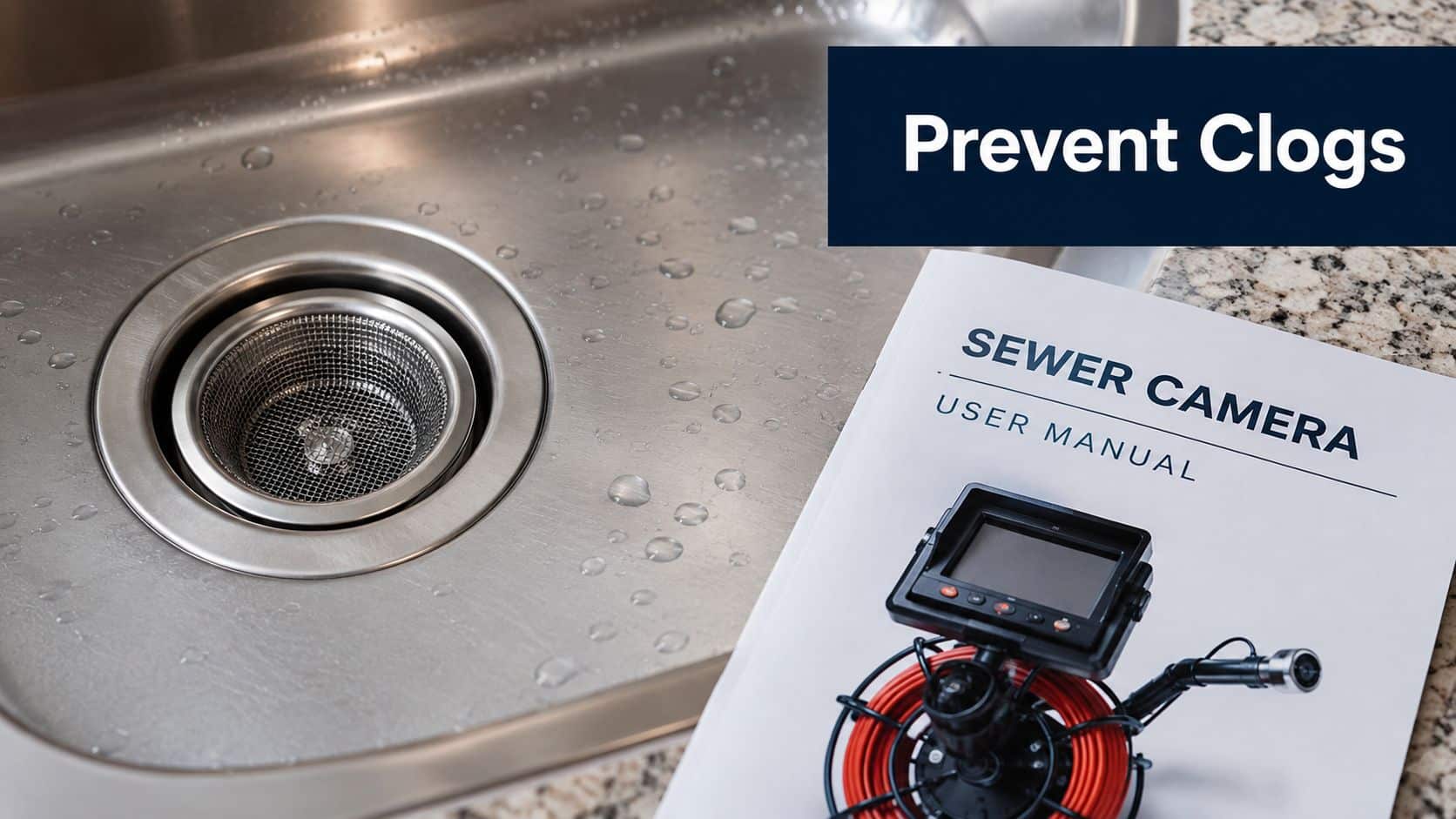
Prevention can reduce avoidable blockages and reveal deterioration before sewage reaches the floor. It cannot restore a corroded pipe. A 1970s sewer line needs targeted habits and inspections, not repeated chemical treatments.
Habits that protect the line
- Keep grease out: Let cooking grease cool, then place it in the trash instead of the kitchen drain.
- Use the toilet only for waste and toilet paper: Wipes, paper towels, feminine products, and cleaning cloths can restrict the line, even when labeled flushable.
- Watch root growth: Mature trees and aggressive roots near the sewer route deserve attention. Avoid planting new deep-rooted trees directly over it.
- Control irrigation: Constantly wet soil around a buried line can worsen movement at weak joints and make a leak resemble an irrigation problem.
- Skip repeated chemical treatments: Drain cleaner may damage finishes, fail to address structural defects, and create an unsafe work area when the line is opened.
Hard-water mineral buildup can narrow pipe openings and worsen an existing restriction, particularly inside aging metal with a rough, corroded interior. Water treatment may improve incoming water conditions, but it cannot repair a sewer lateral that is cracked or collapsed.
A maintenance rhythm that works
Record backups, cleaning visits, and the locations where symptoms return. If the home still has original piping and the same problem keeps coming back, schedule a camera inspection instead of repeating the same clearing procedure. That distinction matters: recurring scale or a removable obstruction points toward cleaning, while roots, separated joints, broken sections, or collapse indicate a line that may no longer be structurally passable.
A camera inspection can document the line before a remodel adds fixtures or outdoor work conceals the route. It also helps determine whether the original cast iron or clay remains serviceable or has passed its practical service window.
Leaks elsewhere can confuse the diagnosis, especially in slab-built houses. If hidden water loss seems more likely than a sewer blockage, arrange a dedicated water leak detection service rather than assuming every wet area comes from the lateral. A recurring backup, sewage odor, wet ground unrelated to irrigation, or symptoms at multiple fixtures warrants a plumber's inspection.
When to Call a Las Vegas Plumber and What to Expect
A plunger is a reasonable first move for one slow fixture. A small drum auger can also make sense when the obstruction is clearly local, the line responds normally, and no other fixture is backing up. Don't keep escalating DIY force when several fixtures react together, sewage appears, the clog returns, or the tool brings back roots and broken material.
Before the appointment, note which fixtures are affected, how often the problem returns, whether the lowest drain backs up first, and what previous cleaners or equipment were used. Point out cleanouts, recent remodeling, mature trees, irrigation lines, and any wet or sunken ground outside. That context helps the plumber choose access and avoid treating a main-line failure like a sink clog.
What a productive visit includes
A professional sewer diagnosis should identify the access point, run a camera through the line when possible, locate significant defects, and explain the pipe material and condition in plain language. The plumber should distinguish a removable obstruction from corrosion, root intrusion, joint separation, a belly, or collapse before recommending a repair.
A sewage backup also requires prompt attention to affected flooring and contents. Homeowners dealing with water or sewage damage can review these steps to take after a leak while arranging appropriate cleanup.
MG Drain Services LLC is a licensed and insured, family-owned, owner-operated residential plumbing company serving Las Vegas, Henderson, and North Las Vegas. Owner Miguel Garcia is a Nevada-licensed C-1d plumbing contractor and journeyman plumber with more than 25 years of trade experience. The company uses sewer cameras, locating equipment, drain-cleaning tools, and hydro-jetting equipment to diagnose residential sewer conditions and recommend a repair that matches the pipe, not just the symptom. If the backup is active and needs prompt residential plumbing attention, review the available Las Vegas emergency plumbing service.
For sewer repairs in 1970s Las Vegas homes, the best time to investigate is before the next backup turns into an indoor cleanup job. Call MG Drain Services LLC at 702-480-8070 to schedule a sewer camera inspection and get a clear explanation of whether your original line needs cleaning, spot repair, lining, or replacement.
If recurring backups, gurgling fixtures, roots, or sewage odors are affecting your Las Vegas, Henderson, or North Las Vegas home, MG Drain Services LLC can inspect and locate the sewer problem before you commit to unnecessary excavation. Call 702-480-8070 to arrange a residential sewer diagnosis based on the actual condition of the line.