Your water heater was supposed to last years longer. Instead, it's making rumbling noises, running out of hot water, or leaking into the pan in a Las Vegas garage or closet.
That's a common call in this valley. Why Las Vegas Water Heaters Fail Faster Than Other Climates comes down to one local reality more than anything else. The water itself is harder on the equipment than what homeowners deal with in many other parts of the country. In Las Vegas, Henderson, and North Las Vegas, that changes how fast scale builds up, how hot metal surfaces get, and how quickly a normal water heater turns into a financial risk.
This isn't just about inconvenience. A failing water heater can leave you without hot water, drive up energy use, and create expensive water damage if it lets go at the wrong time. Homeowners don't need vague advice here. They need a practical explanation of what's happening inside the tank, what works to slow the damage down, and when it makes more sense to repair, flush, descale, or replace the unit before it fails.
The Frustration of a Failing Las Vegas Water Heater
A lot of Las Vegas homeowners go through the same sequence. The unit still looks fairly normal from the outside. Then the hot water gets inconsistent. Then the heater starts popping, takes longer to recover, or leaves a rusty stain in the drain pan. Not long after that, the water heater that was supposed to be a background appliance becomes an urgent plumbing job.
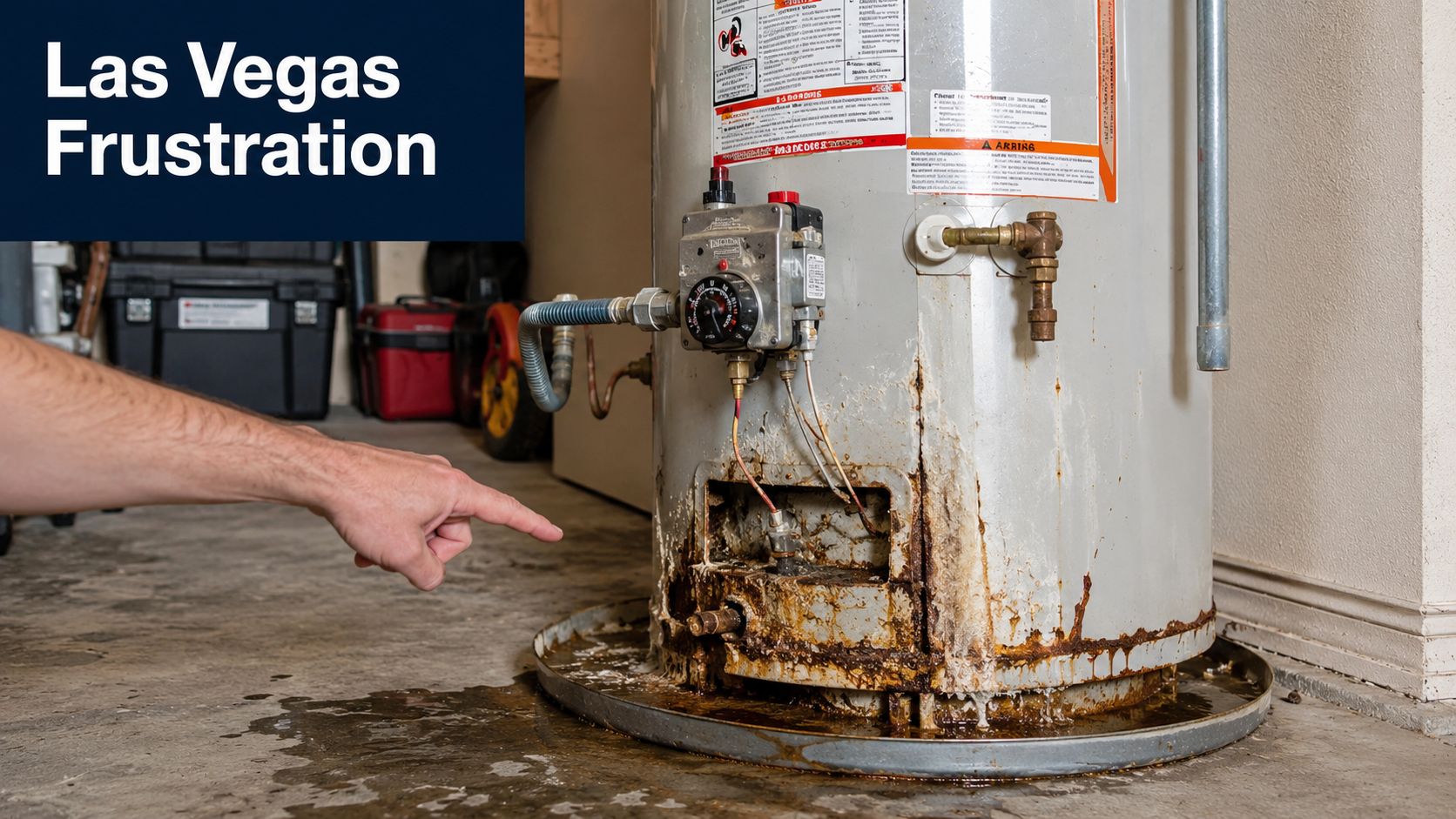
In Las Vegas, this problem shows up earlier than many homeowners expect. It's especially frustrating when the heater isn't that old by normal standards, or when a landlord or property manager just replaced one a few years ago and is already dealing with another failure.
Why this hits Las Vegas homes so often
This valley puts water heaters under a different kind of stress than milder, softer-water climates. The issue usually isn't one dramatic event. It's repeated mineral exposure, repeated heating cycles, and maintenance that gets delayed because the heater still seems to be working.
That's why homeowners in Henderson and North Las Vegas often get surprised. The heater can keep producing hot water while damage is building inside the tank or heat exchanger.
A water heater rarely fails “out of nowhere.” Most Las Vegas failures give warnings first. Homeowners just don't always know what those warnings mean.
Why it matters beyond hot water
A bad water heater isn't only a comfort problem. It's a risk-management problem. If the unit is in a garage, attic-adjacent space, or upstairs closet, a leak can spread fast before anyone notices. That's why plumbers in Las Vegas treat unusual heater noise, rust, slow recovery, and pan water as signs to investigate early, not later.
For homeowners searching for practical plumbing in Las Vegas, the goal is simple. Catch the failure before it turns into replacement plus cleanup, drywall work, and flooring damage.
The Main Culprit Las Vegas's Extremely Hard Water
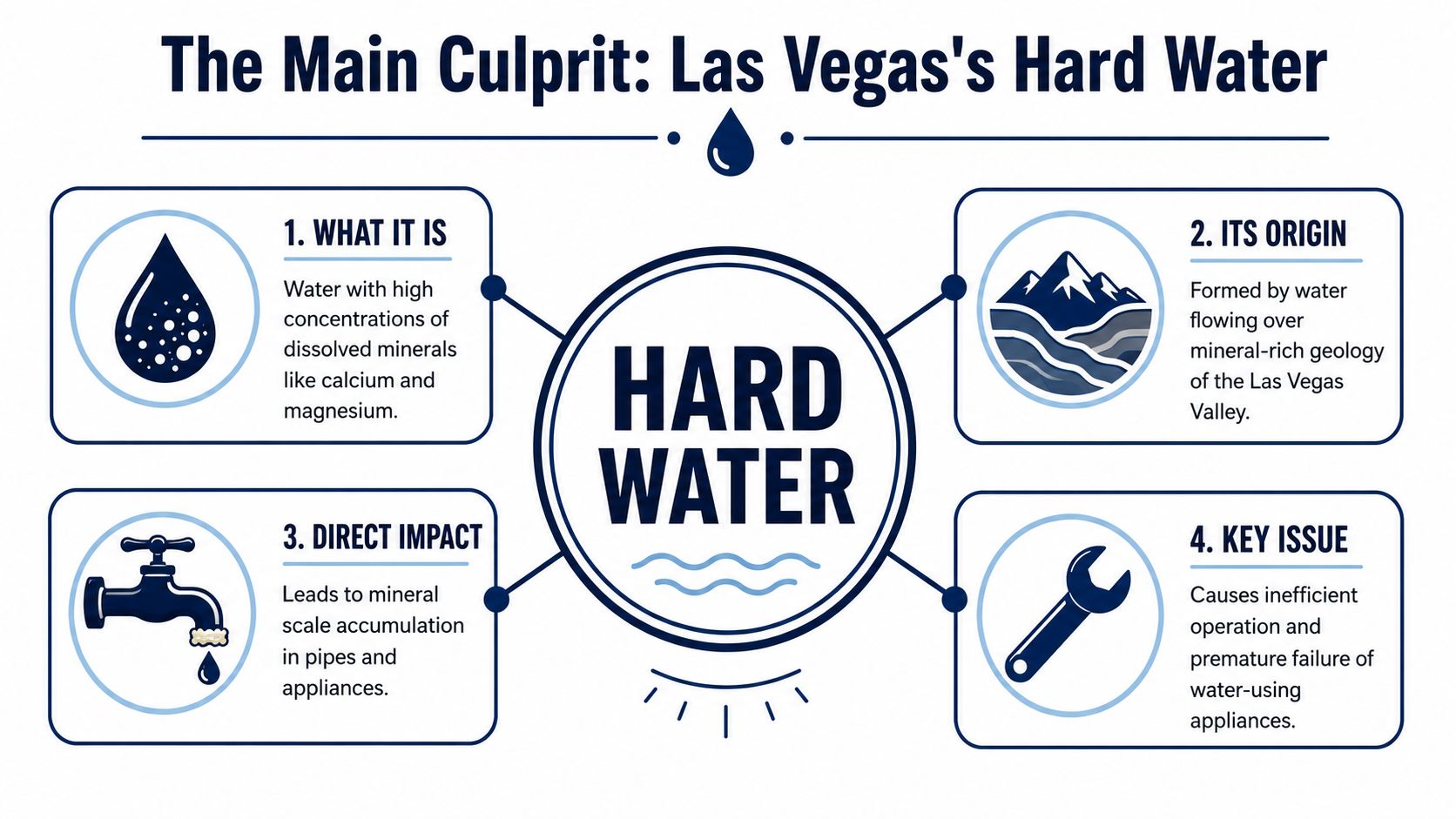
Las Vegas water is hard. That sounds like a harmless water-quality term until you see what it does inside a heater.
The core problem is mineral content. According to this Las Vegas water heater failure analysis, Las Vegas water contains 16 to 18 grains of hardness per gallon, compared with a national average of 7–10 grains. That gap matters because the extra dissolved minerals create faster scale buildup and faster internal corrosion.
What hard water means in plain English
When plumbers talk about hard water, they mean water carrying a heavy mineral load, mainly calcium and magnesium. Those minerals don't stay politely dissolved forever. Once water gets heated over and over, they start dropping out of solution and sticking to metal surfaces.
Inside a tank heater, that turns into sediment on the bottom. Inside a tankless unit, it turns into scale inside narrow passages where hot water has to move efficiently.
Why Las Vegas is different
Las Vegas water comes from the Colorado River system, and local conditions leave homeowners with water that's rough on plumbing equipment. Nevada is also dealing with increasing extreme droughts and rising evaporative demand, which can concentrate minerals and worsen water quality issues over time, as noted by University of Nevada, Reno Extension.
That's why the same brand of heater can age very differently in Las Vegas than it would in a softer-water market. Brand matters less than homeowners think. Local water chemistry matters more.
What homeowners can do about the root problem
You can't change the valley's water, but you can treat it before it damages the rest of your plumbing system. A whole-home softener is the most direct way to reduce the mineral load entering the heater. If you want to understand the service side of that option, this guide to water softener service in Las Vegas is a good place to start.
Here's the practical takeaway:
- Soft water treatment helps upstream: It reduces the mineral load before it reaches the heater.
- Untreated hard water keeps attacking daily: Every shower, dishwasher cycle, and load of laundry feeds more minerals into the system.
- Delay gets expensive: The buildup doesn't stop on its own. It hardens.
How Hard Water Destroys Your Water Heater from the Inside Out
The damage starts gradually. Water enters the heater carrying minerals you can't see. The burner or element heats that water, and those minerals begin to separate and settle. At first it's a dusty layer. Then it thickens. Then it hardens into a crust that changes how the heater works.
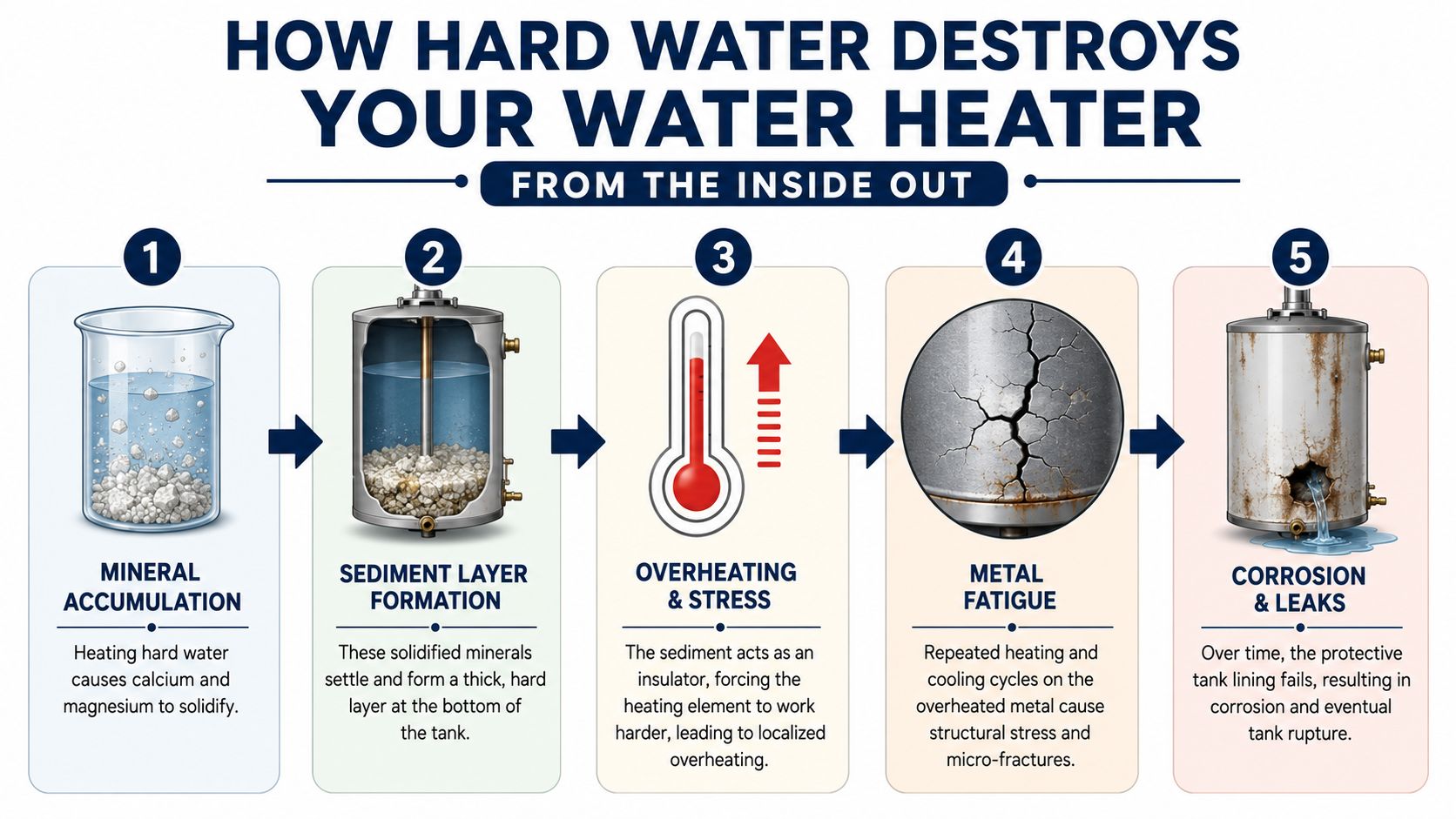
A detailed local breakdown from Active Plumbing on sediment boil in Las Vegas explains that the industry-standard 10–12 year lifespan for tank water heaters drops to 6–9 years in the Las Vegas Valley, and many units fail in 4–6 years because of sediment boil, which causes the popping and rumbling sounds homeowners hear.
What sediment does inside a tank
That hardened layer acts like insulation in the worst possible place. The burner or element has to work harder to push heat through the sediment and into the water above it. Metal at the bottom of the tank runs hotter than it should, and repeated overheating stresses the tank lining and steel underneath.
This is the mechanical part many homeowners never get told. The heater may still be making hot water, but it's doing it inefficiently and under strain.
Practical rule: If a tank heater in Las Vegas starts popping or rumbling, don't treat it like “normal aging.” That noise often means scale has already changed how heat is transferring inside the tank.
Why the noises matter
The term sediment boil sounds technical, but the symptom is easy to recognize. Water gets trapped under hardened scale at the bottom of the tank and starts boiling in pockets. That's where the rumbling, crackling, and popping come from.
By the time a homeowner hears those sounds regularly, the unit usually needs attention soon. Flushing may help if the buildup hasn't hardened too far. If the scale is severe, flushing alone may not reverse the damage.
A similar principle applies to smaller appliances. If you've ever had to maintain your Keurig for a fresh brew, you've already seen what minerals do when heated water moves through a machine repeatedly. A household water heater deals with the same chemistry on a much bigger and more expensive scale.
Signs that point to internal damage
The warning signs usually show up in clusters:
- Popping or rumbling: Sediment boil is often behind it.
- Slower hot-water recovery: The heater is struggling to transfer heat efficiently.
- Water around the base or in the pan: Corrosion may already be winning.
- Rust-colored water: Internal deterioration may be advancing.
- Higher utility bills: The heater is working harder to do the same job.
If those symptoms sound familiar, this article on signs of water heater failure can help homeowners match what they're seeing with likely failure points.
Tank vs Tankless Heaters A Realistic Las Vegas Comparison
Tank and tankless heaters both work in Las Vegas. Neither gets a free pass from hard water.
Tank heaters suffer from sediment settling at the bottom of the vessel. Tankless heaters avoid stored water, but they have a different vulnerability. Their heat exchangers have narrow passages, and scale buildup can restrict flow and reduce heat transfer. That's why the usual sales shortcut, “just go tankless and you're done,” doesn't hold up in this valley.
Where tank heaters struggle
A standard tank heater is simpler, and replacement is usually straightforward. For many homes, that still makes sense. The downside is obvious in Las Vegas. The tank becomes the collection point for minerals, especially if flushing gets skipped.
Tank systems are often a solid fit when homeowners are realistic about maintenance. Ignore the sediment, and the heater ages fast. Stay ahead of it, and you have a much better shot at avoiding an early tank failure.
Where tankless helps and where it doesn't
Tankless units do have one real operating advantage. A Lawrence Berkeley National Laboratory comparison of tank and tankless systems found tankless water heaters reduce annual energy use by 2,800 MJ/year, or 16% less than tank models.
That efficiency benefit is real. But efficiency isn't the same as durability in hard water.
According to Pure Plumbing's Las Vegas tankless guidance, the claim that tankless heaters last 20+ years in Las Vegas is highly conditional, and without a water softener, mineral buildup from 16–18+ grain-per-gallon water can still degrade the heat exchanger far earlier than homeowners expect.
Sales claims about tankless lifespan usually assume ideal maintenance conditions. Las Vegas water is not an ideal condition.
The honest comparison homeowners need
Here's the practical side-by-side view:
| System | Main Las Vegas weakness | What helps most |
|---|---|---|
| Tank heater | Sediment settling and overheating at tank bottom | Flushing, anode inspection, soft water |
| Tankless heater | Scale inside heat exchanger passages | Descaling, filtration, soft water |
A tankless upgrade can make sense in Las Vegas, but only if the homeowner understands the maintenance commitment. If you're comparing options, this local guide to tankless water heater choices gives a useful starting point.
The candid recommendation is simple. If your plan is “I'll descale it once in a while and that should be enough,” don't assume you're buying a 20-plus-year solution in Clark County.
Your Proactive Defense Plan to Prevent Costly Failures
A water heater failure in Las Vegas is often a money problem before it becomes a plumbing emergency.
According to this analysis of property damage from water heater failures, approximately 40–50% of water heater failures result in property damage, with repair costs ranging from $500 to $25,000, and catastrophic failures can exceed $10,000. In local homes, that risk gets worse when the heater sits in an upstairs closet, garage corner with no attention, or an interior utility room where a slow leak can go unnoticed.
What works in the field
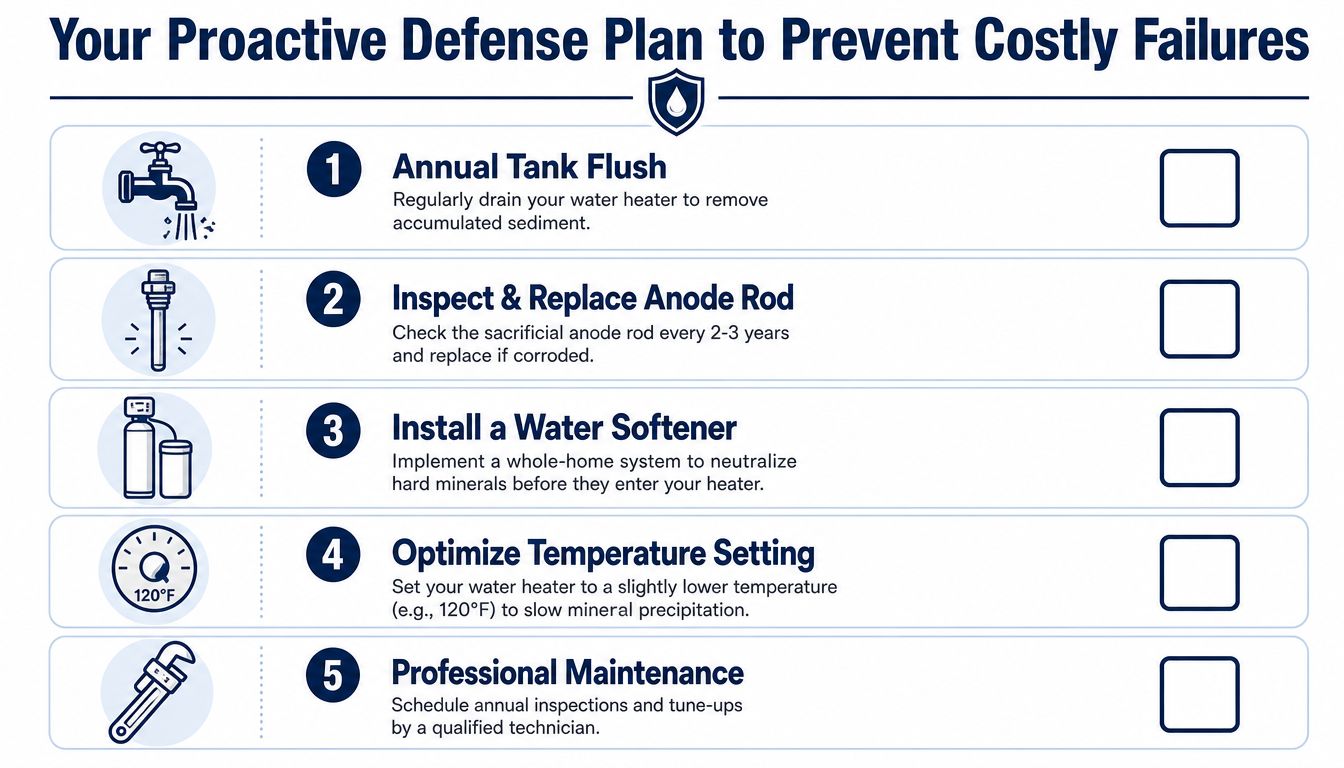
The goal is simple. Slow the wear that hard water causes and catch small problems before they turn into replacement, drywall repair, and flooring damage.
A practical defense plan has three parts:
Flush the tank on schedule
This clears out loose sediment before it bakes onto the bottom of the tank and traps heat where it should not.Inspect the anode rod before corrosion reaches the tank
The anode rod is there to corrode first. Once it is depleted, the tank itself starts taking that damage.Lower the mineral load coming into the home
A water softener does more than reduce spotting on fixtures. It cuts down the scale your heater has to handle every day.
For larger systems or properties with heavier treatment demands, some owners look at broader guidance on specifying industrial water treatment to understand how softening and filtration choices affect equipment life. The principle is the same in a house. Better pretreatment usually means fewer heater problems and a lower chance of paying for an early replacement.
What you can monitor yourself
Homeowners can catch a lot without taking anything apart.
Check for rust streaks, water in the drain pan, new popping or rumbling sounds, and changes in hot water recovery. Read the manufacture date. If the unit is aging and performance is slipping, that is the time to plan, not wait for a weekend leak.
Some work should stay with a plumber:
- Anode rod replacement: Clearance is often tight, and seized rods can turn a routine job into damaged piping or a twisted tank connection.
- Leak diagnosis: Water near the heater might come from a valve, fitting, expansion issue, or venting problem. It is not always a failed tank.
- Descaling tankless equipment: If the restriction is severe or in the wrong spot, a basic flush may not solve it.
MG Drain Services LLC handles plumbing repairs in Las Vegas, including water heater issues, leak detection, and maintenance work for homeowners and property managers.
When to stop watching and call
Call for professional plumbing in Las Vegas if you notice any of these:
- Water in the pan that keeps coming back
- Repeated popping or rumbling
- Rust at the fittings or around the base
- Hot water running out sooner than it used to
- A heater installed in a second-floor closet or finished interior space
At that point, delay gets expensive. A service call costs less than uncontrolled water damage, and if the tank body is already leaking, replacement usually makes more financial sense than trying to buy a little more time.
Las Vegas Water Heater FAQs
How often should a tank water heater be flushed in Las Vegas
In Las Vegas, a tank heater should usually be flushed once a year. Alpine Intel's water heater failure guidance supports that schedule for reducing sediment buildup and helping a tank last closer to its expected local service life.
That said, annual flushing is a starting point, not a guarantee. If the heater already rumbles, recovers slowly, or the house shows heavy scale on faucets and showerheads, a basic flush may not remove much. At that stage, the question is less about maintenance and more about whether the unit is already losing the battle inside the tank.
Does a water softener really pay off in Clark County
In many homes, yes.
Homeowners usually notice softer skin and less spotting first, but the bigger financial benefit is behind the walls and inside appliances. A softener cuts down on scale buildup in the heater, helps valves and fixtures last longer, and reduces the kind of mineral-related service calls that keep showing up in Las Vegas homes.
The payoff depends on how long you plan to stay, how much hot water the household uses, and how aggressive the scaling is in that property. In a short-term ownership situation, the math is different. In a long-term home, untreated hard water often costs more than people expect because the expense shows up as earlier replacements, more maintenance, and avoidable plumbing repairs.
Is tankless still worth it in Las Vegas
It can be, but only if the owner treats water quality and maintenance as part of the installation cost.
Tankless units do offer real advantages. They save space, avoid standby heat loss, and can work well for homes with the right usage pattern. What they do not do is make hard water disappear. In Las Vegas, the advertised long lifespan depends on conditions. Descaling helps, but it is not the whole story. Flow sensors, heat exchangers, valves, and small internal passages still deal with the same mineral load coming through the system.
That is why I caution homeowners against buying tankless based on a headline lifespan alone. A tankless unit can be a smart choice here. It is not a simple fix for local water conditions, and it should be priced as a system that needs regular upkeep.
Can one brand handle Las Vegas water better than the others
No brand gets a pass from hard water.
Some models are easier to service. Some have better parts availability or controls that make diagnosis easier. Those things matter to plumbers, and they matter to homeowners once the unit needs work. But brand name does not cancel out scale formation, poor installation, bad sizing, or skipped maintenance.
A well-installed heater with access for service and a plan for water treatment will usually outperform a premium unit that gets ignored.
What are the signs that a water heater is close to failure
Watch for changes in behavior before you see a major leak. Rumbling or popping sounds, less hot water than usual, rust around fittings, water in the pan, or dampness near the base all deserve attention.
Small symptoms turn into expensive problems fast, especially if the heater sits in a closet, garage corner near storage, or any finished part of the house. From a cost standpoint, Las Vegas homeowners suffer greatly from these rapid escalations. Waiting often turns a manageable service call into a replacement job plus cleanup, drywall work, flooring damage, or insurance hassle.
Should landlords and property managers treat this differently
Yes. Rentals need a tighter maintenance schedule because tenants often report problems late or describe them vaguely. A heater may make noise for months before anyone mentions it, and a slow leak in a pan can go unnoticed until there is staining, swelling, or damage in the next room or unit.
For landlords and property managers, this is less about plumbing theory and more about risk control. Regular inspection, documented maintenance, and replacement planning usually cost less than emergency response, property damage, and tenant disruption.
Las Vegas water heaters fail faster because local conditions are hard on them, but the pattern is predictable. Homeowners who treat that pattern as a financial risk, not just a mechanical nuisance, make better decisions about flushing, softening, maintenance, and replacement timing.
If your water heater is rumbling, leaking, or aging faster than it should in Las Vegas, Henderson, or North Las Vegas, contact MG Drain Services LLC for practical help. The company is licensed and insured, locally based, and staffed by experienced technicians who handle plumbing repairs, leak detection, drain issues, and water heater problems with honest pricing and fast response times. For service, call 702-480-8070 or book online.