It’s a frustration every Las Vegas homeowner knows. You turn on the shower expecting a powerful spray, but all you get is a disappointing trickle. If you're asking yourself what causes low water pressure, you've come to the right place. The answer usually points to a handful of common culprits, from something as simple as a clogged faucet to a more serious problem like a hidden leak or a failing pressure regulator. For homeowners in Las Vegas, this isn't just an annoyance; it's a sign your plumbing needs a professional look.
The Frustration Of Weak Water Flow In Your Las Vegas Home
Nothing throws a wrench in your daily routine faster than weak water flow. It makes washing dishes a grind and turns what should be a relaxing shower into a test of patience. For homeowners and property managers across Las Vegas, Henderson, and North Las Vegas, this isn't just a minor annoyance—it’s often a warning sign that your plumbing system needs a closer look.
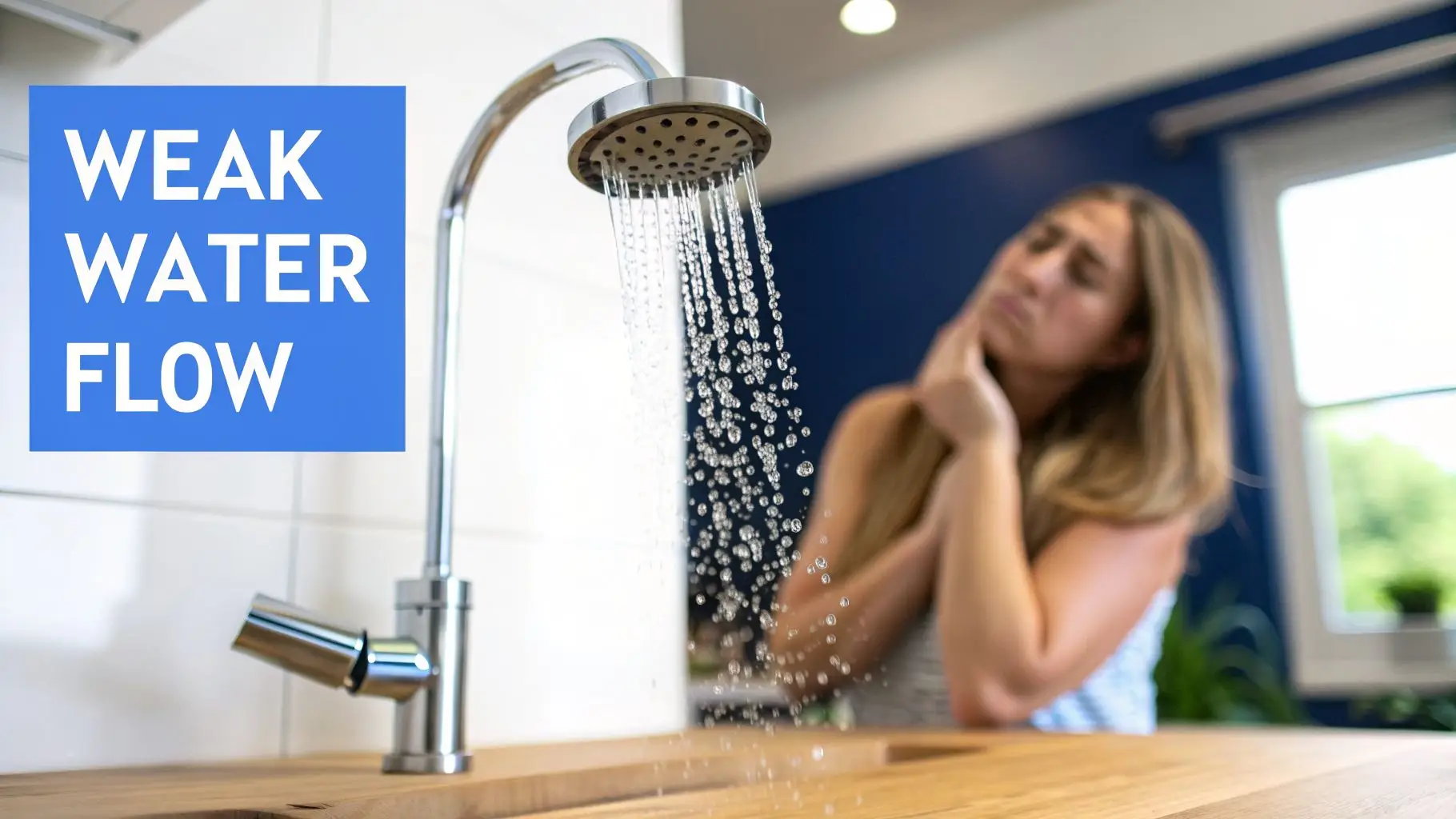
This guide is built to help you diagnose the problem just like a pro would. We’ll get into the unique challenges we see right here in Las Vegas homes, from our notoriously hard water mineral buildup choking your pipes to the aging plumbing found in many older local properties. Pinpointing the cause is always the first step toward getting your pressure back.
Before we dive deep, here’s a quick overview of the usual suspects we encounter when a Las Vegas homeowner calls our team about low water pressure.
Common Causes Of Low Water Pressure At A Glance
| Cause | Common Symptoms | DIY Fix Or Pro Call? |
|---|---|---|
| Municipal Supply Issue | Neighbors have low pressure too; sudden drop across the whole house. | Pro Call (or wait for the city to fix it). |
| Hidden Pipe Leak | Unexplained spike in your water bill; sound of running water; damp spots. | Pro Call – Urgent leak detection is essential. |
| Clogged Pipes/Fixtures | Pressure is low at only one or two faucets; gradual decline in flow. | DIY Fix (clean aerators) or Pro Call for pipe descaling. |
| Failing PRV | Pressure is too high or too low; banging pipes; sudden changes. | Pro Call – This requires a licensed plumber. |
| Shared Water Lines | Pressure drops when a neighbor uses water (common in older duplexes). | Pro Call – May require re-piping. |
| Well or Pump Problems | You're on a well system; sputtering faucets; pump cycles frequently. | Pro Call – Needs a well & pump specialist. |
This table gives you a starting point. Now, let’s dig into why this stuff really matters for the health of your home.
Why Your Water Pressure Matters
Think of your home's water pressure like its heartbeat. When it's weak, the whole system suffers. Your dishwasher, washing machine, and even your tankless water heater are designed to work with a specific amount of pressure. When they don't get it, performance plummets. Ignoring a gradual drop in pressure can easily snowball into much bigger headaches and costly damage.
Here’s what we see happen all the time in Las Vegas homes:
- Inefficient Appliances: Your dishwasher runs longer and leaves dishes spotty. Your washing machine struggles to rinse clothes properly.
- Hidden Water Damage: A slow, undetected leak is one of the most common reasons for pressure loss. That "small" leak can cause thousands in damage to drywall, flooring, and foundations.
- Worsening Pipe Blockages: That mineral buildup from our hard water won't clear itself out. Over time, it will only get worse, constricting flow until a full-blown blockage occurs.
Professional Insight: As a local Las Vegas company, our experienced technicians have learned to spot the patterns. A sudden, house-wide drop in pressure often screams a specific failure, like a broken Pressure Reducing Valve (PRV) or a fresh pipe leak. A slow, gradual decline over months or years? That almost always points to mineral scale building up inside the pipes.
This guide will walk you through the most common issues, starting with the easy fixes you can tackle yourself before moving on to the complex jobs that need a professional. By the end, you'll have real, actionable answers and know exactly when it’s time to call the local plumbing professionals at MG Drain Services.
Is the Problem Bigger Than Your House? Checking for City-Wide Issues
Before you start tearing apart your plumbing or taking a wrench to a faucet, let's take a step back. Your first move should always be to figure out if the problem is actually in your Las Vegas home. Sometimes, the source of your weak shower is miles away, coming from the municipal supply managed by the Las Vegas Valley Water District.
Think of the city's water grid like our freeway system. A major water main break or scheduled maintenance on the other side of town can cause a backup that slows water flow to your entire neighborhood. A quick check can save you a massive headache and the cost of a plumbing visit you didn't need.
Are Your Neighbors Having Trouble, Too?
The fastest way to know if it's a city problem? Just ask your neighbors. A quick text or a shout over the fence can tell you everything you need to know. If everyone on your block is suddenly dealing with a trickle, the culprit is almost certainly outside your property line.
When that happens, your best bet is to check the Las Vegas Valley Water District's website or social media pages. They’re usually pretty good about posting updates on outages or maintenance work. If it's a city issue, all you can do is be patient while their crews get it handled.
It's also worth noting that a gradual, widespread drop in pressure across the valley can point to a bigger issue we all face in the Southwest. As our local aquifers are strained, especially during peak summer demand, the city's pumps have to work that much harder. This can sometimes result in lower pressure for everyone. It's a complex challenge, and you can learn more about the global effects of water scarcity from UN University.
What to Do If the Problem Is Widespread
So, you've confirmed your neighbors are in the same boat. Now what? Your job is to become an informed homeowner, not a DIY plumber.
- Check for Official Alerts: Pull up the Las Vegas Valley Water District's official website or their social media. They'll post banners or updates about any known service interruptions or emergency repairs.
- Report the Problem: If you don't see any announcements, give their customer service line a call. The more homes that report an outage, the faster they can pinpoint the location and get a crew on-site.
Local Pro Tip: See LVVWD trucks or a construction crew digging up the street in your neighborhood? That's your sign. The low pressure is almost definitely related to their work, and your home’s plumbing is in the clear.
Once you’ve confirmed the city’s water supply is flowing strong, then it’s time to put on your detective hat and start investigating inside your own home.
Diagnosing The Hidden Culprits In Your Home's Plumbing
Alright, so you've checked with the neighbors and their water pressure is just fine. That's a classic sign the problem is somewhere on your property. When the issue is isolated to just your house, it’s time to play detective, because the cause is almost always lurking inside your own plumbing system.
Before you start tearing things apart, it helps to follow a simple process. Think of it like a decision tree for your plumbing—it walks you through the first steps every homeowner should take to narrow down the problem.
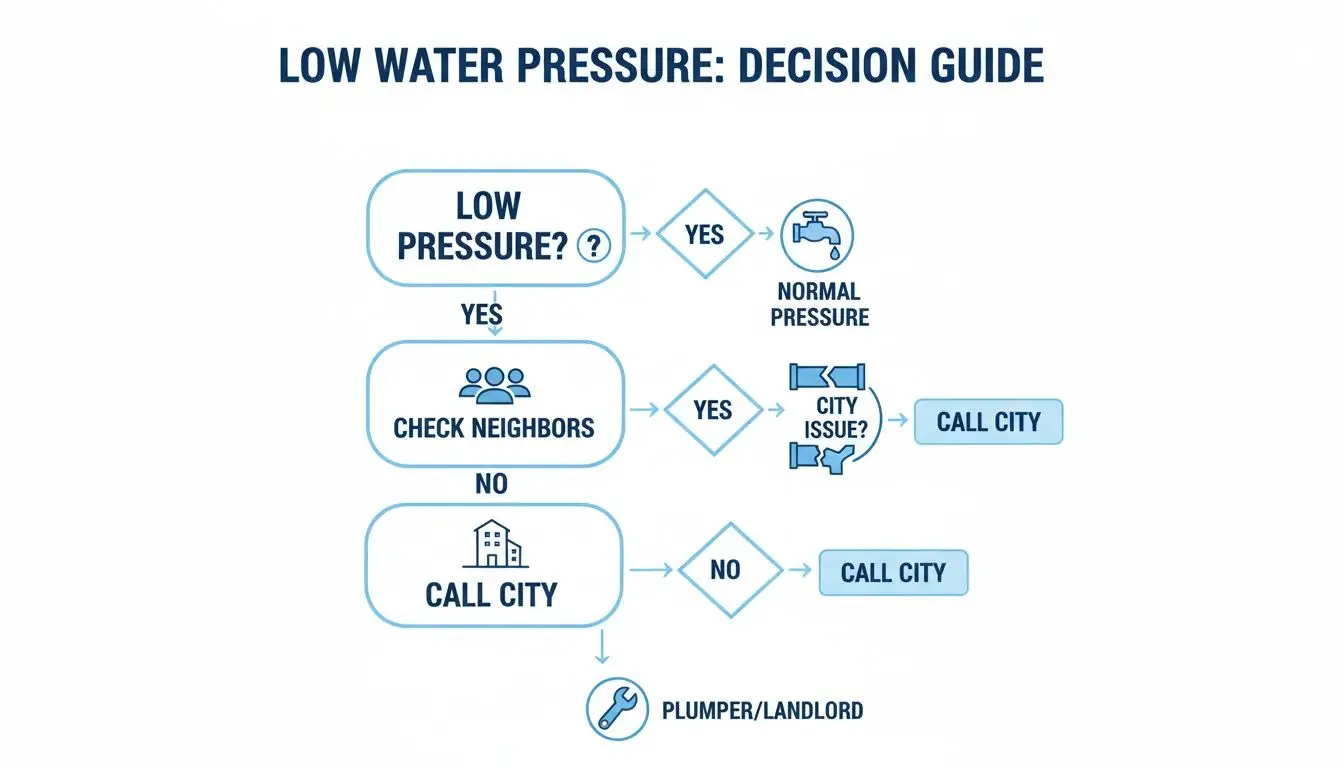
The idea is simple: rule out the big, external problems first. Once you know for sure the headache is yours and yours alone, you can start digging into these common hidden causes we see every day.
Check Your Main Water Shutoff Valve
Think of your home's main water shutoff valve as the master switch for every drop of water that comes into your house. It’s usually in the garage, a basement, or outside near the water meter. It’s surprisingly easy for this valve to get partially closed—maybe after some other work was done, or even just accidentally bumped—which immediately chokes the water flow to every faucet and shower.
A quick look is all it takes to know for sure.
- For a lever-style valve: The handle should run parallel with the pipe. If it's sitting at an angle, it’s not all the way open.
- For a wheel-style valve: Give that wheel a turn counter-clockwise until it stops. If it moves at all, it wasn't fully open.
If a simple turn of the handle brings your pressure roaring back to life, problem solved. If not, let's move on to the next likely suspect.
Inspect Your Pressure Reducing Valve (PRV)
Most homes here in Las Vegas have a Pressure Reducing Valve, or PRV. It's a bell-shaped device on your main water line that takes the super-high pressure from the city's supply and dials it down to a safe level (usually 50-75 PSI) for your home's pipes and appliances.
A failing PRV is one of the top reasons we get called out for what causes low water pressure in Las Vegas. These valves have a lifespan of about 10-15 years, and when their internal parts wear out or get clogged with sediment, the pressure can drop off a cliff.
While you should never try to adjust a PRV yourself—that’s a job for a licensed plumber—you can listen for clues. A faulty PRV will often make a humming or even a hammering sound, especially when you're running water.
The Slow Creep Of Clogged Pipes
The notoriously hard water we have in Las Vegas is packed with minerals like calcium and magnesium. Over the years, these minerals stick to the inside of your pipes, building up a layer of scale. It’s just like cholesterol clogging an artery; the opening inside the pipe gets narrower and narrower, strangling the water flow and killing your pressure.
Mineral buildup is a major "hidden culprit," so learning how to get rid of hard water can be key to keeping your pipes clear. This problem is especially bad if you have older galvanized steel pipes. While you can sometimes clean a single clogged faucet, widespread blockages in the system need a professional fix, like hydro jetting from a qualified Las Vegas plumber.
Going through these checks will help you get a much better handle on what's going on. If you've tried these steps and are still dealing with a weak flow, our guide on how to fix low water pressure has more insights to help you out.
Troubleshooting Low Pressure At A Single Faucet Or Shower
If your low water pressure problem is only happening in one spot—say, the kitchen sink or a single shower—you can probably breathe a sigh of relief. This is usually great news.
It almost always means the issue is localized and not some kind of system-wide failure. That makes it one of the easiest plumbing problems for a homeowner to solve on their own.
When pressure drops at just one fixture, the culprit is almost always a blockage right where the water comes out. Think of it like a clogged nozzle on a spray bottle. The bottle is full, but nothing comes out with any force because the opening is blocked. In your Las Vegas home, our hard water minerals are the number one cause, creating scale that builds up in the small openings of faucet aerators and showerheads.
Cleaning a Clogged Faucet Aerator
That little screw-on tip at the end of your faucet is the aerator. Its job is to mix air into the water for a smooth, splash-free stream, but its fine mesh screen is the perfect trap for sediment and mineral gunk. Cleaning it is a quick fix that often brings the pressure right back.
- Remove the Aerator: Most can be unscrewed by hand. If it’s on there tight, wrap a cloth around it and use pliers to gently turn it counter-clockwise.
- Inspect and Disassemble: Once it’s off, you’ll probably see a collection of white, chalky debris. Carefully take apart the small screens and rubber washers inside, making sure to keep them in order.
- Soak and Scrub: Drop all the parts into a small bowl of white vinegar for about 30-60 minutes. The acid in the vinegar is perfect for dissolving those mineral deposits. Afterwards, use an old toothbrush to scrub off any stubborn bits.
- Rinse and Reassemble: Rinse the parts thoroughly with clean water, put them back together in the correct order, and screw the aerator back onto the faucet.
Turn on the water and test it out. You should notice a huge difference in the flow.
Clearing a Blocked Showerhead
A weak, unsatisfying shower is often the first place homeowners notice the signs of low water pressure. Just like a faucet aerator, the tiny nozzles on a showerhead are prime targets for mineral clogs from our hard water. The cleaning process is pretty much the same.
Expert Tip: If you can't easily unscrew your showerhead, just fill a plastic bag with white vinegar and use a rubber band to secure it over the head. Let it soak overnight, and the vinegar will dissolve the buildup without you needing any tools.
For a really deep clean, though, it’s best to take it off completely. You can get the full rundown in our detailed guide on how to unclog a shower head.
If cleaning these fixtures doesn’t solve the problem, the blockage might be deeper in the supply line. That’s a job that requires a professional diagnosis from a local Las Vegas plumber.
How A Hidden Water Leak Can Steal Your Water Pressure
A gradual drop in your home’s water pressure—or even a sudden one—is a serious red flag that something’s not right. If you’ve already ruled out a city-wide issue or a simple clogged faucet, the next suspect is often the most dangerous: a hidden water leak.
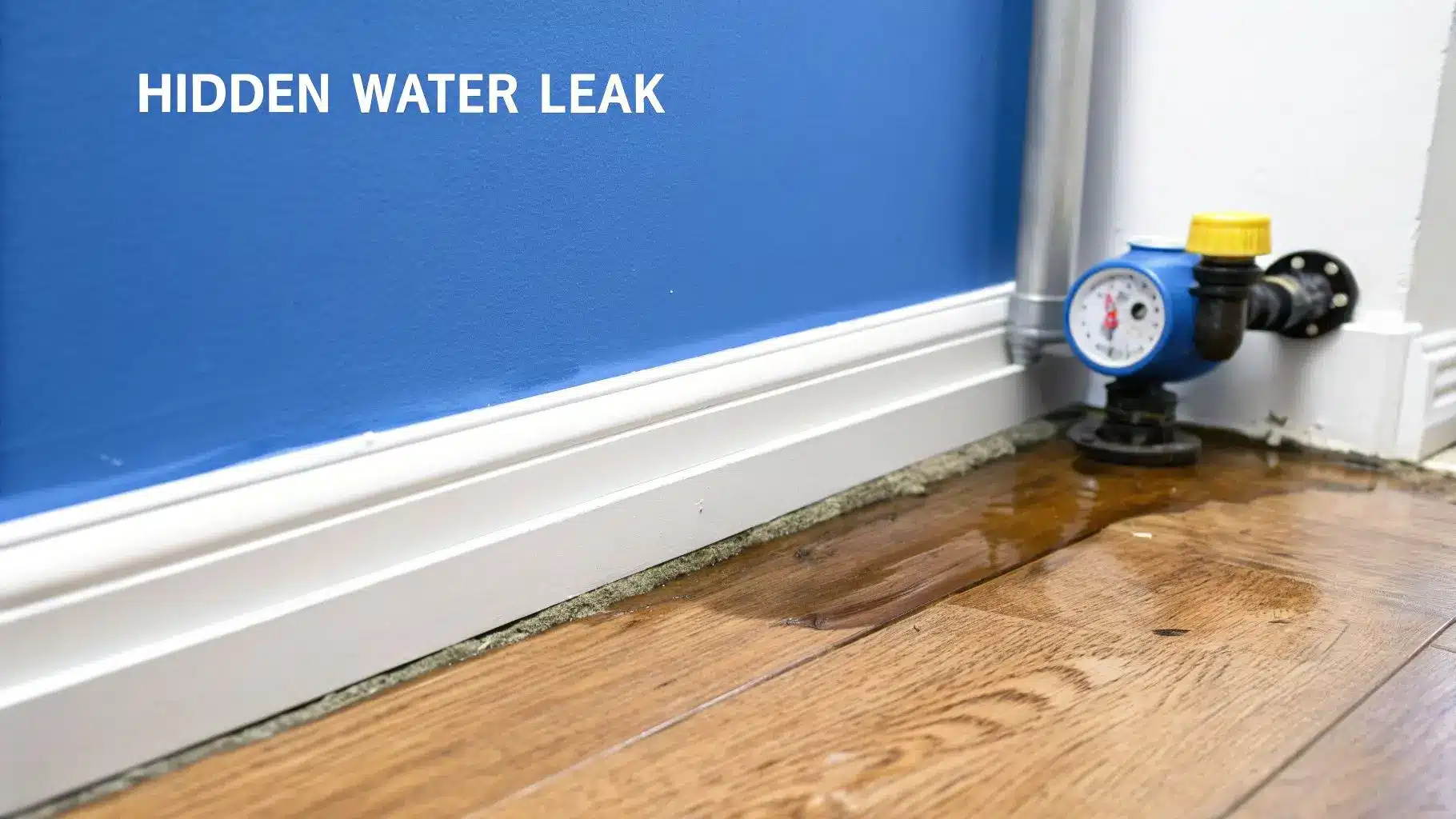
It helps to think of your plumbing system like a sealed loop. When a pipe gets a hole—whether it's a tiny pinhole leak behind your drywall or a crack in the main line under your foundation—water starts escaping. That diverted water means there's less of it, and therefore less pressure, to make it to your shower and sinks.
Of all the things that answer the question of what causes low water pressure, a hidden leak is the one that should get your attention the fastest.
Telltale Signs Of A Hidden Leak
Leaks might be sneaky, but they almost always leave clues. If you’ve noticed weaker water flow and you spot any of these signs, it’s time to play detective.
- An Unexplained Spike in Your Water Bill: Your habits haven't changed, but your bill shot up? That water is going somewhere you can't see.
- The Sound of Running Water: When every faucet and appliance is off, your home should be quiet. That faint hissing or dripping you hear behind a wall is the classic sound of a leak.
- Mysterious Damp Spots: Keep an eye out for odd wet spots on the carpet, discolored patches on ceilings or walls, or even warm spots on the floor—a dead giveaway of a hot water line leak.
A hidden leak is not just a plumbing problem; it's a threat to your property. Even a small leak can release thousands of gallons of water over time, leading to mold growth, structural damage, and costly repairs that far exceed the initial plumbing fix.
How To Perform A Water Meter Test
You can confirm if you have a leak with a simple test that every Las Vegas homeowner should know how to do. It’s called a water meter test.
- Shut It All Down: Make sure every single water-using appliance is turned off. This means all faucets, showers, the washing machine, dishwasher, and even the ice maker.
- Locate Your Water Meter: Head outside and find your water meter. It’s usually in a concrete box near the curb.
- Check the Dial: Look for a small triangle or a little dial on the meter's face. If it's spinning or moving at all, water is flowing somewhere on your property.
If you think you have a leak, there are various water saving devices that can find and fix water leaks on the market. But finding the exact spot, especially if it's underground or in a wall, usually takes professional gear.
If your meter test points to a leak, the next step is to act fast. You can learn more about how our expert technicians find these sneaky leaks in our guide to professional water leak detection.
When To Call Your Local Las Vegas Plumbing Professionals
[youtube https://www.youtube.com/watch?v=lSSTkgqZ8wU]While cleaning out a faucet aerator is a satisfying fix you can handle yourself, some of the real culprits behind low water pressure demand a licensed and insured technician. Trying to tackle complex plumbing issues without the right training or tools can turn a small headache into a full-blown, expensive disaster. Knowing when to put down the wrench and pick up the phone is the smartest thing you can do for your Las Vegas home.
It's time to bring in professional plumbers in Las Vegas if you run into any of these situations:
You Suspect a PRV Failure: Are you hearing a strange humming or banging noise from your pipes? Does your water pressure feel great one minute and weak the next? That's a classic sign your Pressure Reducing Valve is on the fritz. Messing with a PRV is a job for a pro, as a wrong move can damage your entire plumbing system.
You've Confirmed a Hidden Leak: Did the water meter test point to a leak somewhere on your property? Finding its exact location, especially when it's buried under a concrete slab or hidden behind a wall, requires professional leak detection equipment. Don't put this off—every day a hidden leak drips is another day it can cause serious water damage and mold.
Pressure Is Low Everywhere: If you've already checked that your main shutoff valve is wide open but the pressure is still weak throughout the entire house, it’s not a simple fixture problem. This points to a bigger issue that a professional needs to diagnose.
The Value of a Professional Diagnosis
Calling a professional isn’t giving up; it’s making a smart investment in your property. Our experienced technicians have the diagnostic tools to pinpoint the exact source of your low water pressure, saving you from a frustrating and expensive guessing game.
At MG Drain Services, we believe in honest work and clear communication. Our team provides fast, professional plumbing with fast response times across Las Vegas, Henderson, and North Las Vegas, and we always give you honest pricing before any work begins. A professional repair means the problem gets solved correctly the first time, giving you peace of mind and the reliable water pressure you depend on.
Frequently Asked Questions About Low Water Pressure
After learning about the common culprits behind low water pressure, you probably still have a few questions. We get it. Here are the answers to some of the most common things Las Vegas homeowners ask our team.
How Much Does It Cost To Fix Low Water Pressure In Las Vegas?
Honestly, the cost can be all over the map because it completely depends on the problem. If it's just a clogged faucet aerator, you might fix it yourself for free with a bit of cleaning. On the other hand, replacing a bad Pressure Reducing Valve (PRV)—a super common job here in Vegas—can run anywhere from a few hundred to several hundred dollars, depending on where it’s located and the model we need to use.
More serious problems come with a higher price tag. A hidden slab leak, for instance, requires specialized water leak detection equipment just to find it before repairs can even start. At MG Drain Services, we don’t like surprises any more than you do. That’s why we give you a clear, upfront quote after our diagnosis, so you know the exact cost before we pick up a single tool.
Can Las Vegas's Hard Water Cause Permanent Low Water Pressure?
Yes, it absolutely can. Over time, the heavy mineral content in our local water creates serious scale buildup inside your pipes, kind of like plaque building up in an artery. This "pipe atherosclerosis" slowly narrows the inside of the pipe, permanently choking off water flow and dropping your pressure.
While cleaning your faucets and showerheads gives you some temporary relief, severe scale buildup inside the pipes might call for professional hydro-jetting to blast it clean. In the worst cases, it could mean repiping older sections of your home. The best defense is always regular plumbing maintenance to manage the risk.
My Water Pressure Is Only Low In The Shower. What Should I Do?
If the problem is only happening in your shower, the culprit is almost always a clogged showerhead or a worn-out mixing valve. Your first move should be to unscrew the showerhead and soak it in a bowl of white vinegar overnight. That usually dissolves the mineral gunk that builds up so quickly around here.
If a good cleaning doesn't bring the pressure back, the problem is likely the mixing valve cartridge inside the wall, which is the part that controls your water flow and temperature. Swapping that cartridge can be a tricky job, and it's one we'd recommend leaving to a professional from MG Drain Services to make sure you don't end up with leaks or bigger plumbing headaches.
Is Low Water Pressure A Plumbing Emergency?
It definitely can be. If you notice a sudden, major drop in pressure across your whole house—especially if you also see damp spots on walls, hear water running when nothing is on, or see your water meter spinning—you should treat it as an emergency. Turn off your main water valve right away and call a plumber to prevent serious water damage.
But if the pressure has just been getting weaker over months or years, it’s not a middle-of-the-night emergency. It is, however, something you need to get looked at before it gets worse. MG Drain Services offers fast response times for both emergencies and routine plumbing repairs all over the Las Vegas valley.
Don't let low water pressure throw off your whole day. For fast, professional plumbing solutions in Las Vegas, call the trusted experts at MG Drain Services LLC. Visit us online at https://mgdrainservices.com or give us a call at 702-480-8070 to schedule your service today.