Low water pressure usually shows up at the worst time. You turn on the shower before work in Las Vegas and get a weak spray. The washing machine takes forever to fill. The kitchen faucet feels lazy. If you're dealing with Water Pressure Problems in Las Vegas Homes: Causes and Solutions, the issue is often local, predictable, and fixable.
In Las Vegas, Henderson, and North Las Vegas, low pressure usually isn't random. Hard water, aging plumbing in older neighborhoods, service line leaks, and failing pressure regulators all show up again and again. The good news is that some checks are simple, and the right repair can restore flow before the problem turns into pipe damage, appliance stress, or expensive water loss.
That Frustrating Trickle Your Guide to Las Vegas Water Pressure
A lot of homeowners call after the same kind of morning. One bathroom seems fine, the other barely runs. The upstairs shower feels weak. The dishwasher sounds normal, but the sink next to it dribbles. In Las Vegas homes, that pattern often points to a plumbing issue inside the house, not just a bad day from the city supply.
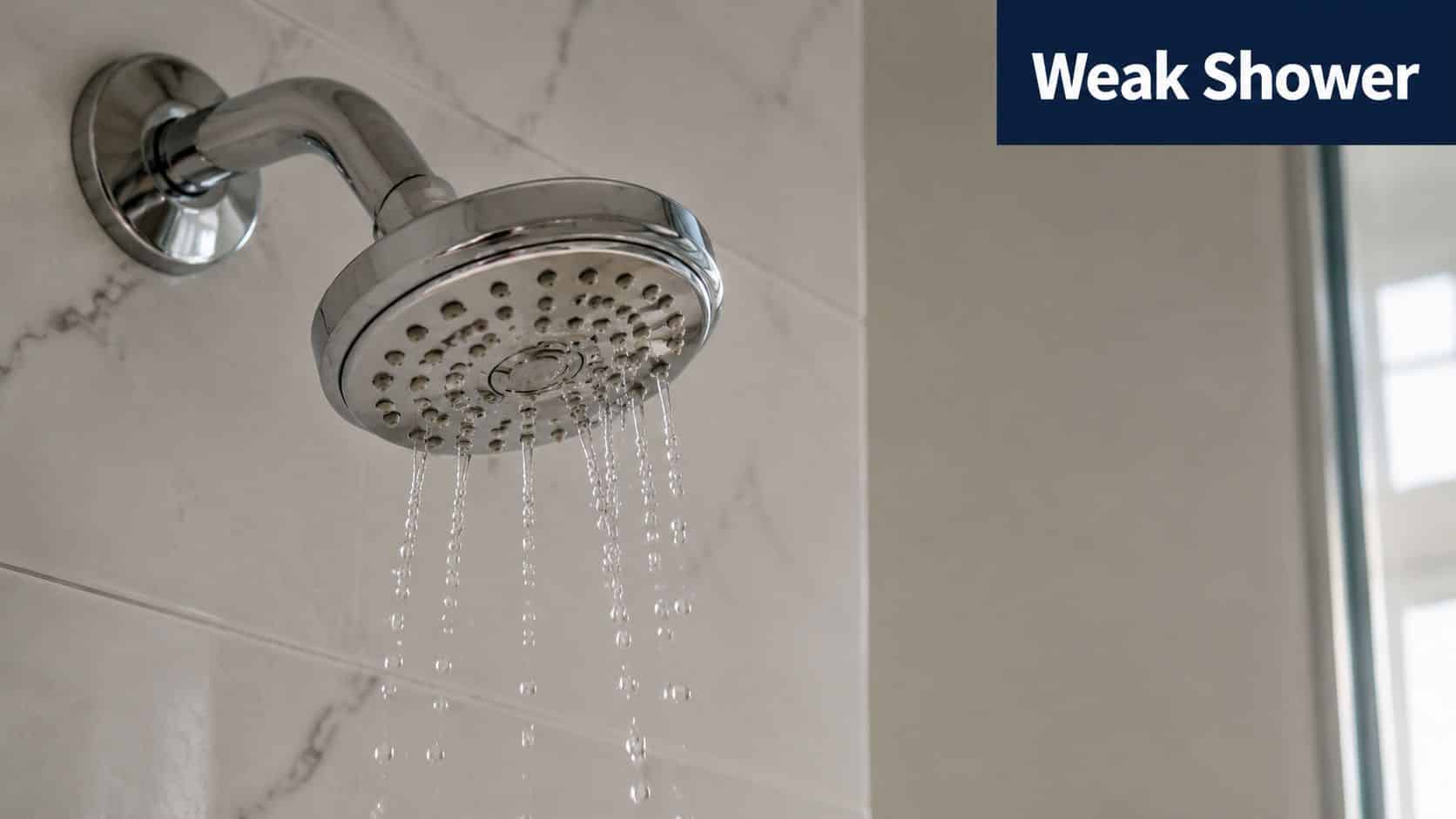
Low pressure isn't just annoying. It changes how the whole house works. Laundry takes longer, showers get inconsistent, and fixtures that already have wear start showing it faster. In older Las Vegas and Henderson homes, low pressure can also be the first obvious sign that the plumbing system has been narrowing internally for years.
What homeowners usually notice first
Some signs are obvious right away, others build slowly:
- Weak shower flow: You feel it immediately, especially in the morning.
- Slow sink filling: Kitchen and bathroom faucets take longer to do simple jobs.
- Pressure differences by fixture: One faucet runs fine while another struggles.
- Upper floor problems: Two-story homes in Las Vegas often show pressure issues upstairs first.
- On and off performance: Pressure may seem normal at one time of day and poor later.
Practical rule: If the pressure problem affects the whole house, think system issue. If it affects one fixture, start with that fixture.
The fix depends on whether you're dealing with a clogged aerator, a water softener issue, a failing PRV, mineral-packed pipes, or a hidden leak. The wrong approach wastes time. A quick fixture cleaning won't solve a regulator failure, and replacing a showerhead won't open a pipe that's closing up from scale.
Why this is so common in Las Vegas
Las Vegas water pressure problems have a local pattern. The valley's hard water creates buildup. Older homes still have galvanized piping in some cases. Distribution pressure can fluctuate. That combination makes pressure complaints common for plumbers in Las Vegas, especially in established neighborhoods and rental properties where maintenance has been delayed.
Why Is My Water Pressure So Low The Main Culprits in Las Vegas
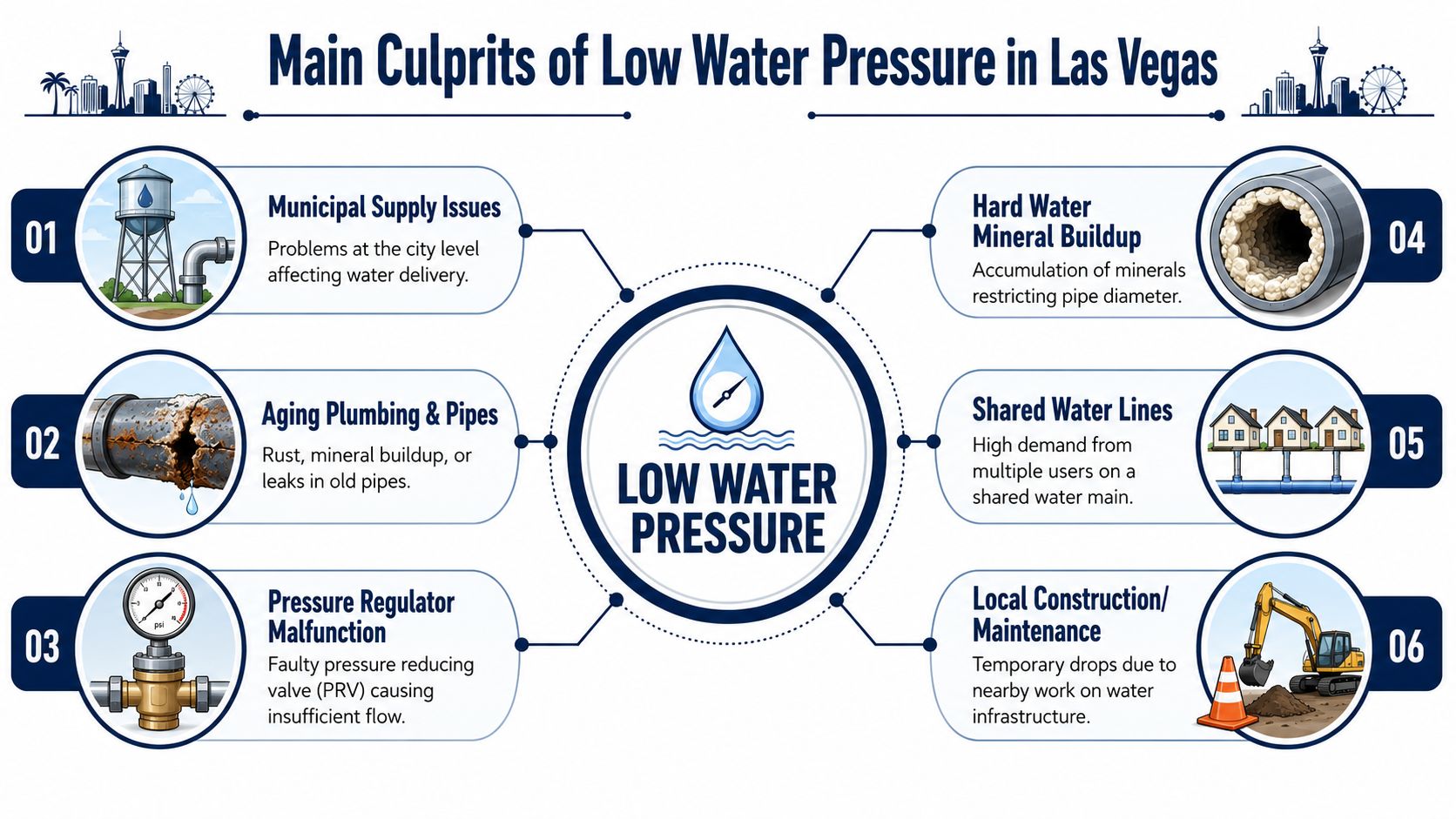
The biggest mistake homeowners make is assuming low pressure has one cause. In Las Vegas, it usually comes from a short list of repeat offenders, and more than one can be happening at the same time.
Hard water buildup inside the plumbing
In Las Vegas homes, hard water minerals are the number one cause of low water pressure, creating scale that builds up inside faucet aerators and showerheads and progressively narrows pipe interiors like plaque in an artery, a condition described as pipe atherosclerosis in MG Drain Services' hard water pressure guide.
That description fits what plumbers see in the field. Scale doesn't wash away on its own. It keeps collecting. Flow drops gradually, then one day the homeowner notices the shower is weak or a faucet barely runs. In older systems, especially galvanized iron, mineral buildup and corrosion work together and make the restriction worse.
PRV problems and pressure swings
A pressure reducing valve, or PRV, controls the pressure entering the home. Las Vegas Valley homes can see pressure conditions that make this valve especially important. When the PRV starts failing, pressure may drop, spike, or fluctuate. Homeowners often describe banging pipes, changing shower pressure, or fixtures that don't feel consistent from one day to the next.
Here's the trade-off. If pressure is too low, daily use becomes frustrating. If pressure is too high, fixtures, supply lines, and appliances take the hit. A bad PRV doesn't just make water feel weak. It can stress the whole plumbing system.
A failing regulator can make a home feel like it has two different plumbing systems, weak one hour and aggressive the next.
Other common causes in Las Vegas homes
Not every pressure problem is scale or a regulator. These are also common:
| Cause | What it looks like |
|---|---|
| Partially closed valve | Whole-house low flow after repairs, tenant turnover, or recent plumbing work |
| Faulty fixture | One sink or shower is weak while the rest of the house is fine |
| Corroded galvanized pipe | Gradual decline, often worse in older Las Vegas homes |
| Hidden service line leak | Low pressure combined with damp spots, running water sounds, or a rising bill |
| Municipal supply issue | Neighbors notice the same pressure drop at the same time |
A hidden leak matters for more than pressure. It can damage drywall, flooring, and foundations if it goes unnoticed. When low pressure comes with water where it shouldn't be, that moves the problem out of the nuisance category and into urgent plumbing repair.
Simple Water Pressure Checks You Can Do Today
You turn on the shower, then the kitchen sink, and the flow drops to a trickle. That pattern matters. It helps narrow the problem before anyone starts replacing parts that are still fine.
Start with the simple checks
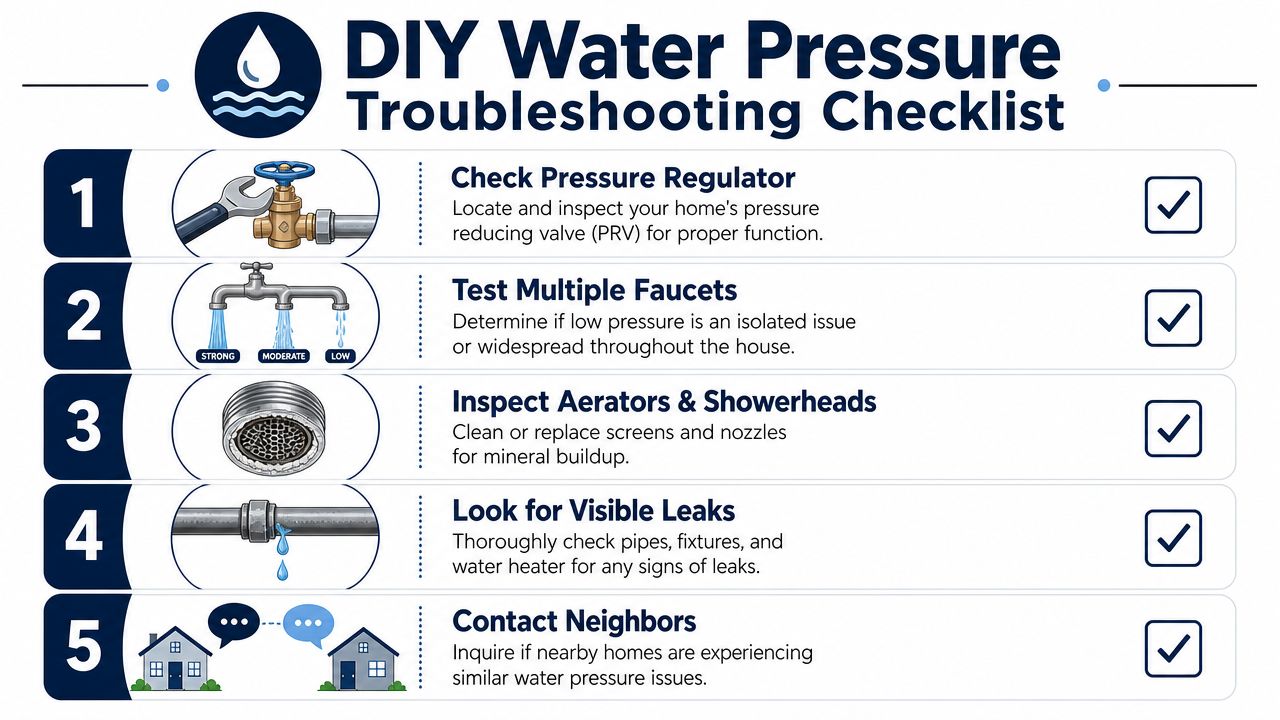
First, figure out whether the problem affects one fixture, one room, hot water only, or the whole house. Run a faucet, a shower, and an exterior hose bib if you have one. Test hot and cold separately. In Las Vegas homes, that quick comparison often points you toward scale buildup, a softener restriction, or a pressure regulator issue.
Then work through these checks:
Check the main shutoff valve
A valve that is only partly open can reduce flow throughout the house.Inspect the water meter valve visually
If it looks partly closed after recent work, that can explain a whole-house pressure drop. Leave any adjustment to the utility or a plumber.Remove and clean faucet aerators and showerheads
Hard water debris collects fast here. If the shower is the main problem, this guide on how to unclog a shower head gives you a good first check.Look for visible leaks
Check under sinks, around the water heater, near irrigation tie-ins, and at hose bibs. A small leak can steal more pressure than homeowners expect.Ask a neighbor if they have the same issue
If nearby homes are seeing the same drop at the same time, the problem may be on the utility side rather than inside your plumbing.
The overlooked Las Vegas test
A lot of homeowners skip the water softener check. They should not.
Las Vegas Valley Water District advises homeowners with low pressure to see whether a water treatment device is restricting flow by placing it in bypass and checking whether pressure improves, on its water pressure troubleshooting page. In this valley, that test matters because softeners work hard against very hard water, and a unit with resin, valve, or maintenance problems can choke down flow to the whole house.
If pressure improves on bypass, the softener may need service, cleaning, a valve rebuild, or replacement. If nothing changes, keep looking upstream.
Measure the pressure instead of guessing
A hose-bib pressure gauge is inexpensive and useful. Attach it to an exterior hose connection or laundry bib and check the reading with no water running inside the house.
The Southern Nevada Water Authority says residential pressure can range widely depending on elevation and location, and pressure-reducing valves are used in many homes to keep pressure at a safe level, on its water pressure and PRV information page. For a homeowner, the practical takeaway is simple. Very high pressure points toward a regulator problem. Normal gauge pressure with weak flow at fixtures points more toward buildup, a softener restriction, or clogged fixture parts. Low pressure across the whole house usually means it is time to have the service line, shutoff valves, and PRV checked professionally.
One more trade-off to keep in mind. Cleaning an aerator or bypassing a softener is a safe homeowner test. Adjusting a PRV or meter valve without confirming the actual pressure can create a second problem.
Professional Solutions for Lasting Water Pressure Restoration
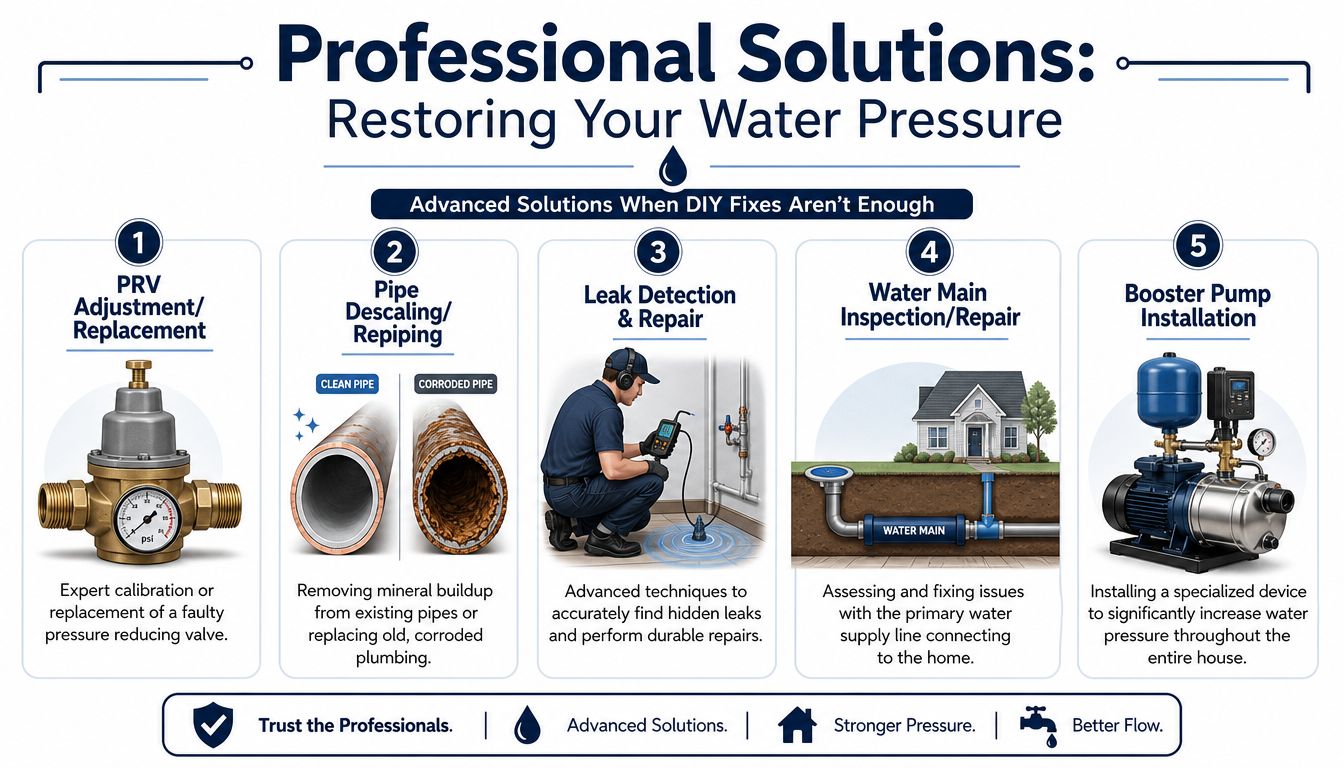
Once the easy checks are done, the next step is matching the repair to the actual failure point. In Las Vegas, that usually means separating three common problems that look similar at the tap. Hard water buildup inside the pipe, an aging or failing PRV, and worn older piping can all produce weak flow, but they do not get the same fix.
What works and what doesn't
A cable machine can break through a blockage. It does not clean mineral scale off the full inside wall of a water line. In older Las Vegas homes with galvanized or heavily scaled piping, pressure loss often comes from narrowed pipe diameter, so the better repair may be descaling, line replacement, or both.
Hydro-jetting can help in the right system, especially when buildup is restricting flow and the pipe still has enough wall integrity to handle cleaning. It is not automatic. Before recommending jetting, a plumber should confirm the pipe material, age, and condition. In some houses, cleaning buys more service life. In others, the pipe is too deteriorated, and replacement is the safer investment.
That trade-off matters. A lower-cost cleaning can make sense if the restriction is localized and the pipe is still sound. If the house has repeated pressure complaints, corrosion at multiple fixtures, or older lines that are failing in several places, a repipe is often the longer-lasting answer. Homeowners weighing that decision can review this guide to water system repipe in Las Vegas.
The professional tools that matter
A proper diagnosis usually involves more than one test, because pressure and flow problems can overlap.
- PRV testing and adjustment: In Las Vegas, a bad pressure reducing valve is one of the first things to check when the whole house is affected. Some PRVs fail low, some hunt up and down, and some stop regulating consistently.
- Video inspection: Useful for checking service line condition, locating restrictions, and seeing whether corrosion or debris is part of the problem.
- Targeted leak detection: Pressure loss with a wet wall, slab concern, or rising water bill needs leak testing, not guesswork.
- Descaling or selective line replacement: Good options when hard water scale has narrowed piping but a full repipe is not yet necessary.
- Booster pump evaluation: Appropriate in a smaller group of homes where incoming supply conditions are the limiting factor, not an internal restriction.
One often-overlooked point in this stage is the water softener. If pressure improved when the unit was placed in bypass during your earlier checks, a plumber should inspect that system before opening walls or replacing pipe. A fouled control valve, clogged resin bed, or maintenance issue at the softener can mimic a larger house-side pressure problem.
MG Drain Services handles plumbing repairs, color video camera inspections, hydro-jetting, leak detection, and water pressure troubleshooting in Las Vegas.
The lasting fix is the one that matches the failed part of the system. Everything else is temporary.
Why Las Vegas Homeowners Trust MG Drain Services
Low water pressure is easy to misread. A weak upstairs shower in an older Las Vegas home might be pipe scale. A whole-house drop after years of normal pressure often points to the PRV. A sudden change after softener trouble can send people chasing the wrong repair. Homeowners trust a plumber more when the diagnosis matches the way Las Vegas systems are known to fail.
That local pattern matters. Hard water leaves mineral buildup inside fixtures, valves, and older supply lines. In neighborhoods with aging galvanized pipe, flow can fall off long before a line fully fails. PRVs also wear out here with regularity, and they do not all fail the same way. Some stick low. Some drift. Some create inconsistent pressure that feels different from one hour to the next.
What people look for in a plumber
Homeowners usually want a few straightforward things:
- Licensed and insured service: Important for regulator work, leak investigation, and repairs that affect the whole house.
- Strong diagnostic habits: Water pressure problems are often a testing job before they become a repair job.
- Prompt scheduling: Low pressure can be inconvenient, but it can also be an early sign of a larger plumbing issue.
- Clear pricing: People want to know what is being tested, what is being repaired, and what can wait.
- Las Vegas experience: Homes in Henderson, North Las Vegas, Summerlin, and older central neighborhoods often show different failure patterns.
MG Drain Services LLC is a local Las Vegas company serving homeowners, landlords, and small commercial properties across the valley. The company is family-owned, licensed and insured, and known for experienced journeyman plumbers, transparent pricing, bilingual support, and modern diagnostic equipment.
When it's time to make the call
If pressure is still low after the basic checks, including a water softener bypass test, the next step is a proper diagnosis. Waiting rarely improves anything. Scale buildup continues to restrict flow. A worn PRV keeps causing trouble. A hidden leak keeps wasting water.
For direct plumbing help, call 702-480-8070 or book through MG Drain Services plumbing repairs. A focused service call can identify whether the problem is the softener, the regulator, a restricted line, or a leak before money gets spent in the wrong place.
Frequently Asked Questions About Las Vegas Water Pressure
Can the city be responsible for my low water pressure
Yes. If several homes on the street lose pressure at the same time, the issue may be tied to municipal supply, maintenance work, or peak demand. If your neighbors still have normal flow, the problem is usually inside your property line.
Start with the simplest check first. Ask the houses next to you whether their pressure changed, and do it the same day the problem shows up. In Las Vegas, Henderson, and North Las Vegas, that quick comparison helps separate a neighborhood supply issue from a house problem such as a worn PRV, scale buildup, a partially closed valve, or a hidden leak.
How often should a PRV be replaced in Las Vegas
There is no fixed replacement calendar for every home. In Las Vegas, PRVs often fail from wear, debris, and hard water conditions that make internal parts stick or wear out faster.
What matters is how the house behaves. If pressure drops across every fixture, swings during the day, or changes suddenly after being stable for years, the PRV deserves a close check. The Southern Nevada Water Authority notes that pressure-reducing valves are commonly installed where incoming pressure is high, and those valves can affect how water performs throughout the house.
I tell homeowners to pay attention to patterns. A bad aerator affects one faucet. A bad PRV affects the whole house.
Could a hidden leak cause low pressure and a high water bill
Yes, and that combination should be checked quickly.
A hidden leak on the service line or in a wall can steal pressure before water ever reaches the fixture. In older Las Vegas neighborhoods, aging underground lines and slab leaks are common enough that I do not ignore low pressure when the water bill also climbs. Wet soil, warm spots on flooring, or the sound of water running with everything shut off all point in that direction.
Is low pressure always caused by old pipes
No. Older galvanized or scaled copper piping is a common cause, especially in central Las Vegas neighborhoods, but it is far from the only one.
I also see softeners that are restricting flow, shutoff valves that were never reopened fully after prior work, clogged fixture screens, and failing PRVs that make the entire house feel weak. The softener bypass test gets overlooked all the time. If pressure improves in bypass, that narrows the problem fast and can save you from replacing pipe that is not the main issue.
Can drain cleaning fix water pressure problems
Only in limited cases. Drain cleaning addresses wastewater lines. Low water pressure is usually a supply-side issue.
If hard water scale has narrowed the inside of the water piping, the repair may involve descaling, valve replacement, PRV work, leak repair, or repiping. That is a different diagnosis than clearing a kitchen or sewer drain. The right fix depends on where the restriction is and whether the problem affects one fixture, one branch, or the whole house.
If pressure is low throughout the home, or it changes room to room, call MG Drain Services LLC at 702-480-8070 for a proper diagnosis. A licensed plumber can test the pressure, isolate whether the problem is the softener, regulator, piping, or a leak, and keep you from spending money on the wrong repair.